Blog
How long does a herniated disc take to heal?
Usually weeks to months, and the disc itself often shrinks back without surgery. What the studies show about recovery, what guidelines recommend and when a doctor needs to see you quickly.
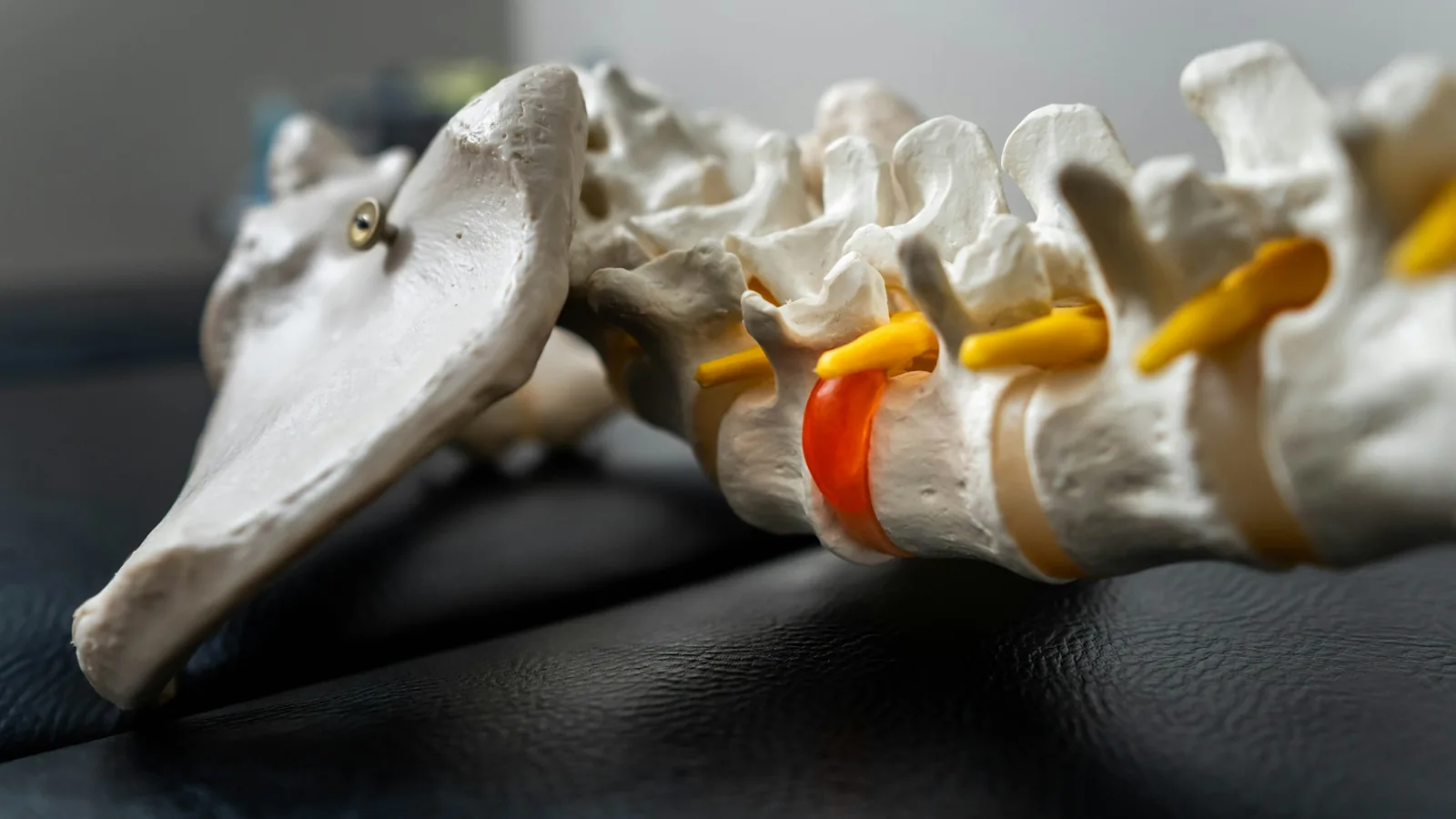
A herniated disc sounds like damage that will need fixing, and the first question most people ask is how long it will take. So, how long does a herniated disc take to heal? There is no fixed timetable, but the usual course is kinder than the diagnosis sounds. The NHS says a slipped disc usually gets better slowly with rest, gentle exercise and painkillers (NHS), and studies that scan people twice show the disc material itself often shrinks back without surgery.
What a herniated disc is
Between the bones of your spine sit intervertebral discs, soft cushions of tissue. In a herniated disc, also called a slipped or prolapsed disc, one of them bulges outwards. It is painful if it presses on nerves (NHS).
The NHS lists the possible symptoms as lower back or neck pain, numbness or tingling in the shoulders, back, arms, hands, legs or feet, problems bending or straightening your back, muscle weakness, and pain in the buttocks, hips or legs if the disc presses on the sciatic nerve. Not every slipped disc causes symptoms, and many people never know they have one (NHS).
That leg pain is sciatica, and a slipped disc is its most common cause (NHS). Doctors call pain, tingling or weakness from a squeezed or irritated nerve root radiculopathy. Most of the research below is about the lower back, where herniated discs and sciatica have been studied most.
A bulging disc is a related term from scan reports. Studies sort disc changes on scans into bulges, protrusions, extrusions and sequestrations (Chiu et al., 2015), and those categories turn out to matter for healing, as you will see below.
How long does a herniated disc take to heal?
It helps to separate two questions: how long the symptoms last, and what happens to the disc itself.
How long the pain lasts
The NHS says sciatica usually gets better in a few weeks to a few months, but can sometimes last longer, and it can come back if you have had it before (NHS). For a slipped disc, it advises seeing a GP if the pain is not getting better after a few weeks (NHS).
Studies put numbers on this, but the numbers depend on who was studied and what counted as better:
- A UK study followed 609 people who saw their GP with back-related leg pain, including sciatica, and gave them all an MRI scan. A year later, 55% had improved, both in the whole group and among those with sciatica. Improved meant a drop of at least 30% in how much the pain limited their daily life (Konstantinou et al., 2018).
- A Dutch trial took 283 people who had already had severe sciatica for 6 to 12 weeks. After a year, 95% said they had recovered, whether they had been assigned to early surgery or to longer non-surgical care (Peul et al., 2007).
Those two figures are not contradictory. One counted a measured improvement in a broad group seen in general practice; the other asked people in a trial whether they felt recovered. Together they say that most people improve within a year, and that a fair share are still affected at that point.
The UK study also looked at what predicted a slower recovery. Leg pain that had already lasted longer, and the person’s own belief that the problem would last a long time, were among the factors most strongly linked to less improvement (Konstantinou et al., 2018). That is a link, not proof that worrying slows healing, but it fits what is known about yellow flags in back pain.
What happens to the disc
The disc often shrinks back on its own. A systematic review pulled together 31 studies of people with a herniated disc in the lower back who were treated without surgery and scanned at least twice. Nine of the studies used the same disc categories, so the authors could combine them. The herniated material shrank back in 96% of sequestrations, 70% of extrusions, 41% of protrusions and 13% of bulges. It disappeared completely in 43% of sequestrations and 15% of extrusions (Chiu et al., 2015).
The surprising part is that extrusions and sequestrations were significantly more likely to shrink than bulges and protrusions, so the more dramatic finding on a scan was not the worse outlook. A later meta-analysis of 31 studies with 2,233 people treated without surgery found the disc had shrunk in about 70% overall, again most often in sequestrations and extrusions. The shrinking mainly happened within six months of starting non-surgical treatment (Zou et al., 2024).
These studies followed people on repeat scans, and in the 2024 analysis the rates differed significantly between countries. They show that shrinking is common, not that it happens to everyone or on a set date.
The scan and the pain are not the same thing
A disc that looks bad on an MRI does not always explain the pain. A review of 33 imaging studies covering 3,110 people with no back pain found disc bulges in 30% of 20-year-olds, rising to 84% of 80-year-olds, and disc protrusions in 29% rising to 43%. The authors concluded that many of these findings are likely part of normal ageing and unrelated to pain (Brinjikji et al., 2015).
That is why a scan is not usually the first step. The NHS says a slipped disc can usually be diagnosed from your symptoms and an examination, and you may be referred for an MRI if the symptoms do not get better (NHS). NICE advises against routine imaging for low back pain with or without sciatica outside specialist settings, and suggests considering it in specialist care only if the result is likely to change the treatment (NICE NG59).
What the guidelines recommend
Keep moving
The NHS advice for a slipped disc is that you may need to rest at first if the pain is very bad, but that you will get better more quickly if you gradually start gentle exercise such as walking, swimming or yoga as soon as you can. The type of exercise is not important, as long as it does not cause pain or make your back pain worse (NHS). For sciatica, it says to carry on with normal activities as much as possible and not to sit or lie down for long periods: even if moving hurts, it is not harmful (NHS).
NICE asks clinicians to explain what low back pain and sciatica are and to encourage people to continue with normal activities, and to consider a group exercise programme for an episode or flare-up (NICE NG59). If walking is your way in, see Is walking good for back pain?
Painkillers
The NHS slipped disc page suggests anti-inflammatory painkillers such as ibuprofen, taken regularly up to the recommended daily amount rather than only when the pain is bad, and says codeine-based painkillers should only be used for a few days (NHS). Its sciatica page is more cautious: paracetamol is unlikely to help, and it is not clear how much anti-inflammatories help with sciatica (NHS).
NICE, which advises doctors, warns about the risk of harm and limited evidence of benefit from anti-inflammatories in sciatica. It advises against gabapentinoids, other antiepileptics, oral corticosteroids and benzodiazepines for sciatica, because there is no overall evidence of benefit and there is evidence of harm, and against opioids for long-term sciatica (NICE NG59). A pharmacist can tell you whether anti-inflammatories are suitable for you.
Injections and surgery
For acute and severe sciatica, NICE suggests considering an epidural injection of local anaesthetic and steroid. It suggests considering spinal decompression surgery when non-surgical treatment has not improved pain or function and the scan findings match the symptoms (NICE NG59). The NHS says surgery is not usually needed, but a GP might refer you to discuss it if your symptoms have not improved with other treatments or include worsening muscle weakness or numbness (NHS).
What surgery changes is mainly the speed. In the Dutch trial, people who had early surgery got relief from leg pain faster, but there was no significant overall difference in disability over the first year, and 39% of those in the non-surgical group ended up having surgery anyway, on average about 19 weeks in (Peul et al., 2007). A review comparing surgery with exercise-based care for disc herniation found surgery better in the short term only, and noted that high-quality evidence is lacking (Fernandez et al., 2016).
NICE also lists things not to offer for low back pain with or without sciatica, among them traction, belts and corsets, acupuncture and TENS (NICE NG59).
Do exercises help a herniated disc?
Honestly, the evidence is thinner than many exercise programmes suggest. What it supports clearly is staying active. Whether a specific exercise programme adds much on top is less certain:
- A review of five trials in people with sciatica compared structured exercise with advice to stay active. Exercise gave a small extra improvement in leg pain in the short term, about 11 points on a 0 to 100 scale, with no difference in disability. In the medium and long term there was no difference. The authors rated the short-term evidence as low quality and the long-term evidence as moderate (Fernandez et al., 2015).
- A Cochrane review found moderate-quality evidence that, in sciatica, advice to rest in bed and advice to stay active make little or no difference to pain or function. One trial of 250 people found little or no difference with physiotherapy either, though that evidence was low quality (Dahm et al., 2010).
So bed rest does not speed things up, and moving does not appear to do harm. The NHS lists exercises and stretches and physiotherapy among the main treatments for sciatica (NHS), and NICE recommends manual therapy only as part of a package that includes exercise (NICE NG59). Exercise is part of the plan, then, but not a shortcut. A physiotherapist can help you find movements that do not flare the leg pain. Our pages on lower back stretches and lower back pain from sitting look at the wider research for the lower back, and if you are weighing up private sessions, see how much physiotherapy costs.
The longer view matters too. Back pain often eases and then returns, which is the subject of Will back pain go away on its own?, and the NHS advice on keeping sciatica from coming back starts with staying active and taking regular exercise (NHS).
When to see a doctor
See a GP if you have back pain and painkillers are not helping, the pain is not getting better after a few weeks, it is worse at night, or it comes with a very high temperature or feeling hot, cold or shivery, unexplained weight loss or a swelling in your back (NHS). With sciatica, see a GP if the pain has not improved after a few weeks of home treatment, is getting worse or is stopping you doing your normal activities (NHS).
Call 999 or go to A&E if back pain or sciatica comes with:
- numbness around or under your genitals, or around your bottom
- being unable to pee, finding it hard to start, or not being able to control when you pee or poo
- loss of feeling in one or both legs
- sciatica on both sides
- weakness or numbness in both legs that is severe or getting worse
- pain that started after a serious accident, such as a car accident
These come from the NHS pages on slipped disc and sciatica, which say they could be symptoms of a serious back problem that needs hospital treatment as soon as possible (NHS). Do not drive yourself. Several of them are signs of cauda equina syndrome, compression of the spinal nerves at the tail end of the spinal cord. It is rare, occurring in one to three in 100,000 people, and an NHS spinal service advises going to A&E immediately with any combination of these symptoms (Torbay and South Devon NHS). There is a fuller list of warning signs on our red flags page.
Where Bavelu fits
Bavelu is not a treatment for a herniated disc. If you have pain, numbness, tingling or weakness spreading down a leg or an arm, see a doctor or physiotherapist first, and ask them which movements are fine for you right now.
Once you know that, regular gentle movement is what the guidelines point to. Bavelu’s lower back sessions are designed and filmed by physiotherapists and done on a chair or a mat with no equipment, and the daily session comes in a short and a full version. If a movement makes the leg pain worse, stop it and check with your physiotherapist. The app is exercise guidance, not a diagnosis.
Questions people ask
How long does a herniated disc take to heal?
There is no fixed timetable. The NHS says a slipped disc usually gets better slowly with rest, gentle exercise and painkillers, and that sciatica, its most common result, usually gets better in a few weeks to a few months but can last longer. In a large meta-analysis, most shrinking of the disc seen on repeat scans happened within six months of non-surgical treatment.
Can a herniated disc heal on its own without surgery?
Often, yes. A systematic review of people treated without surgery found the herniated material shrank back in 96% of sequestrations, 70% of extrusions and 41% of protrusions. The NHS says surgery is not usually needed.
Do exercises help a herniated disc?
Staying active is the main advice from the NHS and NICE. In trials of people with sciatica, a structured exercise programme gave a small extra short-term improvement in leg pain over advice to stay active, and no difference in the long term. The NHS says the type of exercise matters less than choosing something that does not make the pain worse.
Do I need an MRI for a herniated disc?
Not usually at first. A slipped disc is normally diagnosed from symptoms and an examination, and NICE advises against routine imaging outside specialist settings. An MRI may be arranged if symptoms do not get better, and disc bulges also show up on scans of many people with no pain at all.
When is a herniated disc an emergency?
Call 999 or go to A&E if back pain comes with numbness around your bottom or genitals, you cannot pee or cannot control when you pee or poo, you lose feeling in one or both legs, you have sciatica on both sides, or weakness or numbness in both legs is severe or getting worse.
Terms on this page
- Herniated discWhen a disc between the bones of the spine bulges outwards, sometimes pressing on a nerve.
- Intervertebral discThe cushions between the bones of the spine, with a gel-like centre inside a tough ring.
- Bulging discA disc that spreads evenly beyond the edges of the vertebrae, very common on scans with or without pain.
- Nerve rootThe point where a spinal nerve leaves the spinal cord, and what happens when it is pinched.
- RadiculopathyPain, tingling, numbness or weakness in an arm or leg caused by a pinched or irritated nerve root in the spine.
- SciaticaPain, tingling or numbness running from the buttock down the leg because the sciatic nerve is irritated or compressed.
- Yellow flagsPsychological and social factors that raise the chance of back pain becoming long-lasting or disabling.
- Red flagsWarning signs that back or neck pain could have a serious cause and needs a doctor promptly.
Sources
- NHS. Slipped disc. Last reviewed 24 April 2024.
- NHS. Sciatica. Last reviewed 3 December 2024.
- NICE. Low back pain and sciatica in over 16s: assessment and management (NG59). Recommendations, last updated 29 July 2026.
- Chiu CC et al. The probability of spontaneous regression of lumbar herniated disc: a systematic review. Clinical Rehabilitation, 2015.
- Zou T et al. Incidence of spontaneous resorption of lumbar disc herniation: a meta-analysis. Clinical Spine Surgery, 2024.
- Konstantinou K et al. Prognosis of sciatica and back-related leg pain in primary care: the ATLAS cohort. The Spine Journal, 2018.
- Peul WC et al. Surgery versus prolonged conservative treatment for sciatica. New England Journal of Medicine, 2007.
- Brinjikji W et al. Systematic literature review of imaging features of spinal degeneration in asymptomatic populations. American Journal of Neuroradiology, 2015.
- Fernandez M et al. Advice to stay active or structured exercise in the management of sciatica: a systematic review and meta-analysis. Spine, 2015.
- Fernandez M et al. Surgery or physical activity in the management of sciatica: a systematic review and meta-analysis. European Spine Journal, 2016.
- Dahm KT et al. Advice to rest in bed versus advice to stay active for acute low-back pain and sciatica. Cochrane Database of Systematic Reviews, 2010.
- Torbay and South Devon NHS Foundation Trust. Cauda equina syndrome (CES).
This page explains a topic in general terms. It is not a diagnosis and does not replace a doctor or physiotherapist. If something hurts badly, keeps getting worse or comes with numbness, weakness or fever, see a doctor.