Blog
How much of your year do you spend sitting?
Add up the hours at a desk and you get weeks, not hours. What that does and doesn't mean for your back.
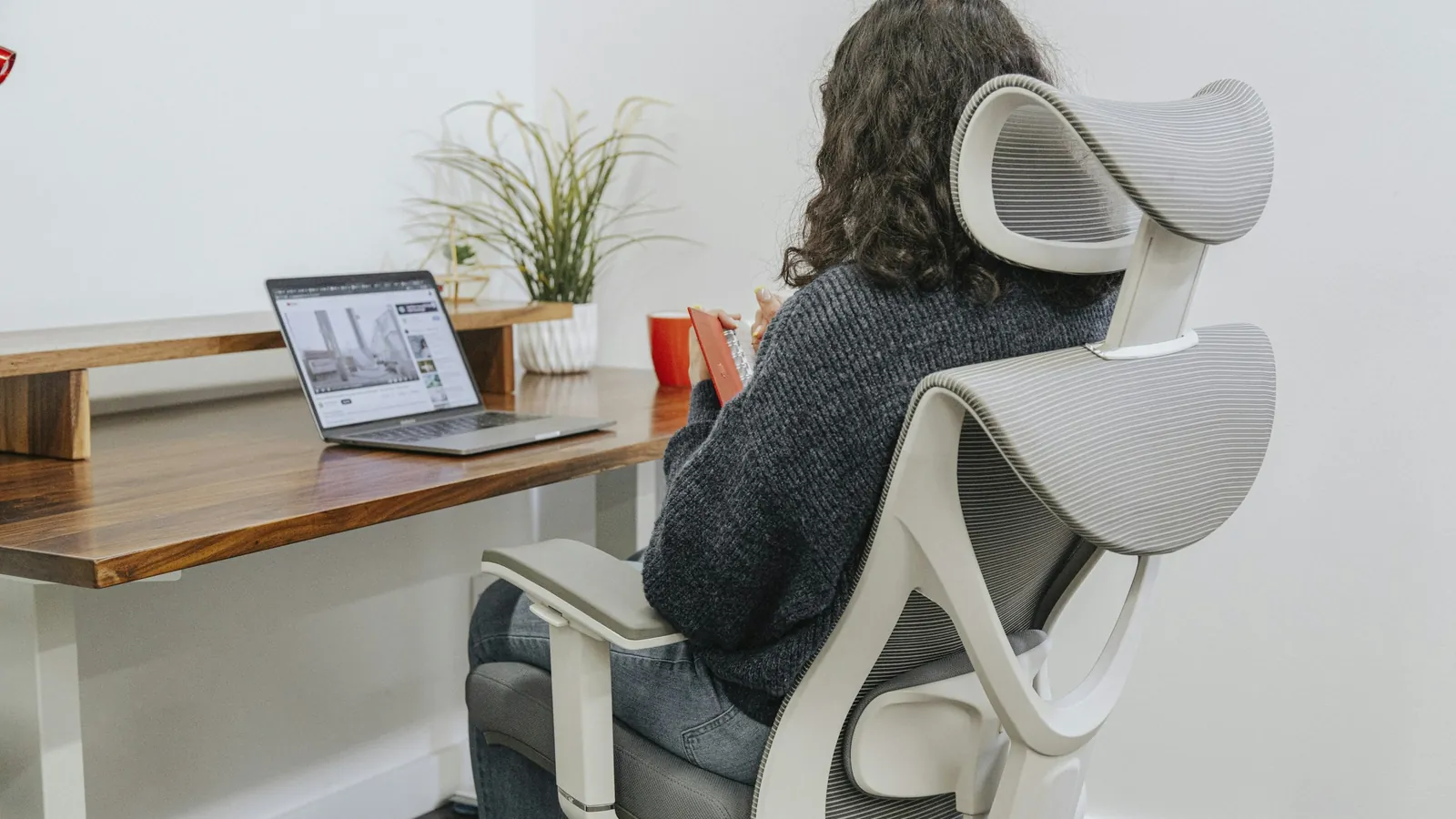
Ask someone “how much time do you spend sitting?” and you’ll hear “a lot”. Put a number on it and it becomes harder to ignore.
The arithmetic
Take 230 working days a year. If you sit at a screen for 7 hours on each of them, that is 1,610 hours, or 67 days in a row, every year. At 5 hours it is 48 days. At 8 hours it is about 77.
| Sitting per workday | Hours per year (230 workdays) | Full 24-hour days |
|---|---|---|
| 5 hours | 1,150 | 48 |
| 6 hours | 1,380 | 58 |
| 7 hours | 1,610 | 67 |
| 8 hours | 1,840 | 77 |
| 9 hours | 2,070 | 86 |
Those are full days, nights included. Count only waking hours, say 16 a day, and 1,610 hours becomes about 100 waking days in a chair. That is before the commute, meals and the evening on the sofa. To put in your own hours, use the sitting time calculator.
How much time do you spend sitting at work?
When 50 office workers in Perth wore motion sensors for a week, they spent 82% of their working hours sitting. About 15% of work time went on light activity, such as walking around the office, and just 3% on anything more vigorous (Parry & Straker, 2013).
The pattern mattered as much as the total. At work, the same people sat in longer unbroken stretches of more than 30 minutes and took fewer breaks than in their free time. Outside work they were still sitting for about 69% of the time, so the evening was not much of a counterweight.
It is a small study from one city, measured in 2008 and 2009, but it fits what bigger surveys show. In a nationally representative US survey, adults’ own estimates of their total daily sitting rose from 5.5 hours in 2007 to 6.4 hours in 2016. Over a similar period, the share of adults using a computer for an hour or more a day outside work grew from 29% to 50% (Yang et al., 2019). Those are averages across all adults, including people whose jobs keep them on their feet.
Researchers have a name for this: sedentary behaviour, meaning any waking time spent sitting, reclining or lying while using very little energy. The WHO lists desk-based office work, driving and watching television as typical examples. It is counted separately from physical inactivity, which means not reaching the recommended amount of physical activity (Bull et al., 2020). So you can run three times a week and still be highly sedentary on workdays.
Some jobs push the total higher than others. Our pages for programmers, accountants and drivers look at what long days at a desk or behind the wheel mean in each job.
Is sitting bad for your back?
This is where it pays to be precise.
- A review of 79 studies looked at sitting and pain. In studies where people reported their own sitting time, sitting a lot at work was linked to higher odds of low back pain, about 1.5 times, and of neck and shoulder pain, about 1.7 times. When sitting was measured with devices instead, that link was not found consistently (Dzakpasu et al., 2021).
- For the neck, a review of 25 studies with more than 43,000 people found the odds of pain rising with time: 1.35 times higher with two or more hours of screen time, and up to 1.88 times with six or more hours of sitting. The link was stronger in employees than in students, and stronger for phones than for computers (Meng et al., 2025).
- And posture itself? A review of 41 earlier reviews found no consensus that slouching, or any other posture, causes back pain (Swain et al., 2020).
The phone finding is worth knowing if your breaks are spent scrolling. Whether “text neck” is a real condition is a separate question, which we look at in Is “text neck” real?
Why the studies can’t settle it
The links in the 79-study review come from cross-sectional studies, which ask about sitting and pain at the same moment. A snapshot like that cannot tell you which came first. People in pain may sit more, or remember their sitting differently, and the review’s authors say plainly that reverse causation cannot be ruled out. Studies that followed people over time were too few or too mixed to settle it. And the link being clearer with self-reports than with sensors is another reason for caution.
A more useful clue comes from people who had already had back pain. In a study that followed 250 people who had recently recovered from an episode, sitting for more than five hours a day was one of the factors that predicted a new episode within a year, along with frequent awkward postures and more than two previous episodes (da Silva et al., 2019). We cover that study in Will back pain go away on its own?
The 79-study review also found something hopeful: in the experimental studies it included, cutting down sitting at work went together with less low back, neck and shoulder pain.
So the fair reading is not “sitting breaks your back”. It is that long hours in one position go together with more neck and back pain, and that the fix is less about a perfect posture than about moving more often. If one area bothers you most, see lower back pain from sitting or neck pain from desk work.
What sitting means for the rest of your health
The back and neck are not the only reasons to care. A pooled analysis of more than a million adults compared sitting time and activity with deaths over 2 to 18 years of follow-up. People who sat more than eight hours a day and were the least active had a 59% higher death rate than those who sat under four hours and were the most active. But in the most active quarter, roughly 60 to 75 minutes of moderate activity a day, long sitting was no longer linked to a higher death rate (Ekelund et al., 2016). These were questionnaire-based observational studies, so they show a link, not proof. Whether that makes sitting “the new smoking” is a separate question, which we look at here.
How you sit may matter too. In 168 Australian adults who wore sensors for a week, those who broke up their sitting more often had smaller waists and better blood sugar and blood fat readings, regardless of their total sitting time (Healy et al., 2008). That was also a snapshot study, and its authors called for public health advice on breaking up sitting time.
The WHO’s 2020 guidelines put it simply: adults should limit sedentary time, and replacing it with activity of any intensity, light activity included, has health benefits. The evidence was not strong enough to name a safe number of hours (Bull et al., 2020).
Is standing the answer?
Partly. A Cochrane review of 34 studies with 3,397 workers found that sit-stand desks reduced sitting at work by about 100 minutes per workday in the first three months, and by about 57 minutes at three to twelve months. The authors rated that evidence as low quality, and there were no data beyond a year. Handing people information or counselling on its own made no clear difference in the short term (Shrestha et al., 2018).
Standing all day is not the goal either. In a lab study, 20 adults did two hours of standing computer work. Their discomfort rose in every body area measured and their reaction times got slower, although creative problem solving improved. The authors advised caution about simply swapping sitting for standing (Baker et al., 2018). What helps is variety: changing position before any one position has gone on for too long.
What you can do with that
You probably can’t sit less at work. You can change what happens between the hours.
- Break up long stretches. In one study in the Cochrane review, short breaks of one to two minutes every half hour cut sitting by about 40 minutes a day compared with two 15-minute breaks. It was a single study with low-quality evidence, but it suggests that little and often is worth trying. Our guide to microbreaks looks at how often to move.
- Alternate, don’t swap. If you have a sit-stand desk, move between sitting and standing through the day rather than doing either for hours.
- Set up the desk once. A chair, desk and screen that fit you make it easier to sit comfortably and to change position. Start with the desk height calculator, then office chair setup and monitor setup.
- Build movement into the work itself. Take phone calls standing, walk to a colleague instead of messaging, use the stairs, refill your water more often. None of this needs a plan.
- Keep moving outside work. WHO recommends 150 to 300 minutes of moderate activity a week plus muscle-strengthening on two or more days, and says some activity is better than none (Bull et al., 2020).
If you look after a team, the Cochrane findings are a useful steer: changing the workplace did more than handing out information. There is more on movement at work on our page for teams.
A short, regular routine is easier to keep than a big plan, and for the neck and shoulders even two minutes on workdays has shown an effect in a trial (Is two minutes of exercise enough?).
Bavelu gives you desk routines of two to four minutes for the moments in between, guided by your AirPods, and can let you know when your head starts to lean forward (how AirPods track head posture). On days with more time, there is a full daily session designed and filmed by physiotherapists.
Questions people ask
How many hours a day does an office worker sit?
In one Australian study, 50 office workers wore motion sensors for a week and spent about 82% of their working hours sitting, often in unbroken stretches of more than 30 minutes. Over an eight-hour working day that is roughly six and a half hours, before any sitting outside work.
Is sitting all day bad for your back?
Long hours of sitting go together with more neck and low back pain in many studies, but most of them measure sitting and pain at the same moment, so they cannot show that sitting causes the pain. There is also no consensus that any particular posture causes back pain. Moving and changing position often is the more useful focus.
Can exercise make up for sitting all day?
For overall health, pooled data from more than a million adults found that about 60 to 75 minutes of moderate activity a day removed the extra risk of death linked to sitting more than eight hours a day. That is an observational finding about mortality, not about back or neck pain. WHO advises both limiting sitting and being active.
Is a standing desk better than sitting?
A Cochrane review found that sit-stand desks cut sitting at work by about 100 minutes a day in the first three months, though the evidence was low quality. Standing for long stretches has its own costs: in a lab study, two hours of standing raised discomfort in every body area measured. Switching between the two is the sensible middle ground.
Terms on this page
Sources
- Parry S, Straker L. The contribution of office work to sedentary behaviour associated risk. BMC Public Health, 2013.
- Dzakpasu FQS et al. Musculoskeletal pain and sedentary behaviour in occupational and non-occupational settings: a systematic review with meta-analysis. IJBNPA, 2021.
- Meng Y, Xue Y, Yang S, Wu F, Dong Y. The associations between sedentary behavior and neck pain: a systematic review and meta-analysis. BMC Public Health, 2025.
- Swain CTV et al. No consensus on causality of spine postures or physical exposure and low back pain: a systematic review of systematic reviews. Journal of Biomechanics, 2020.
- Yang L et al. Trends in sedentary behavior among the US population, 2001-2016. JAMA, 2019.
- Bull FC et al. World Health Organization 2020 guidelines on physical activity and sedentary behaviour. British Journal of Sports Medicine, 2020.
- da Silva T et al. Recurrence of low back pain is common: a prospective inception cohort study. Journal of Physiotherapy, 2019.
- Ekelund U et al. Does physical activity attenuate, or even eliminate, the detrimental association of sitting time with mortality? A harmonised meta-analysis of data from more than 1 million men and women. The Lancet, 2016.
- Healy GN et al. Breaks in sedentary time: beneficial associations with metabolic risk. Diabetes Care, 2008.
- Shrestha N et al. Workplace interventions for reducing sitting at work. Cochrane Database of Systematic Reviews, 2018.
- Baker R et al. A detailed description of the short-term musculoskeletal and cognitive effects of prolonged standing for office computer work. Ergonomics, 2018.
This page explains a topic in general terms. It is not a diagnosis and does not replace a doctor or physiotherapist. If something hurts badly, keeps getting worse or comes with numbness, weakness or fever, see a doctor.
