Exercises · Whole spine
Desk stretches you can do without leaving your chair
A seated cat-cow moves your whole back in both directions in about a minute, without standing up or changing clothes. Here is how it fits into a working day, and what stretching at work can and cannot do.
Cat - Cow
Cat and cow seated on a chair - moving the spine right at your desk.
- 1:10
- On a chair
- Spine
- Back
Move slowly. Stop if it hurts, or if you feel tingling or numbness.
-
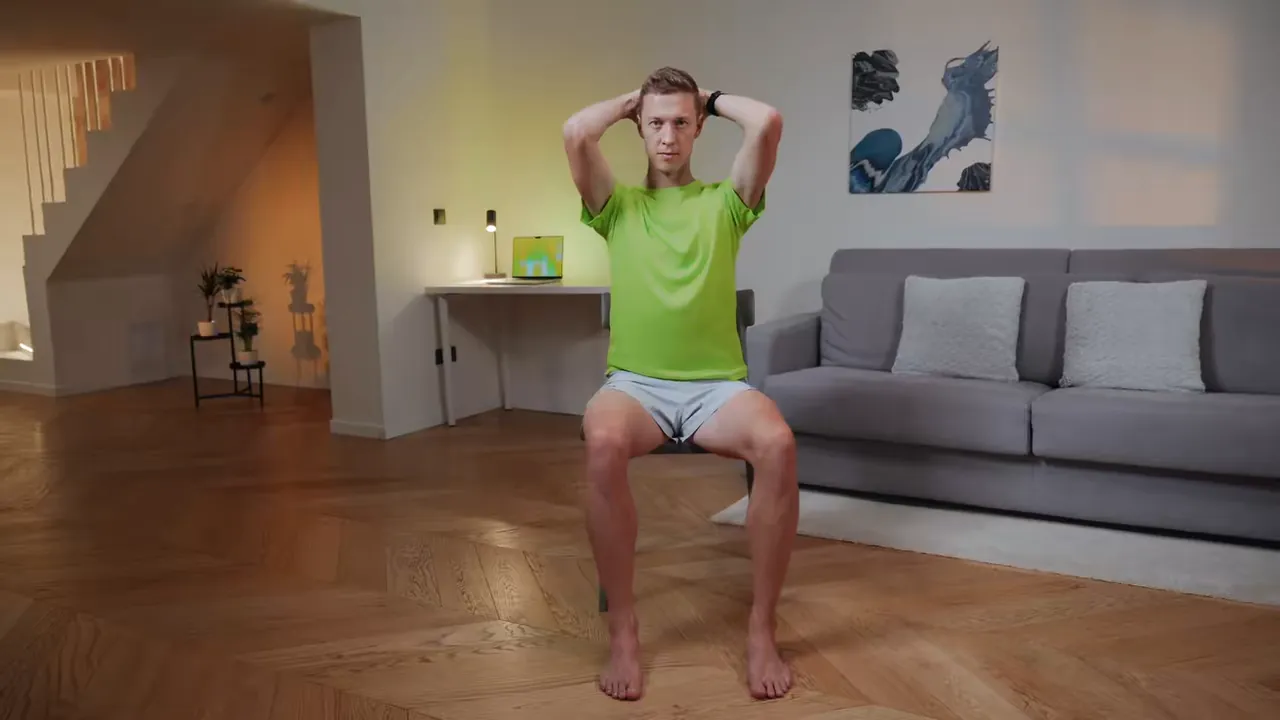
Step 1: Sit on the edge of the chair with your hands behind your head.
Keep: Sit on the edge of the seat with your hands behind your head.
Avoid: Sitting back in the chairLeaning against the backrest leaves your back little room to arch or round.
-
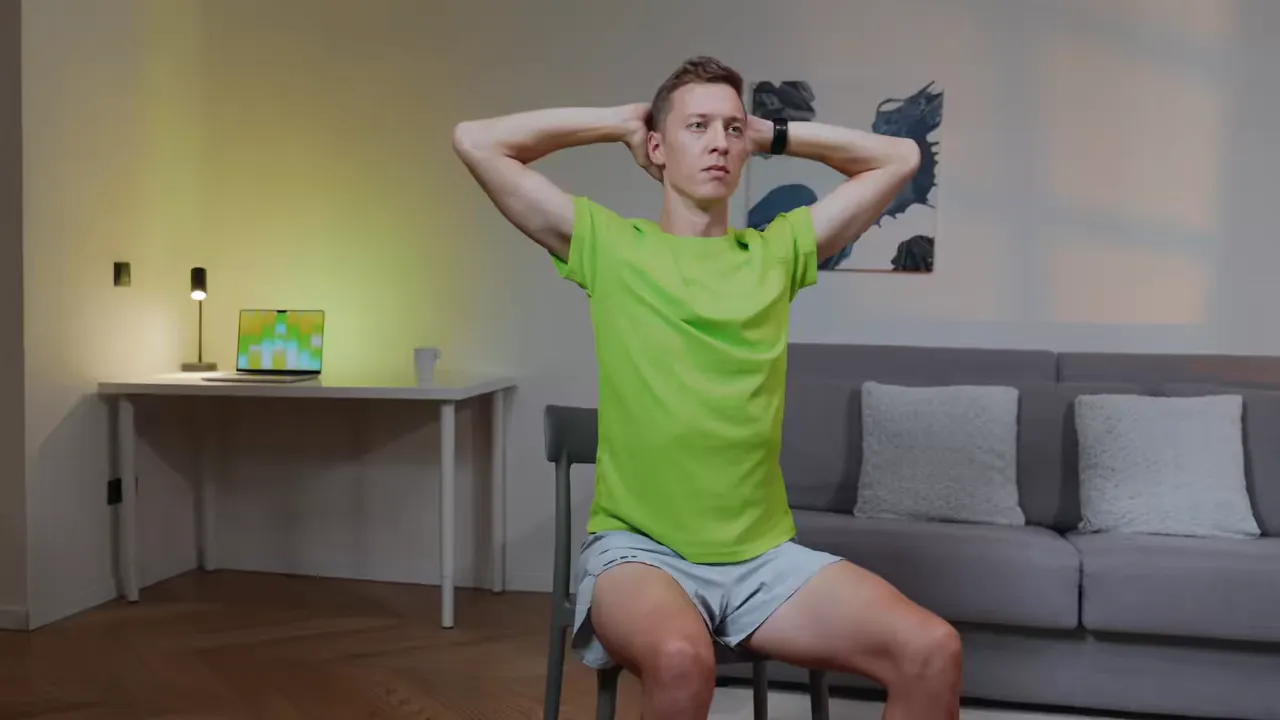
Step 2: Breathe in, arch your back and open your elbows.
Keep: Arch your back on the in-breath and open your elbows.
Avoid: Breathing against the movementHolding your breath, or swapping the two, turns an easy movement into an effort.
-
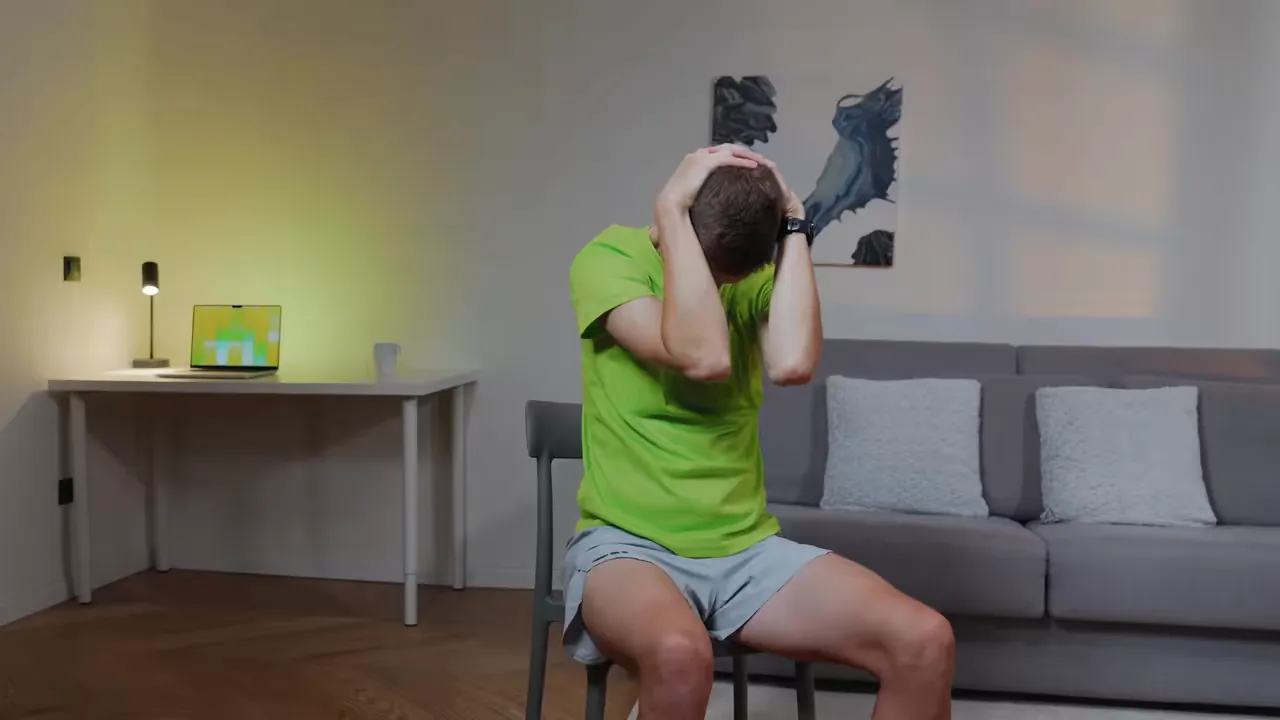
Step 3: Breathe out, round your back and bring your elbows together.
Keep: Round your back on the out-breath and bring your elbows together.
Avoid: Forgetting the elbowsIf they stay still, the upper back does less of the work.
-
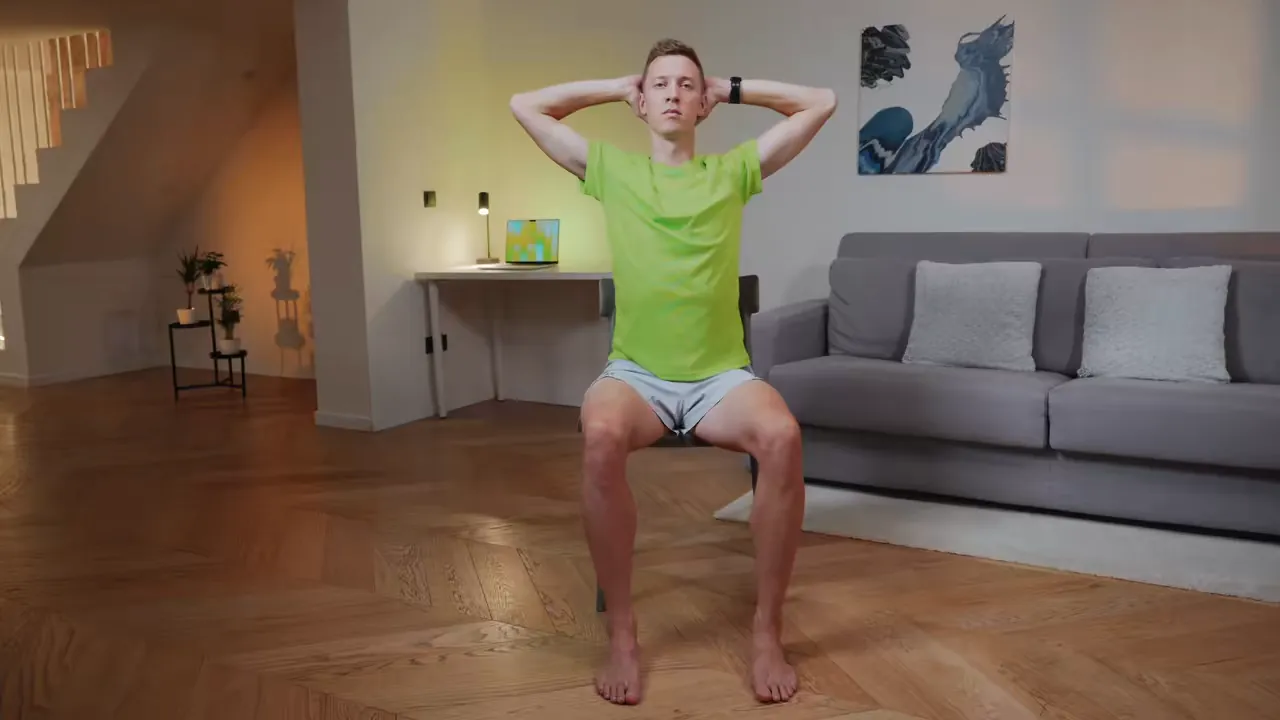
Step 4: Repeat with your breath.
Keep: Repeat with your breath, so slow breathing sets the pace, not a count.
Avoid: Rushing
Stills from the exercise video in the Bavelu app, with physiotherapist Mgr. Lukáš Kučera.
How it should feel
A comfortable, rolling movement through the whole back rather than a strong pull in one place. As you breathe in, your chest lifts and your elbows widen. As you breathe out, your back rounds and your elbows come towards each other. How big the movement is depends on what feels easy today; there is no target to reach.
Gentle pullRight
A comfortable, rolling movement through the whole back rather than a strong pull in one place.
Sharp pain, tingling or numbnessStop
It should never cause sharp pain, pins and needles, or pain that runs into an arm or a leg; if it does, stop.
Cat - Cow is one of 4 exercises in Desk Break
The other three are in the app, guided on video by a physiotherapist. The whole session takes about 6 minutes.
- Neck Half Circles 1:27 · in the app
- Trapezius Stretch 1:43 · in the app
- Cat - Cow On this page
- Seated Twist Using the Chair Back 1:58 · in the app

Desk stretches are the easiest exercise to fit into a working day, because you don’t have to go anywhere. The one on this page is a seated cat-cow from the app’s Desk Break session. You sit on the edge of your chair with your hands behind your head and arch and round your back in time with your breath. It takes a little over a minute, and it moves your back in two directions that a long spell at a screen rarely asks for.
Why a seated cat-cow makes a good desk stretch
Most desk stretches target one spot: the side of the neck, the wrists, the chest. The seated cat-cow works on the back as a whole. Arching on the in-breath and rounding on the out-breath takes your spine one way and then the other, and opening and closing your elbows brings the upper and mid back, the thoracic spine, into the movement as well as the lower back.
It also suits the place you do it. No floor, no mat, no change of clothes, and nothing that looks odd from the next desk. That matters more than it sounds. In a field study of data-entry workers, the 21 who were asked to stretch during their breaks did so in only 25% of their usual breaks and 39% of the extra short ones. With so few stretches done, the researchers could not tell whether stretching helped (Galinsky et al., 2007). A desk stretch you actually do is worth more than a better one you skip.
What it should feel like
A comfortable, rolling movement through the whole back rather than a strong pull in one place. As you breathe in, your chest lifts and your elbows widen. As you breathe out, your back rounds and your elbows come towards each other. How big the movement is depends on what feels easy today; there is no target to reach.
It should never cause sharp pain, and it should not bring on pins and needles or pain that runs into an arm or a leg. If it does, stop.
Mistakes that break the steps
Most mistakes come from drifting away from one of the steps above:
- Sitting back in the chair. The first step puts you on the edge of the seat. Leaning against the backrest leaves your back little room to arch or round.
- Breathing against the movement. The steps pair the arch with the in-breath and the rounding with the out-breath. Holding your breath, or swapping the two, turns an easy movement into an effort.
- Forgetting the elbows. They open as you arch and come together as you round. If they stay still, the upper back does less of the work.
- Rushing. The last step is to repeat with your breath, so the pace is set by slow breathing, not by a count.
When to do desk stretches in a working day
There is no proven best interval. The Chartered Society of Physiotherapy suggests breaking up long periods of sitting with short bursts of activity, such as going up and down the stairs every 30 minutes, and setting an alarm to remind you to get up and move (CSP). Our guide to microbreaks goes through what the ergonomics bodies recommend and what the trials found.
In practice, tie the stretch to something that already happens: the end of a call, sending a long email, waiting for a file to upload. A seated cat-cow at that moment, followed by a walk to refill your water, breaks up a long stretch of sedentary behaviour twice. To see how the hours add up across a week, try the sitting time calculator.
Do desk stretches help? What the research says
Some trials found that stretching at work helped. Reviews are more cautious, and the biggest practical problem is that people stop doing it.
- A six-month trial. 142 office workers aged 20 to 50 with neck, shoulder and lower back pain were split into four groups: stretching exercises, changes to their workstation, both, or no treatment. The stretching group and the combined group reported less pain in the neck, both shoulders and the lower back than the no-treatment group, and only the stretching group kept improving between months four and six (Shariat et al., 2018). Pain was self-reported on a questionnaire, and the trial tested a programme of stretches, not any single one.
- A review of stretching at work. Seven studies of stretching to prevent work-related musculoskeletal disorders gave mixed results with some benefit, but they were of relatively low quality. The authors also warned that stretching should not take the place of dealing with what causes the strain in the first place (da Costa & Vieira, 2008).
- Breaks in general. A 2025 Cochrane review of nine trials with 626 workers, almost all in offices, rated all the evidence on work breaks as very low certainty. Active breaks made little or no clear difference to muscle fatigue compared with ordinary breaks (Luger et al., 2025).
So a desk stretch is not a treatment with a proven effect of its own. It is a cheap, low-effort way to move more often, which is what the research supports best. If your neck is the main problem, the evidence that strengthening adds more than stretching alone is weighed in do stretches help neck pain from desk work? For the lower back, see lower back pain from sitting.
Other desk stretches worth knowing
The seated cat-cow moves the back as a whole. Other parts of a desk worker’s body need their own: the neck (neck stretches), the wrists and forearms after hours on a keyboard and mouse (wrist stretches), the shoulders (shoulder stretches) and the upper back on its own (upper back stretches, which features the seated twist from the same Desk Break session). If you have a mat and some floor, the all-fours version of the cat-cow moves the spine without your back having to hold you upright at the same time.
Who should be careful
- Pain that spreads, numbness or tingling. Get these checked before doing back exercises. With neck pain, the NHS lists pins and needles or a cold arm as reasons to see a GP (NHS). Pain from your bottom down the back of one leg, sometimes with numbness or tingling, is typical of sciatica (NHS).
- A recent injury or surgery to your back, neck or shoulders. Ask the team treating you when to start.
- Painful shoulders. If raising your hands behind your head hurts, leave this one out and see shoulder pain from computer work.
- Osteoporosis. The UK consensus statement on exercise for osteoporosis recommends avoiding postures that involve a high degree of spinal flexion, that is, bending or rounding forward a long way (Brooke-Wavell et al., 2022). Ask a physiotherapist whether the rounding half of this movement suits you.
- A chair that rolls or tips. For its own seated exercises, the NHS suggests a solid, stable chair without wheels (NHS). If your office chair moves when you sit on its edge, use a steadier one.
- If it hurts, stop. NHS advice for back pain is that exercises and stretches can help, but to stop if your pain gets worse and see a GP (NHS).
The seated cat-cow is one of four exercises in Bavelu’s Desk Break session, which, like the rest of the app, is designed and filmed by physiotherapists led by Mgr. Lukáš Kučera. The rest of the session is listed above, and the full guided video is in the app.
Questions people ask
What are the best desk stretches?
There is no single best one. A useful set moves the parts that stay still longest at a screen: the back, neck, shoulders and wrists. A seated cat-cow is a good place to start because it moves the whole back in both directions without leaving your chair.
How often should you do desk stretches?
No trial has settled an interval. The Chartered Society of Physiotherapy suggests breaking up long spells of sitting with short bursts of activity, for example every 30 minutes, and setting an alarm if it helps. Doing something regularly matters more than the exact timing.
Do desk stretches actually work?
In a six-month trial with 142 office workers, a stretching programme reduced self-reported neck, shoulder and lower back pain compared with no treatment. Reviews are more cautious and rate the evidence as low quality. Stretching is best seen as one way to move more often, alongside a decent workstation and some strengthening.
Is the seated cat-cow the same as cat-cow on all fours?
It follows the same idea of arching and rounding the back in time with your breath. The seated version is done on the edge of a chair with your hands behind your head, so it works at a desk. The all-fours version needs a mat and some floor, and your head moves with your back.
Terms on this page
Sources
- Galinsky T et al. Supplementary breaks and stretching exercises for data entry operators: a follow-up field study. American Journal of Industrial Medicine, 2007.
- Chartered Society of Physiotherapy. Working from home: easy exercises, 2019.
- Shariat A et al. Effects of stretching exercise training and ergonomic modifications on musculoskeletal discomforts of office workers: a randomized controlled trial. Brazilian Journal of Physical Therapy, 2018.
- da Costa BR, Vieira ER. Stretching to reduce work-related musculoskeletal disorders: a systematic review. Journal of Rehabilitation Medicine, 2008.
- Luger T et al. Work-break interventions for preventing musculoskeletal symptoms and disorders in healthy workers. Cochrane Database of Systematic Reviews, 2025.
- NHS. Neck pain and stiff neck. Last reviewed 27 April 2023.
- NHS. Sciatica. Last reviewed 3 December 2024.
- Brooke-Wavell K et al. Strong, steady and straight: UK consensus statement on physical activity and exercise for osteoporosis. British Journal of Sports Medicine, 2022.
- NHS. Sitting exercises. Last reviewed 18 January 2024.
- NHS. Back pain. Last reviewed 5 March 2026.
This page explains a topic in general terms. It is not a diagnosis and does not replace a doctor or physiotherapist. If something hurts badly, keeps getting worse or comes with numbness, weakness or fever, see a doctor.