Exercises · Lower back
Bird dog exercise: strength and control on all fours
Reaching one arm forward and the opposite leg back while your back stays still is a strengthening exercise, not a stretch. The hard part is not the reach but keeping everything else quiet.
Superman on All Fours
Lifting the opposite arm and leg to strengthen the deep muscles around the spine.
- 2:00
- On a mat
- Lower Back
- Back
Move slowly. Stop if it hurts, or if you feel tingling or numbness.
-
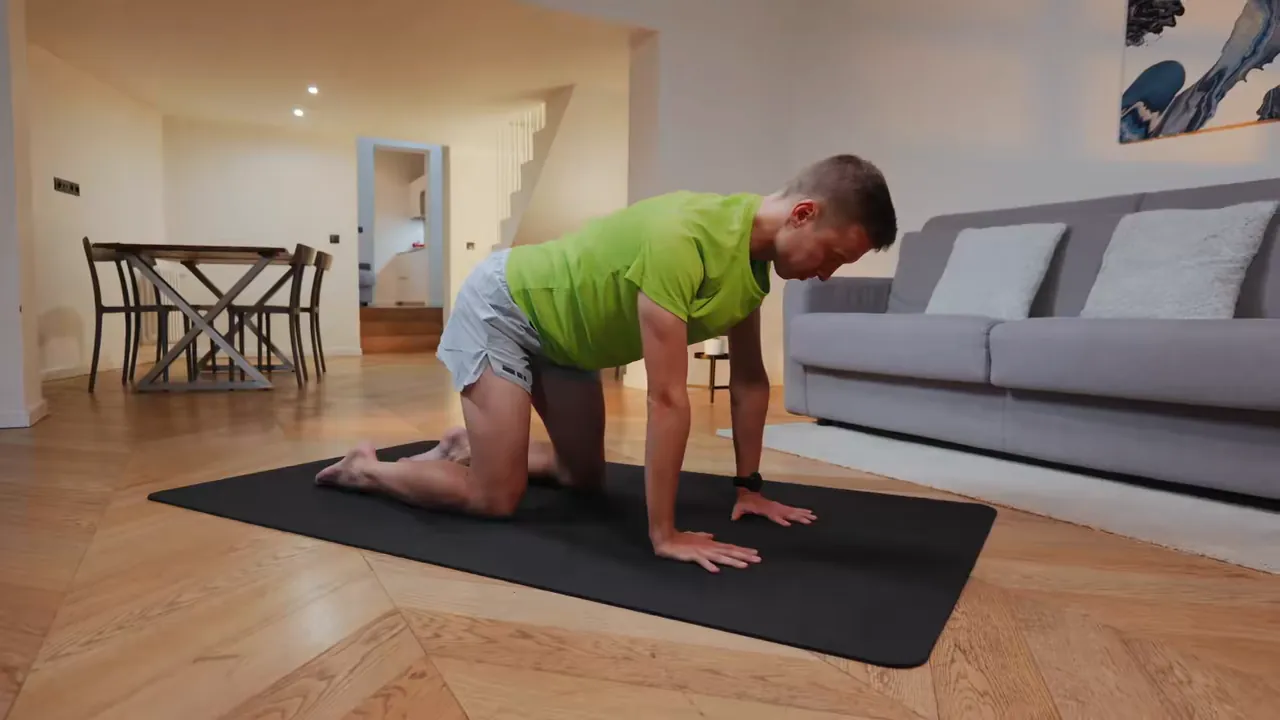
Step 1: Come onto all fours with a flat back.
Keep: Start with a flat back and keep it.
Avoid: Losing the flat backA sagging lower back or a hunched upper back means the trunk has stopped doing its job.
-
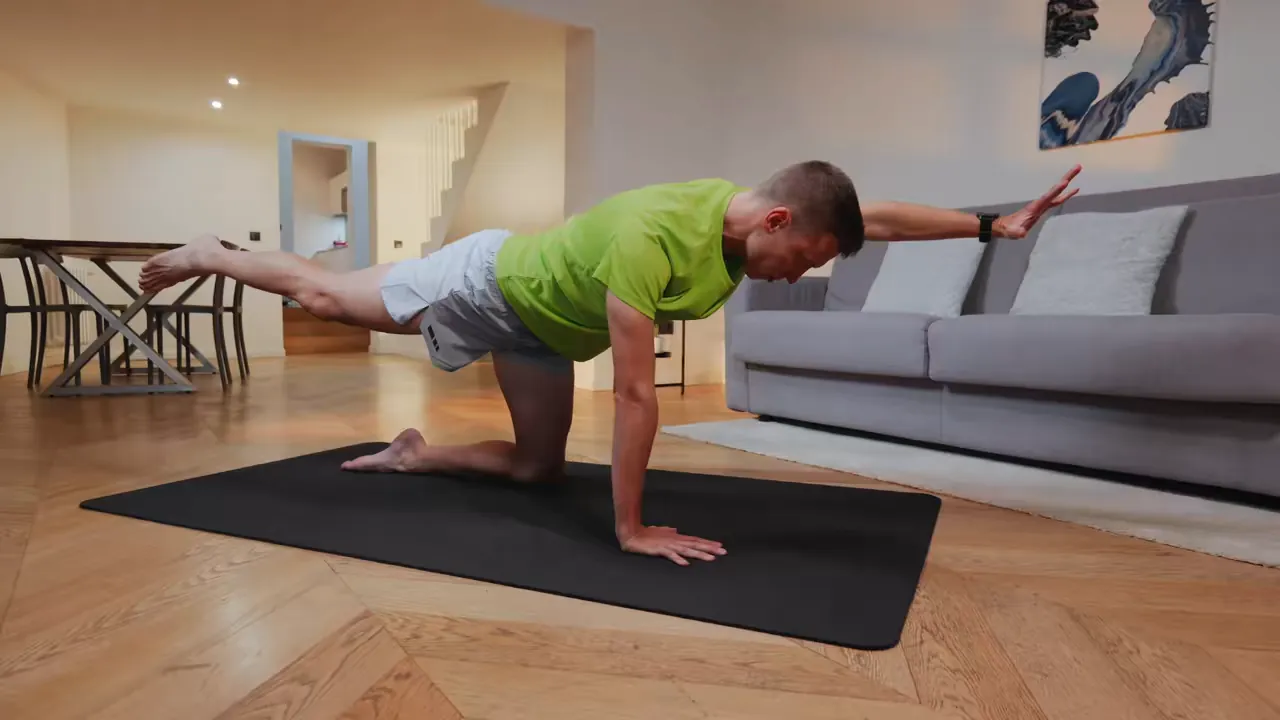
Step 2: Reach one arm forward and the opposite leg back at the same time.
Keep: Reach the opposite arm and leg, at the same time.
Avoid: Same arm, same leg
-
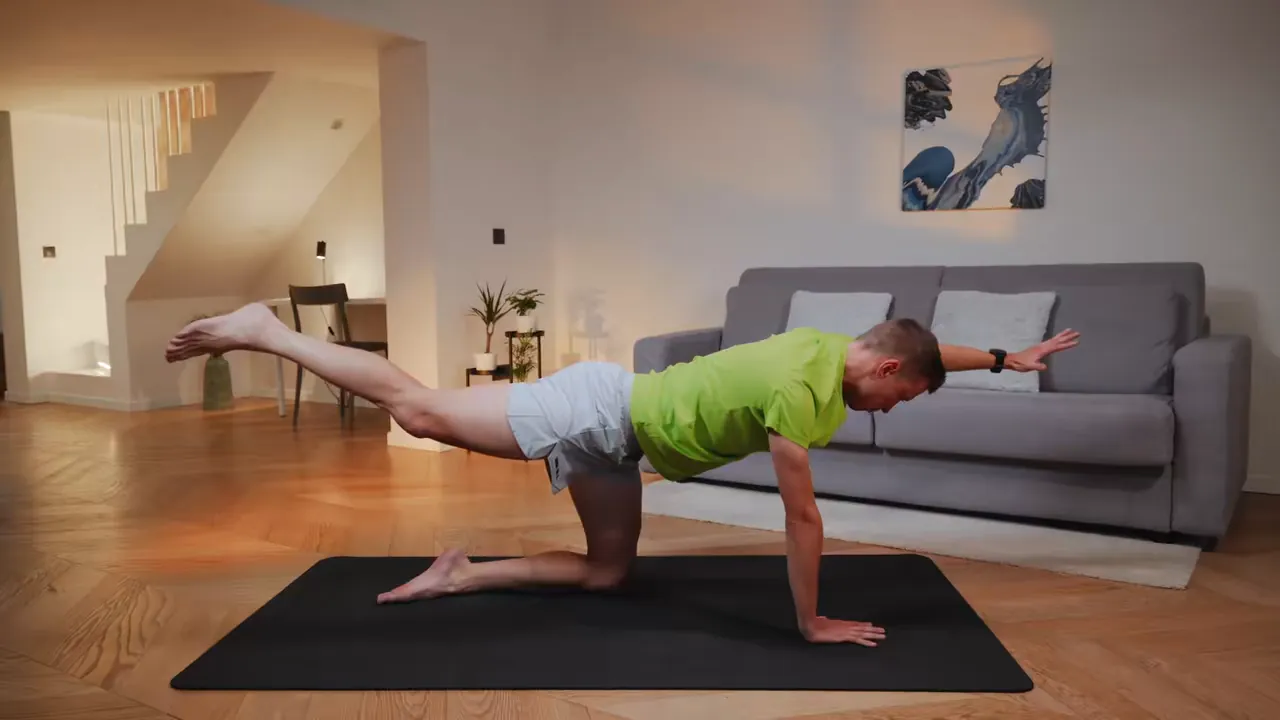
Step 3: Keep your pelvis still and hold the reach.
Keep: Keep your pelvis still as the leg goes back.
Avoid: The pelvis tipping or turningIf the hip lifts and rolls outwards, the reach is bigger than you can control yet.
Keep: Hold the reach, then come back.
Avoid: Swinging rather than holdingSwinging the limbs up and down quickly skips the part that does the work.
-
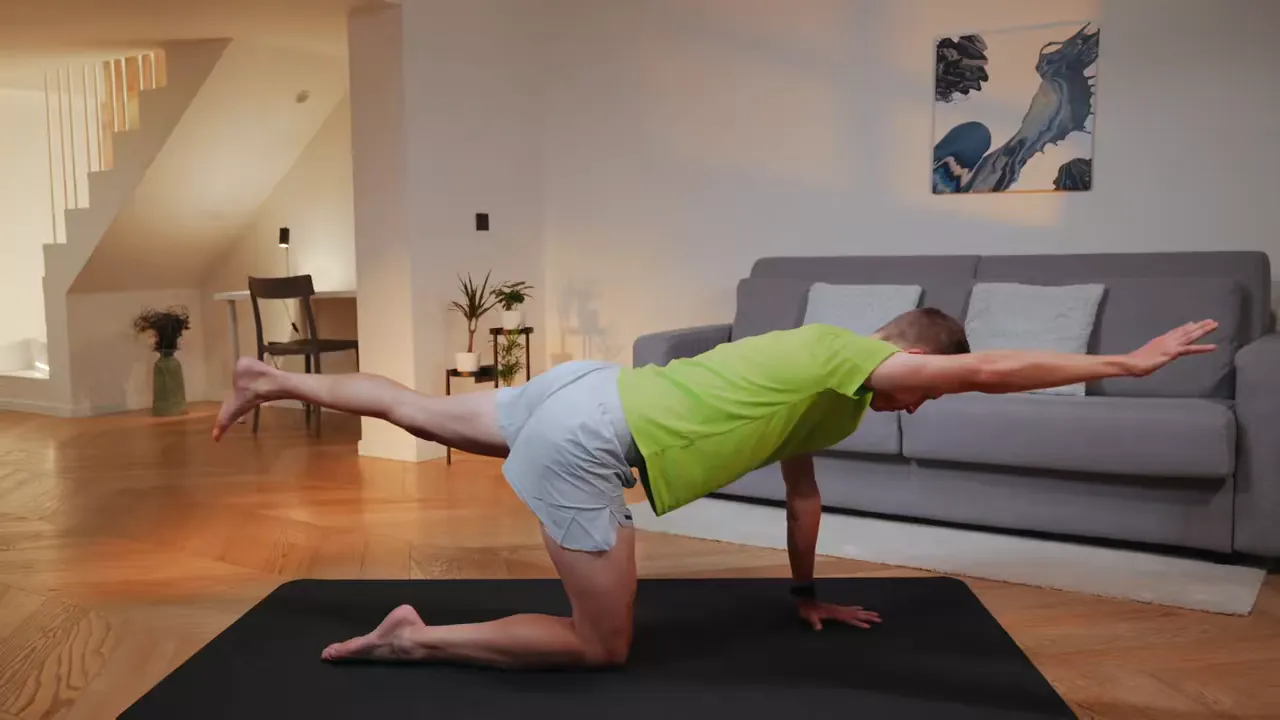
Step 4: Come back and switch sides.
Keep: Switch sides, as the last step says, so both get the same work.
Avoid: Forgetting the other side
Stills from the exercise video in the Bavelu app, with physiotherapist Mgr. Lukáš Kučera.
How it should feel
Steady effort, not a stretch. You should feel the muscles along your back, around your middle and in the buttock of the reaching leg working to keep you level. It is normal for it to feel wobbly at first, and for one side to feel harder than the other. It should not cause pain in your back.
Gentle pullRight
Steady effort, not a stretch; it is normal for it to feel wobbly at first.
Sharp pain, tingling or numbnessStop
It should not cause pain in your back.
Superman on All Fours is one of 4 exercises in Spine Wake-Up
The other three are in the app, guided on video by a physiotherapist. The whole session takes about 8 minutes.
- Cat Mobility on All Fours 1:51 · in the app
- Thoracic Rotation on All Fours 1:59 · in the app
- Superman on All Fours On this page
- Bridge 2:11 · in the app

The bird dog exercise is done on all fours: you reach one arm forward and the opposite leg back, keep your pelvis still, then switch sides. In the app it is called Superman on All Fours, but it is the exercise most people know as the bird dog. In gyms, “superman” usually means a different exercise done lying on your front, which is where the confusion comes from. Unlike most exercises in this section, the bird dog is about strength and control rather than stretching.
What the bird dog exercise works
The app describes it as strengthening the deep muscles around the spine. Those include the long muscles either side of your spine, the erector spinae, and the deeper layers beneath them, whose job is to hold your back steady while your arms and legs move.
A laboratory study measured muscle activity in 30 healthy adults during nine common rehabilitation exercises, including this one, which the authors called the quadruped arm and lower extremity lift. It was one of the few that worked a muscle hard enough to suggest it could build strength: the gluteus maximus, the big muscle of the buttock. The other exercises, done at body weight, produced lower levels of activity that the authors thought better suited to endurance and stability training (Ekstrom et al., 2007).
Put simply, the bird dog asks your trunk to stay quiet while your limbs move. That is the skill it trains.
What it should feel like
Steady effort, not a stretch. You should feel the muscles along your back, around your middle and in the buttock of the reaching leg working to keep you level. It is normal for it to feel wobbly at first, and for one side to feel harder than the other. It should not cause pain in your back.
Mistakes that break the steps
- The pelvis tipping or turning. The steps say to keep your pelvis still. As the leg goes back, the hip on that side tends to lift and roll outwards. If it does, the reach is bigger than you can control yet.
- Losing the flat back. You start with a flat back and keep it. A lower back that sags towards the floor, or an upper back that hunches up, means the trunk has stopped doing its job.
- Same arm, same leg. It is the opposite arm and leg, reaching at the same time.
- Swinging rather than holding. The steps ask you to hold the reach, then come back. Swinging the limbs up and down quickly skips the part that does the work.
- Forgetting the other side. Switch sides, as the last step says, so both get the same work.
Does the bird dog exercise help back pain?
The bird dog is one of many exercises used for back pain, and the evidence is about kinds of exercise rather than this one movement.
- Motor control exercise. The bird dog belongs to the family of exercises that train control of the trunk muscles, which researchers group under motor control exercise. A Cochrane review of 29 trials with 2,431 people with chronic low back pain found that motor control exercise reduced pain compared with minimal intervention, but gave similar results to other forms of exercise. Minor or no side effects were reported. The authors concluded that the choice of exercise should probably depend on preference, the therapist’s training, cost and safety (Saragiotto et al., 2016).
- Exercise in general. Across 249 trials, exercise reduced pain in chronic low back pain by a clinically important amount compared with no treatment, usual care or placebo, with moderate-certainty evidence (Hayden et al., 2021). For prevention, a meta-analysis of 21 trials with 30,850 people found moderate-quality evidence that exercise combined with education lowered the risk of a new episode of low back pain (Steffens et al., 2016).
- A note of caution. In a trial with 60 young, physically active men, bridging and bird dog exercises twice a week for six weeks did not improve trunk performance or balance compared with a control group. The authors suggested that the low doses typical of fitness and rehabilitation routines, and a group with no obvious problems to fix, may explain it (Prat-Luri et al., 2025).
So the bird dog is a sound exercise rather than a special one. It earns its place by needing no equipment and being easy to repeat, not by outperforming other exercise. If your back pain has lasted a while, a physiotherapist can choose exercises for what they find; how much physiotherapy costs covers the options. For more on long-term back pain, see will back pain go away on its own? and lower back pain from sitting.
Where the bird dog fits in a routine
In the app, the bird dog is the third exercise in the Spine Wake-Up session. It comes after the cat-cow stretch on all fours and a thoracic rotation, and before the glute bridge. The session moves the spine first and then asks it to hold still.
It also counts towards something bigger. The NHS recommends that adults do strengthening activities on at least two days a week that work all the major muscle groups, including the legs, hips, back and abdomen, and lists bodyweight exercises among the options (NHS). A few minutes of bird dogs does not cover all of that, but it is a start that fits before work. How far short sessions can take you, and why the lower back seems to need more time than the neck, is covered in is two minutes of exercise enough?
If you are comparing apps for this kind of routine, our guide to what to look for in back pain apps covers the basics.
Who should be careful
- Pain into a leg or arm, numbness or tingling. Get these checked first. Pain from your bottom down the back of one leg, sometimes with tingling or numbness, is typical of sciatica (NHS).
- Warning signs. Pain, tingling, weakness or numbness in both legs, loss of feeling around your genitals or bottom, or changes in your bladder or bowels need emergency care, not exercise. Call 999 or go to A&E (NHS).
- A recent back, hip or shoulder injury or surgery. Ask the team treating you when to start.
- Wrists, knees or shoulders that hurt on all fours. The exercise loads all three. If any of them hurts, ask a physiotherapist.
- Pregnancy. The NHS advises stopping any exercise in pregnancy that makes you feel uncomfortable, too hot or unwell (NHS). Ask your midwife if you are unsure.
- If it hurts, stop. NHS advice is to stop exercises if your back pain gets worse and see a GP (NHS).
Bavelu’s Spine Wake-Up session, designed and filmed by physiotherapists, puts the bird dog in the middle of a short morning routine. The rest of the session is listed above, and the full guided video is in the app.
Questions people ask
Is the bird dog the same as the superman exercise?
The names often get mixed up. In the app, Superman on All Fours is the exercise most people call the bird dog: reaching the opposite arm and leg from all fours. In gyms, "superman" usually means a different exercise done lying on your front.
What muscles does the bird dog work?
It trains the muscles around the spine to keep your trunk still while your arm and leg move. In a lab study of 30 healthy adults, it was one of the few bodyweight exercises that activated the gluteus maximus, the big buttock muscle, strongly enough to suggest a strengthening effect.
Is the bird dog good for lower back pain?
It can be part of a programme, but it is not better than other exercise. A Cochrane review of 29 trials found that motor control exercise reduced pain compared with minimal intervention and gave similar results to other exercise. Stop if it makes your pain worse.
Is the bird dog a stretch?
No. It is a strengthening and control exercise. That is why in the app it comes after two mobility exercises, the cat-cow and a thoracic rotation, so your back is moving freely before it is asked to hold still.
Terms on this page
Sources
- Ekstrom RA, Donatelli RA, Carp KC. Electromyographic analysis of core trunk, hip, and thigh muscles during 9 rehabilitation exercises. Journal of Orthopaedic and Sports Physical Therapy, 2007.
- Saragiotto BT et al. Motor control exercise for chronic non-specific low-back pain. Cochrane Database of Systematic Reviews, 2016.
- Hayden JA, Ellis J, Ogilvie R, Malmivaara A, van Tulder MW. Exercise therapy for chronic low back pain. Cochrane Database of Systematic Reviews, 2021.
- Steffens D et al. Prevention of low back pain: a systematic review and meta-analysis. JAMA Internal Medicine, 2016.
- Prat-Luri A et al. Short-term bridging and bird-dog exercise programs did not enhance trunk performance and whole-body dynamic balance in young physically active males: a double-blind randomized trial. PLOS ONE, 2025.
- NHS. Physical activity guidelines for adults aged 19 to 64. Last reviewed 22 May 2024.
- NHS. Sciatica. Last reviewed 3 December 2024.
- NHS. Back pain. Last reviewed 5 March 2026.
- NHS. Exercise in pregnancy. Last reviewed 24 September 2026.
This page explains a topic in general terms. It is not a diagnosis and does not replace a doctor or physiotherapist. If something hurts badly, keeps getting worse or comes with numbness, weakness or fever, see a doctor.