Exercises · Whole spine
Cat-cow stretch: what it does for your spine
Rounding and arching your back on all fours, in time with your breath, moves the spine from the neck to the lower back. Here is what to feel, what to avoid and what the research can and cannot say.
Cat Mobility on All Fours
Alternately rounding and arching the back to move the spine one vertebra at a time.
- 1:51
- On a mat
- Spine
- Back
Move slowly. Stop if it hurts, or if you feel tingling or numbness.
-
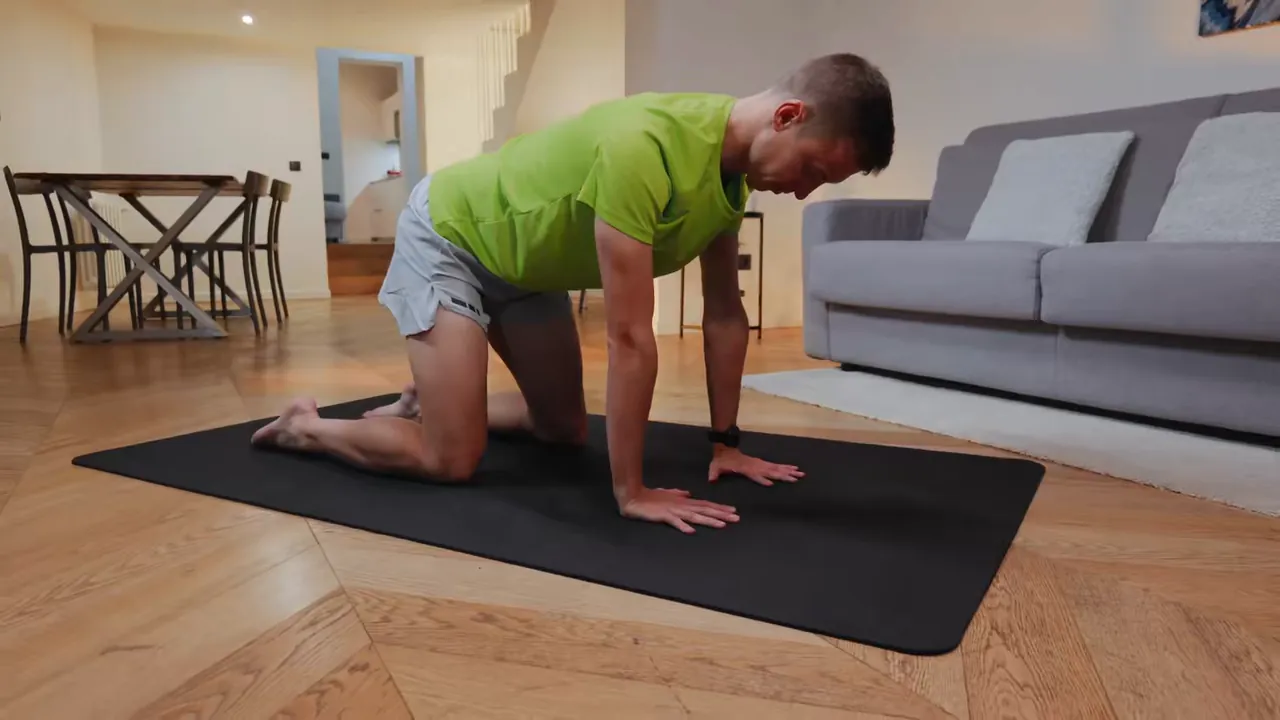
Step 1: Come onto all fours, hands under shoulders, knees under hips.
Keep: Hands under your shoulders, knees under your hips. If they drift, check the start position again.
Avoid: Hands and knees out of place
-
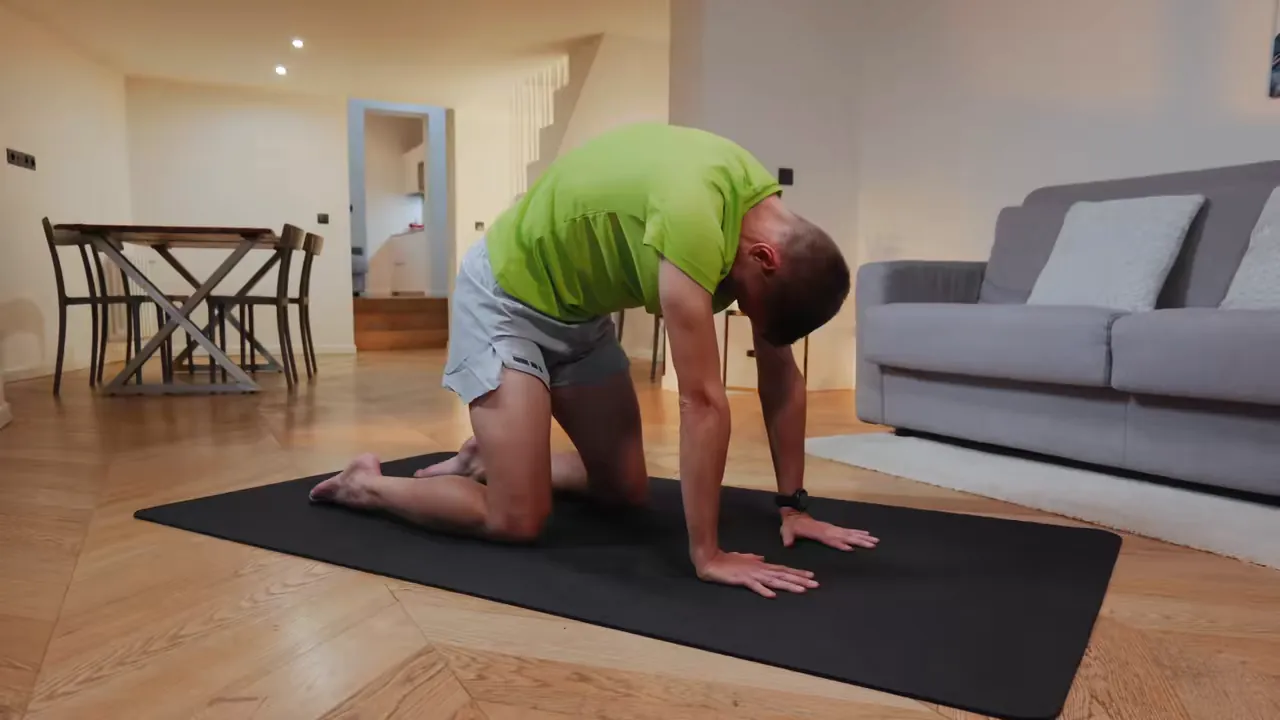
Step 2: Breathe out, round your back and draw your chin to your chest.
Keep: Round your back on the out-breath and draw your chin to your chest; arch on the in-breath.
Avoid: Breathing the wrong way round
-
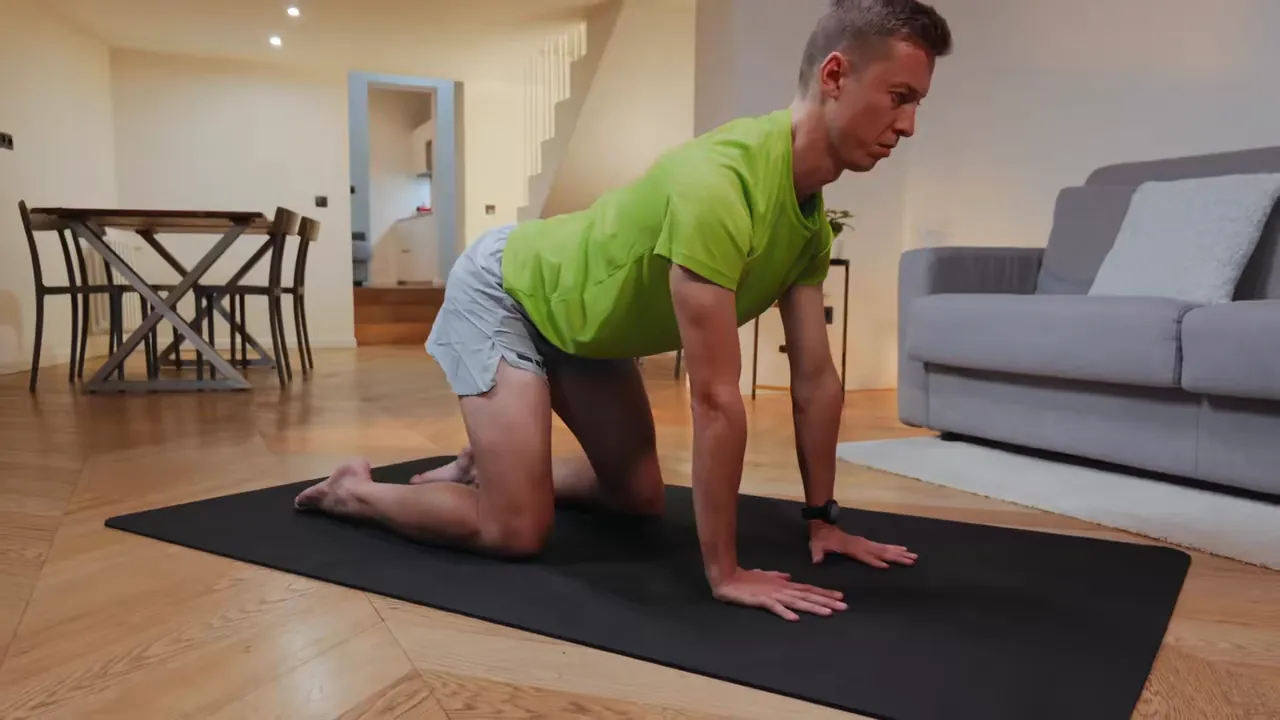
Step 3: Breathe in, arch your back and lift your gaze ahead.
Keep: Arch your back as you lift your gaze, with the head following the back.
Avoid: Moving only your headIf only the chin drops and lifts while the back stays still, your back misses out.
-
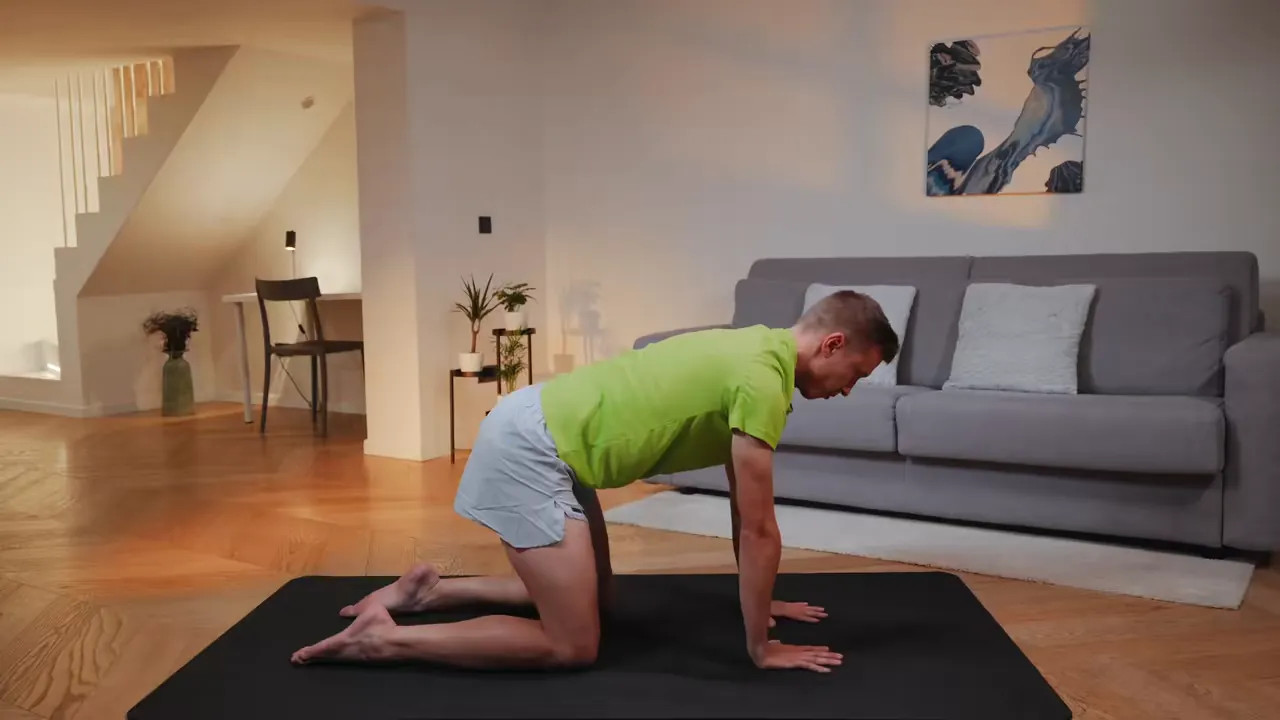
Step 4: Keep flowing between the two with your breath.
Keep: Keep flowing between the two with your breath.
Avoid: Stopping at each endPausing to push further at either end turns it into a held stretch, which this one is not for.
Stills from the exercise video in the Bavelu app, with physiotherapist Mgr. Lukáš Kučera.
How it should feel
Smooth and unhurried. The rounding half usually feels like a gentle opening across the upper back. The arching half feels like the front of your body lengthening as your chest opens and you look ahead.
Gentle pullRight
Smooth and unhurried, with neither end forced.
Sharp pain, tingling or numbnessStop
Sharp pain, pain that spreads into an arm or leg, or tingling are different: stop.
Cat Mobility on All Fours is one of 4 exercises in Spine Wake-Up
The other three are in the app, guided on video by a physiotherapist. The whole session takes about 8 minutes.
- Cat Mobility on All Fours On this page
- Thoracic Rotation on All Fours 1:59 · in the app
- Superman on All Fours 2:00 · in the app
- Bridge 2:11 · in the app

The cat-cow stretch is one of the simplest ways to move your whole spine. On all fours, you round your back as you breathe out and arch it as you breathe in, flowing between the two. It comes from yoga, and in the app it is the first exercise of the Spine Wake-Up session. This page is about the version on all fours. If you need something for the office, the seated cat-cow works from a chair.
What the cat-cow stretch does
Calling it a stretch undersells it slightly. It is mostly a mobility exercise: in the app’s own description, the aim is to move the spine one vertebra at a time by alternately rounding and arching the back. You travel from one end of your comfortable range to the other, gently, rather than holding a position.
On all fours, your hands and knees carry your weight, so your back can move freely without also holding you upright. And because your head follows, chin towards your chest as you round and gaze lifting as you arch, the movement runs from the neck, the cervical spine, through the upper and mid back, the thoracic spine, down to the lower back.
What it should feel like
Smooth and unhurried. The rounding half usually feels like a gentle opening across the upper back. The arching half feels like the front of your body lengthening as your chest opens and you look ahead.
Neither end should be forced. The point is to move through the range you have today, not to make it bigger. Your back may feel stiff for the first few breaths, especially in the morning. Sharp pain, pain that spreads into an arm or leg, or tingling are different: stop.
Mistakes that break the steps
- Hands and knees out of place. The first step stacks your hands under your shoulders and your knees under your hips. If your hands creep forward or your knees drift back, check the start position again before carrying on.
- Breathing the wrong way round. Round on the out-breath, arch on the in-breath. Holding your breath tends to make the movement stiff and jerky.
- Moving only your head. The steps ask you to round and arch your back, with the head following. If your chin drops and lifts while your back stays still, your back misses out.
- Stopping at each end. The last step is to keep flowing. Pausing to push further at the top or bottom turns it into a held stretch, which is not what this one is for.
When to do it
The cat-cow opens the Spine Wake-Up session in the app, a morning routine. It comes before a thoracic rotation on all fours, the bird dog (called Superman on All Fours in the app) and the glute bridge. As a first movement it asks very little of you, which makes it an easy start for a back that has been still all night.
It works just as well in the evening, after a day spent mostly in a chair. If that describes your weekdays, our page on lower back pain from sitting looks at what the research says sitting does and does not do to the back.
What the research says about the cat-cow stretch
No trial has tested the cat-cow stretch on its own. The evidence comes from studies of yoga and of exercise for back pain in general, where it is one movement among many.
- Yoga for chronic low back pain. A Cochrane review of 21 trials with 2,223 people found that, compared with no exercise, yoga brought small improvements in pain and back-related function at three months, smaller than the difference the authors judged clinically important. Compared with other back exercise, such as physiotherapy, there was probably little or no difference in function. Yoga was linked with more side effects than no exercise, mostly increased back pain, but about the same as other exercise (Wieland et al., 2022).
- Yoga or stretching? In a trial of 228 adults with chronic low back pain, 12 weekly yoga classes did better than a self-care book, but no better than 12 weekly classes of conventional stretching. The benefits lasted at least several months (Sherman et al., 2011).
- Exercise in general. A Cochrane review of 249 trials found moderate-certainty evidence that exercise reduces pain in chronic low back pain compared with no treatment, usual care or placebo, by a clinically important amount at first follow-up (Hayden et al., 2021).
The fair reading is that the cat-cow is a reasonable part of a routine, and that no style of exercise has been shown to beat the others. What you will keep doing matters more than which movement you pick. If your back pain keeps coming back, will back pain go away on its own? looks at what the research says about recurrence.
Cat-cow on all fours or on a chair?
Both versions are in the app and both follow the same idea: arch with the in-breath, round with the out-breath. The all-fours version needs a mat and some floor, and your head moves with your back. The seated version is done on the edge of a chair with your hands behind your head, so you can do it at work. If kneeling is uncomfortable, the seated one is the obvious swap.
For more ways to move the upper back in particular, see thoracic spine mobility exercises.
Who should be careful
- Pain into an arm or leg, numbness or tingling. Get these checked before doing back exercises. Pain from your bottom down the back of one leg, sometimes with numbness or pins and needles, is typical of sciatica (NHS). With neck pain, the NHS lists pins and needles or a cold arm as reasons to see a GP (NHS).
- A recent back injury or surgery. Ask the team treating you when floor exercises are safe to start.
- Osteoporosis. The UK consensus statement on exercise for osteoporosis recommends avoiding postures that involve a high degree of spinal flexion (Brooke-Wavell et al., 2022). The rounding half of the cat-cow is flexion, so ask a physiotherapist whether it suits you.
- Sore wrists or knees. All fours puts weight through both. If either hurts, try the seated version or ask a physiotherapist.
- Pregnancy. The NHS advises stopping any exercise in pregnancy that makes you feel uncomfortable, too hot or unwell (NHS). If you are unsure whether floor exercises suit you, ask your midwife.
- If it hurts, stop. The NHS says exercises and stretches can help with back pain, but to stop if your pain gets worse and see a GP (NHS).
Bavelu’s Spine Wake-Up session, designed and filmed by physiotherapists, starts with this movement and carries on with the three exercises listed above. The full guided video is in the app.
Questions people ask
What is the cat-cow stretch good for?
It moves the whole spine, rounding and arching in time with your breath, so it is mostly a mobility exercise. It is often used to start a routine or to move after a long time still. No trial has tested it on its own, so claims that it treats back pain go beyond the evidence.
Is the cat-cow stretch good for lower back pain?
It can be part of a routine, but it has not been tested by itself. A Cochrane review of yoga for chronic low back pain found small improvements compared with no exercise and little or no difference compared with other back exercise. Stop if it makes your pain worse, and see a GP if pain spreads into a leg or comes with numbness.
Should you do the cat-cow stretch in the morning?
It works well as a first movement of the day because it is gentle and needs nothing but a mat. In the app it opens the Spine Wake-Up session, a morning routine. It suits the end of a long day of sitting too.
Can you do cat-cow if you have osteoporosis?
Ask a physiotherapist first. The UK consensus statement on exercise for osteoporosis recommends avoiding postures that involve a high degree of spinal flexion, and the rounding half of cat-cow is flexion. A physiotherapist can tell you whether it suits you.
Terms on this page
Sources
- Wieland LS et al. Yoga for chronic non-specific low back pain. Cochrane Database of Systematic Reviews, 2022.
- Sherman KJ et al. A randomized trial comparing yoga, stretching, and a self-care book for chronic low back pain. Archives of Internal Medicine, 2011.
- Hayden JA, Ellis J, Ogilvie R, Malmivaara A, van Tulder MW. Exercise therapy for chronic low back pain. Cochrane Database of Systematic Reviews, 2021.
- NHS. Sciatica. Last reviewed 3 December 2024.
- NHS. Neck pain and stiff neck. Last reviewed 27 April 2023.
- Brooke-Wavell K et al. Strong, steady and straight: UK consensus statement on physical activity and exercise for osteoporosis. British Journal of Sports Medicine, 2022.
- NHS. Exercise in pregnancy. Last reviewed 24 September 2026.
- NHS. Back pain. Last reviewed 5 March 2026.
This page explains a topic in general terms. It is not a diagnosis and does not replace a doctor or physiotherapist. If something hurts badly, keeps getting worse or comes with numbness, weakness or fever, see a doctor.