Exercises · Hips
Glute bridge: feel it in your glutes, not your lower back
Lifting your hips from the floor needs nothing but a mat and works the big muscles at the back of your hips. The details decide whether your glutes or your lower back end up doing the work.
Bridge
Lifting the hips from lying down to wake up the glutes and ease the lower back.
- 2:11
- On a mat
- Lower Back
- Hips
Move slowly. Stop if it hurts, or if you feel tingling or numbness.
-
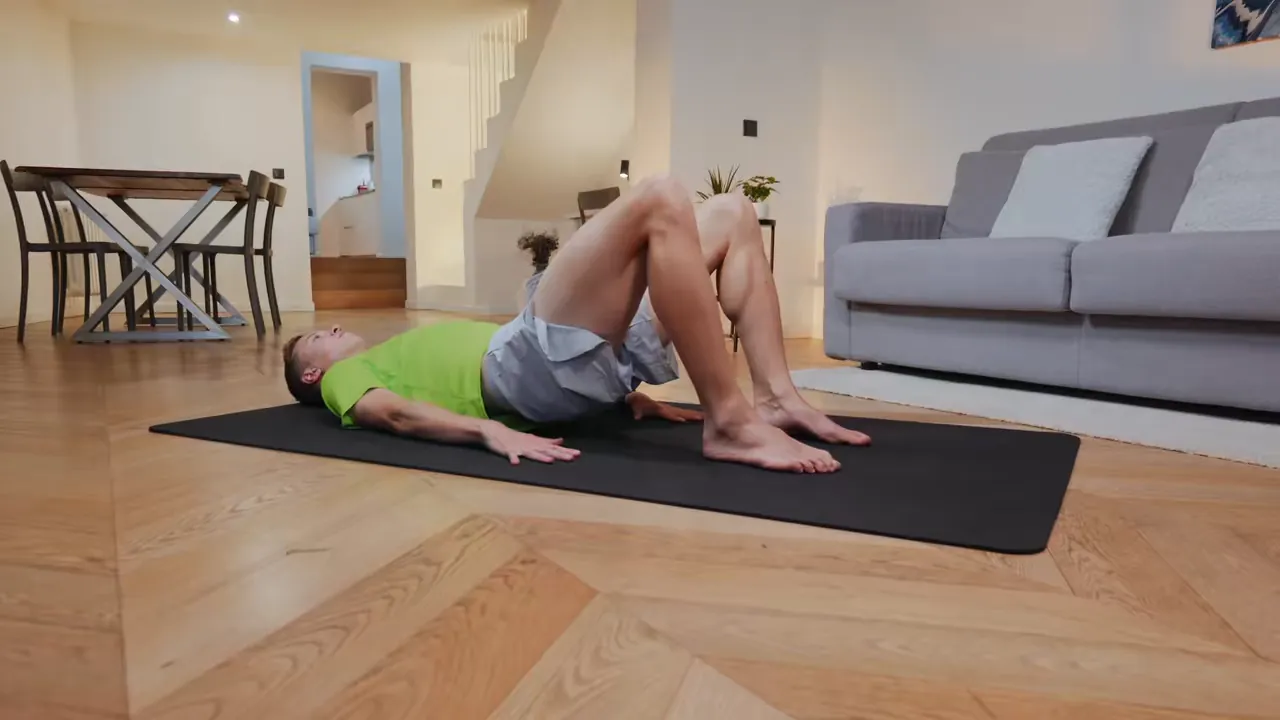
Step 1: Lie on your back, knees bent, feet hip-width apart.
Keep: Lie on your back, knees bent, with your feet hip-width apart.
Avoid: Feet in the wrong placeFeet far apart or pressed together change how your hips and knees line up.
-
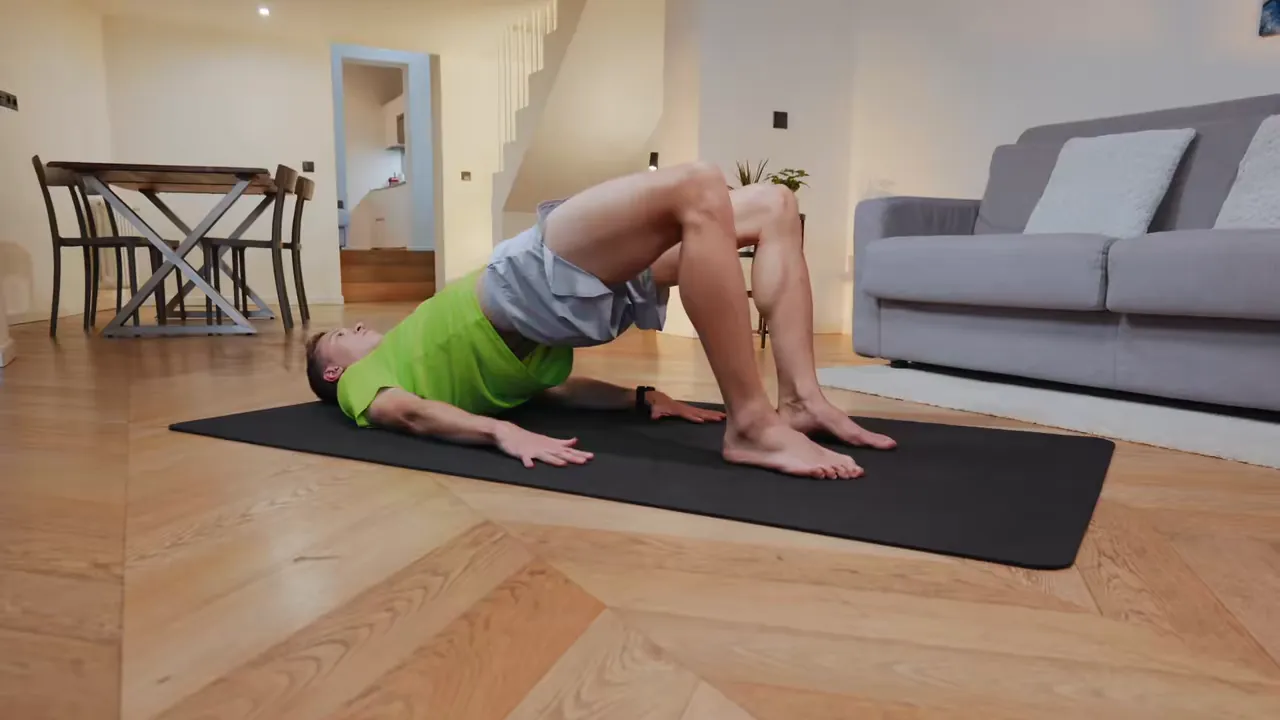
Step 2: Breathe out and lift your hips until your body forms a straight line.
Keep: Lift your hips until your body forms a straight line, and no higher.
Avoid: Lifting too highPushing higher arches your lower back and moves the work from your glutes into your back.
Keep: Breathe out as you lift.
Avoid: Holding your breath
-
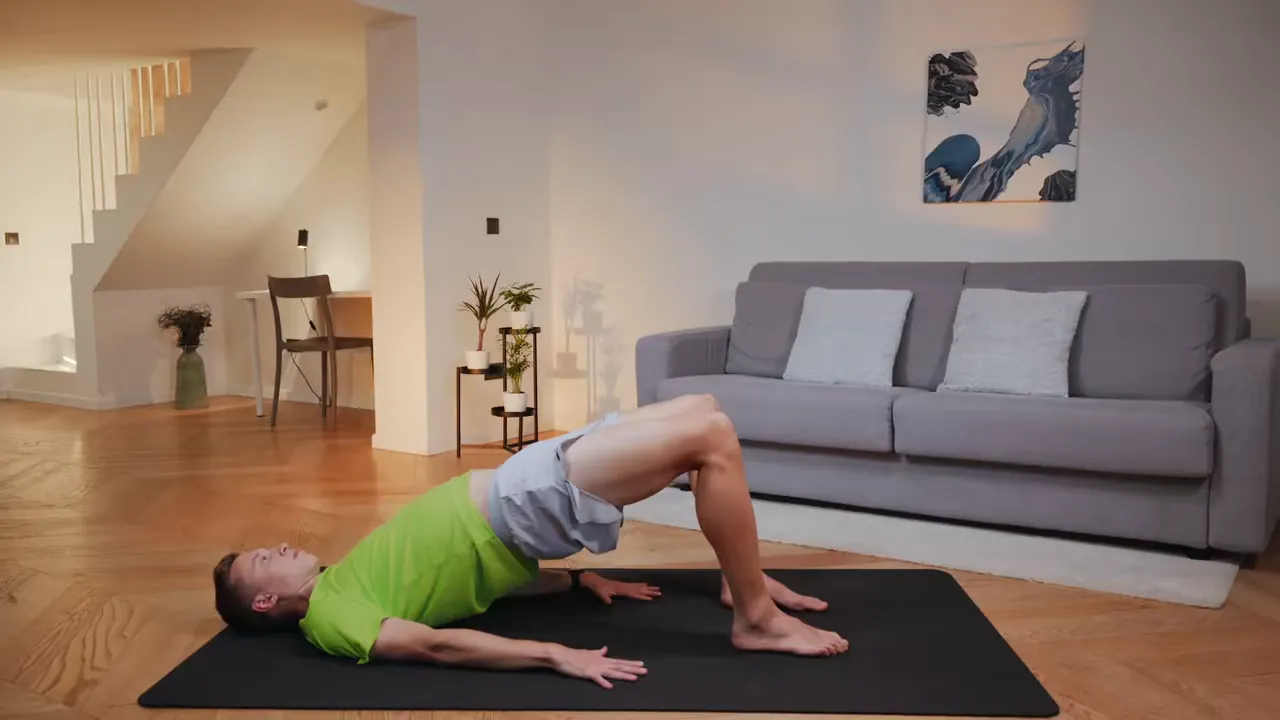
Step 3: Squeeze your glutes at the top and hold briefly.
Keep: Squeeze your glutes at the top. The squeeze is part of the exercise.
Avoid: Skipping the squeezeWithout it, your glutes may do less than they could.
-
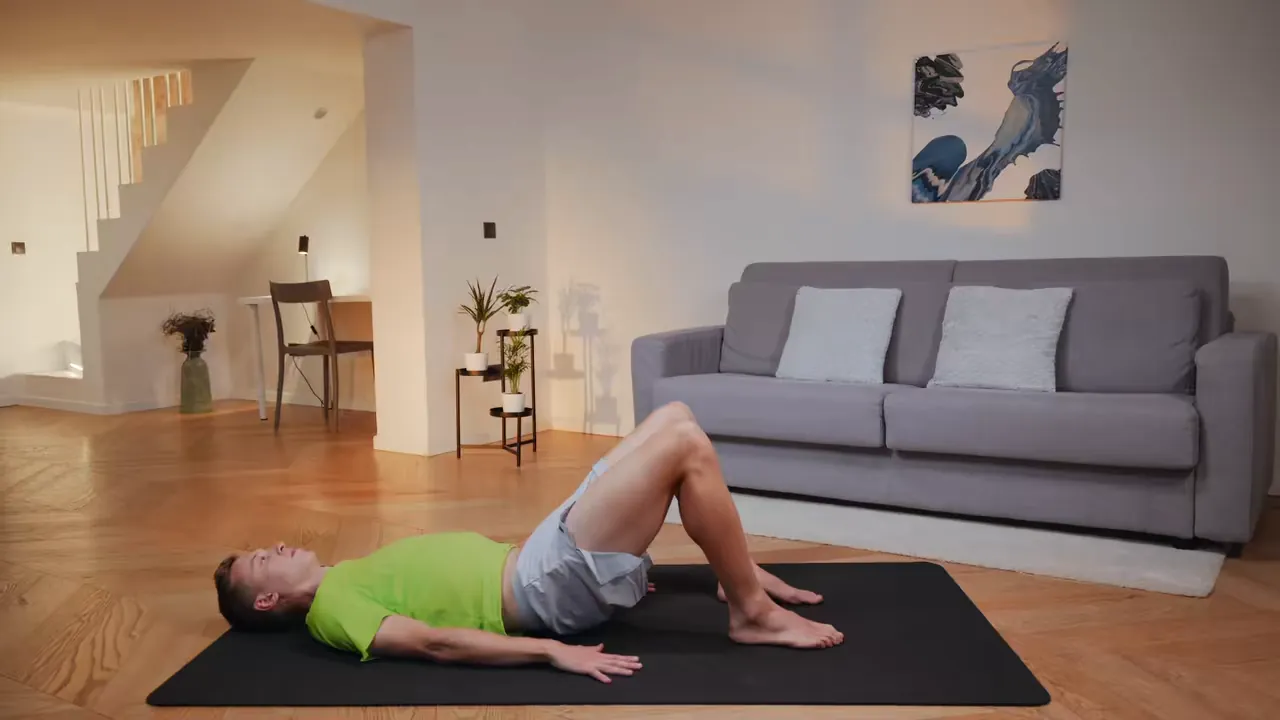
Step 4: Roll back down one vertebra at a time.
Keep: Roll back down one vertebra at a time.
Avoid: Dropping down in one piece
Stills from the exercise video in the Bavelu app, with physiotherapist Mgr. Lukáš Kučera.
How it should feel
At the top, a firm squeeze in your buttocks, which is exactly what the steps ask for. You may feel the backs of your thighs working too. What you should not feel is your lower back doing most of the work, or any pinching in it.
Gentle pullRight
At the top, a firm squeeze in your buttocks; you may feel the backs of your thighs working too.
Sharp pain, tingling or numbnessStop
What you should not feel is your lower back doing most of the work, or any pinching in it.
Bridge is one of 4 exercises in Spine Wake-Up
The other three are in the app, guided on video by a physiotherapist. The whole session takes about 8 minutes.
- Cat Mobility on All Fours 1:51 · in the app
- Thoracic Rotation on All Fours 1:59 · in the app
- Superman on All Fours 2:00 · in the app
- Bridge On this page

The glute bridge is a strengthening exercise done lying on your back, lifting your hips off the mat and lowering them again. In the app it is simply called Bridge, it closes the Spine Wake-Up session, and it is designed to wake up the glutes, the muscles of your buttocks. It is not a stretch, so don’t expect to feel one. What you should feel, and what you should not, is most of what this page is about.
What the glute bridge works
The main target is the gluteus maximus, the big muscle of the buttock that straightens the hip. The backs of your thighs and the muscles along your spine help.
How hard it works them depends on the version. In a lab study of 30 healthy adults, the ordinary two-legged bridge produced less muscle activity than the level the authors linked with building strength. They thought it better suited to training endurance and stability (Ekstrom et al., 2007). A systematic review of 16 studies found the highest gluteus maximus activity in step-ups and in exercises done with added weight, such as deadlifts, hip thrusts, lunges and squats (Neto et al., 2020).
So a bodyweight bridge is a starting point rather than a heavy strength exercise. That is not a flaw. It gets your hips working with no equipment, at home or in a hotel room, on a morning when you would not go to a gym.
What it should feel like
At the top, a firm squeeze in your buttocks, which is exactly what the steps ask for. You may feel the backs of your thighs working too. What you should not feel is your lower back doing most of the work, or any pinching in it.
Mistakes that break the steps
- Lifting too high. The steps stop when your body forms a straight line. Pushing your hips higher than that arches your lower back, which moves the work away from your glutes and into your back.
- Skipping the squeeze. The squeeze at the top is part of the exercise, not a finishing touch. Without it, your hips go up and down but your glutes may do less than they could.
- Feet in the wrong place. The first step sets your feet hip-width apart. Feet far apart or pressed together change how your hips and knees line up.
- Dropping down in one piece. The last step is to roll back down one vertebra at a time. Lowering slowly through the spine makes the way down part of the exercise rather than the end of it.
- Holding your breath. The steps pair the lift with the out-breath.
Does the glute bridge help back pain?
The honest answer is “maybe a little, as part of a wider programme”.
- Adding hip strengthening. A review of five trials with 309 people with low back pain found that adding hip strengthening exercises to other treatment improved pain and disability more than the same treatment without them. The difference in pain was small, about 5 points on a 100-point scale, and the evidence was moderate quality for pain and low quality for disability (de Jesus et al., 2020).
- A trial that found no extra benefit. In a trial with 80 people with non-specific low back pain, adding progressive hip strengthening to a programme of motor control exercise made no difference to pain or disability after six weeks. Both groups improved by a similar, clinically meaningful amount (Kendall et al., 2015).
- Healthy, active people. In 60 young, physically active men, bridges and bird dogs twice a week for six weeks did not improve trunk performance or balance compared with a control group (Prat-Luri et al., 2025).
Put together, the bridge is a reasonable exercise for the hips and lower back, and no study shows it beats other exercise. Exercise as a whole has much stronger evidence for long-term back pain, which our page on lower back pain from sitting covers.
What about sitting and tight hip flexors?
A popular explanation for back pain from sitting is that the muscles at the front of the hip, the hip flexors, tighten from hours in a chair and pull on the lower back, and that the glutes need waking up to balance them. The hip flexor part has been tested. In 118 adults who had not sought care, those with low back pain had slightly less hip flexor flexibility, but once other factors were taken into account, back pain was no longer linked with it; body mass index was the only significant factor (Eimiller et al., 2026). It was one small study at one point in time, so it cannot settle the question, but it does not support the tidy story either. Long, unbroken sitting is still worth breaking up, for reasons covered under sedentary behaviour, and a bridge is one way to do it. For stretching the hips rather than strengthening them, see hip stretches and pigeon pose.
Where the glute bridge fits
It is the last exercise in the Spine Wake-Up session in the app, after the cat-cow stretch, a thoracic rotation and the bird dog. It also works on its own at the end of a long day in a chair.
The NHS recommends strengthening activities on at least two days a week that work all the major muscle groups, including the legs and hips, and counts bodyweight exercises (NHS). A few bridges are not a full programme. How much short sessions can achieve depends on where it hurts: for the neck, brief daily strengthening has helped in trials, while for the lower back the trials that worked used longer sessions. That difference is explained in is two minutes of exercise enough?
Who should be careful
- Pregnancy. The NHS advises avoiding any activity that involves lying flat on your back for more than a few minutes in later pregnancy, and stopping if you feel uncomfortable, too hot or unwell (NHS). Ask your midwife whether the bridge suits you.
- Pain into a leg, numbness or tingling. Pain from your bottom down the back of one leg, with tingling or numbness, is typical of sciatica and needs its own advice (NHS).
- Warning signs. Pain, tingling, weakness or numbness in both legs, loss of feeling around your genitals or bottom, or changes in your bladder or bowels need emergency care. Call 999 or go to A&E (NHS).
- A recent back, hip or knee injury or surgery. Ask the team treating you when to start.
- If it hurts, stop. NHS advice is that exercises and stretches can help back pain, but to stop if your pain gets worse and see a GP (NHS).
Bavelu’s Spine Wake-Up session ends with this bridge and, like everything in the app, is designed and filmed by physiotherapists. The rest of the session is listed above, and the full guided video is in the app.
Questions people ask
What does the glute bridge work?
Mainly the gluteus maximus, the large muscle of the buttock, with help from the backs of the thighs and the muscles along the spine. At body weight it is a moderate exercise: a lab study of 30 healthy adults found activity levels better suited to endurance and stability than to building strength.
Why do I feel the glute bridge in my lower back?
A common reason is lifting the hips higher than the straight line the exercise asks for, which arches the lower back. Missing the squeeze at the top is another. If your back still hurts during the bridge, stop and ask a physiotherapist.
Is the glute bridge good for lower back pain?
It may help a little as part of a wider programme. A review of five trials found that adding hip strengthening to other treatment slightly improved pain, while a trial with 80 people found no extra benefit. No study shows that the bridge beats other exercise.
Can you do glute bridges when pregnant?
Ask your midwife. The NHS advises avoiding activities that involve lying flat on your back for more than a few minutes in later pregnancy, and stopping any exercise that makes you feel uncomfortable, too hot or unwell.
Terms on this page
Sources
- Ekstrom RA, Donatelli RA, Carp KC. Electromyographic analysis of core trunk, hip, and thigh muscles during 9 rehabilitation exercises. Journal of Orthopaedic and Sports Physical Therapy, 2007.
- Neto WK et al. Gluteus maximus activation during common strength and hypertrophy exercises: a systematic review. Journal of Sports Science and Medicine, 2020.
- de Jesus FLA et al. Addition of specific hip strengthening exercises to conventional rehabilitation therapy for low back pain: a systematic review and meta-analysis. Clinical Rehabilitation, 2020.
- Kendall KD, Emery CA, Wiley JP, Ferber R. The effect of the addition of hip strengthening exercises to a lumbopelvic exercise programme for the treatment of non-specific low back pain: a randomized controlled trial. Journal of Science and Medicine in Sport, 2015.
- Prat-Luri A et al. Short-term bridging and bird-dog exercise programs did not enhance trunk performance and whole-body dynamic balance in young physically active males: a double-blind randomized trial. PLOS ONE, 2025.
- Eimiller K, Vraa M, Sigmund K, Zellmer M. Relationship between hip flexor tightness and low back pain in non-care-seeking individuals. Clinical Biomechanics, 2026.
- NHS. Physical activity guidelines for adults aged 19 to 64. Last reviewed 22 May 2024.
- NHS. Exercise in pregnancy. Last reviewed 24 September 2026.
- NHS. Sciatica. Last reviewed 3 December 2024.
- NHS. Back pain. Last reviewed 5 March 2026.
This page explains a topic in general terms. It is not a diagnosis and does not replace a doctor or physiotherapist. If something hurts badly, keeps getting worse or comes with numbness, weakness or fever, see a doctor.