Exercises · Neck
Forward head posture exercises for people who work at a screen
Exercise programmes have changed head posture in trials. Whether that is what eases neck pain is much less clear. Here is one stretch from the app, and a straight account of what to expect from it.
Short Neck Muscle Stretch
A gentle stretch for the small muscles under the skull that hold the head tense after a day at a screen.
- 1:53
- On a mat
- Neck
- Upper Back
Move slowly. Stop if it hurts, or if you feel tingling or numbness.
-
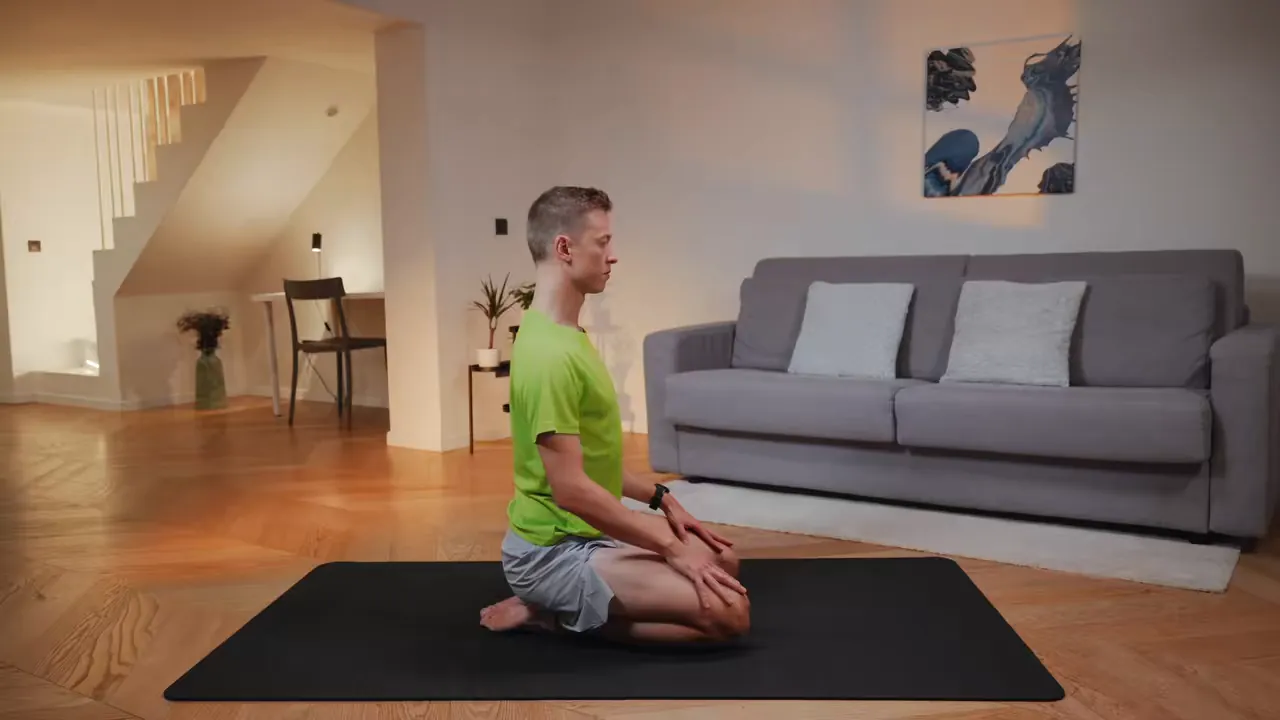
Step 1: Kneel on the mat and sit back on your heels.
Keep: Kneel on the mat and sit back on your heels.
Avoid: Staying up off your heels
-
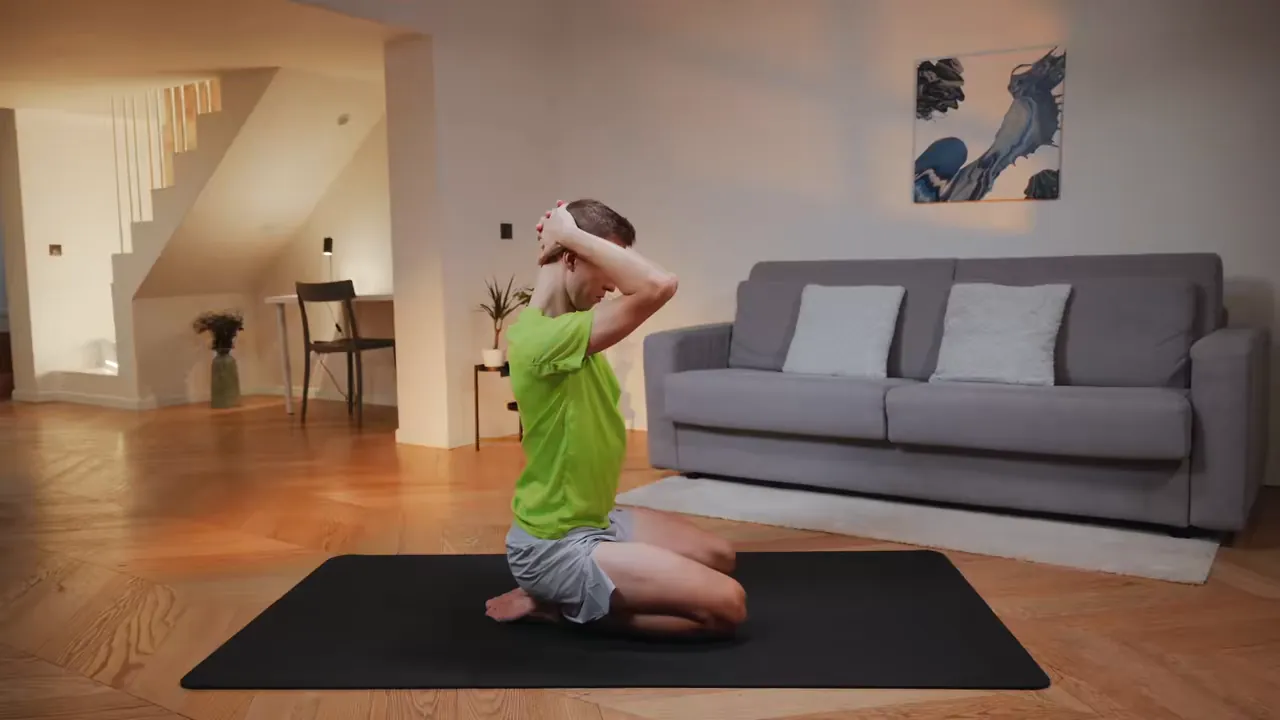
Step 2: Interlace your fingers behind your head.
Keep: Interlace your fingers behind your head. The hands rest there; they do not pull.
Avoid: Pulling with your arms
-
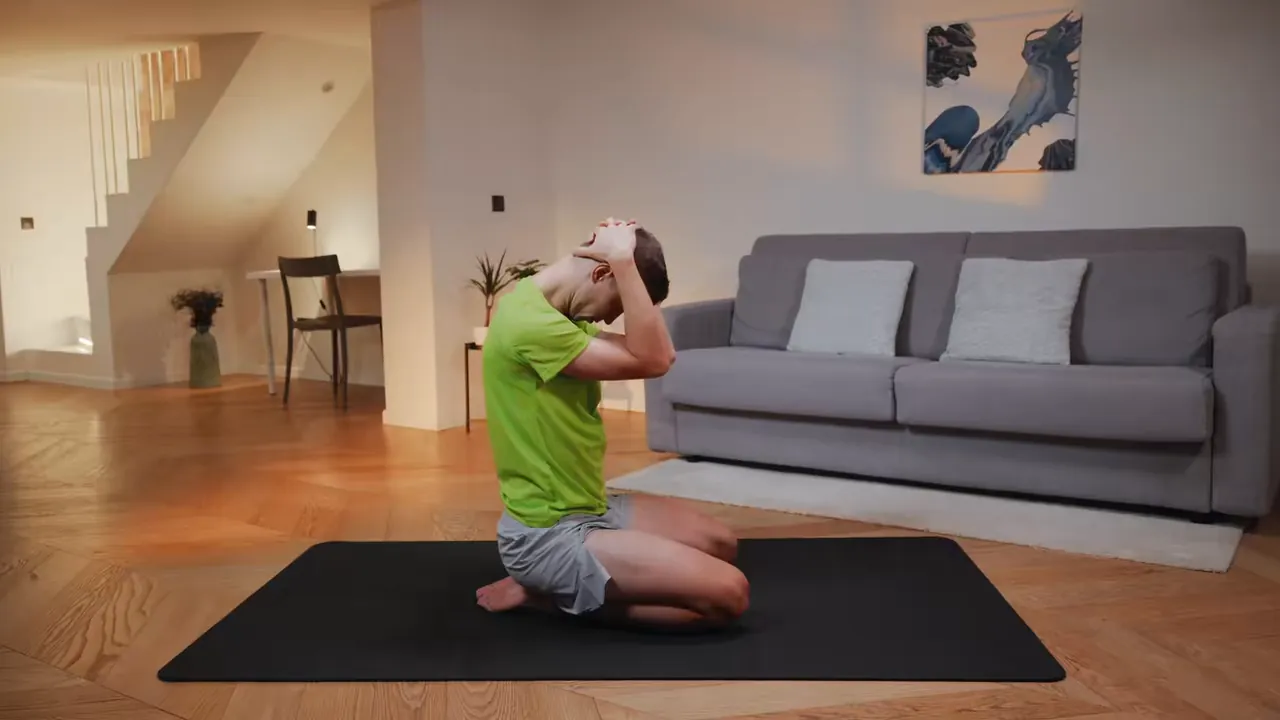
Step 3: Slowly lower your chin to your chest and let your elbows drop.
Keep: Lower your chin slowly.
Avoid: Dropping the chin quickly
Keep: Let your elbows drop.
Avoid: Holding the elbows up
-
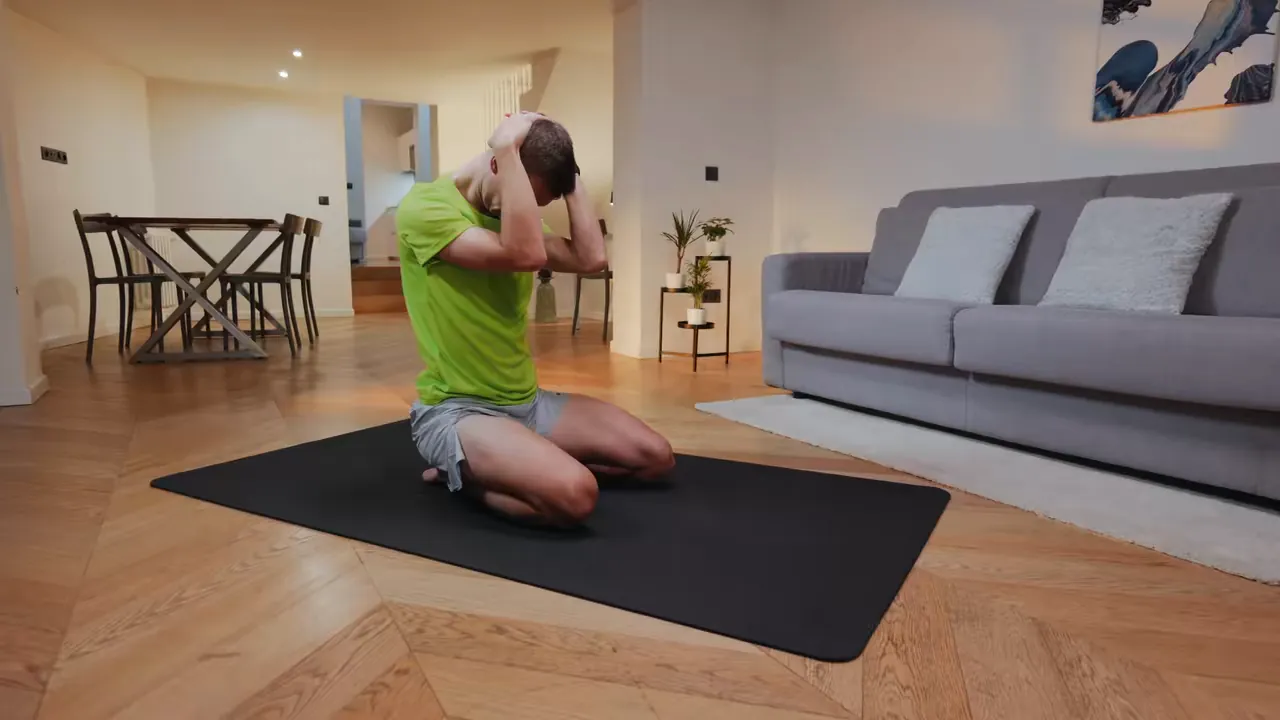
Step 4: Breathe deeply and let the weight of your hands gently lengthen the neck.
Keep: Breathe deeply and let the weight of your hands gently lengthen the neck.
Avoid: Holding your breath
Stills from the exercise video in the Bavelu app, with physiotherapist Mgr. Lukáš Kučera.
How it should feel
A gentle lengthening at the base of the skull and down the back of the neck, sometimes reaching into the top of the upper back. The steps ask you to breathe deeply, and the stretch should be calm enough to let you.
Short Neck Muscle Stretch is one of 4 exercises in Neck and Shoulders
The other three are in the app, guided on video by a physiotherapist. The whole session takes about 7 minutes.
- Short Neck Muscle Stretch On this page
- Shoulder Mobility - Thumbs Up and Down 1:38 · in the app
- Shoulders - Arc Over the Head 1:24 · in the app
- Levator Scapulae Stretch 1:47 · in the app

Many people looking for forward head posture exercises have just caught a side-on view of themselves at a laptop, chin pushed towards the screen. The exercise on this page will not undo that, and no single stretch is likely to. What it is designed to do is gently stretch the small muscles under the skull. Below is what it is for, what it should feel like, and what the trials of posture exercise actually found.
Do you need to correct forward head posture at all?
It depends on what you hope to change. A review of 15 studies found that adults with neck pain held their heads further forward than adults without it, and the further forward, the worse the pain on average. In adolescents there was no such difference. All 15 studies measured posture and pain at the same moment, so they cannot show which came first (Mahmoud et al., 2019).
Other studies point the other way. When 1,108 Australian 17-year-olds were photographed sitting, four distinct neck postures emerged, from upright to slumped with the head forward, and the odds of neck pain or headache did not differ between them (Richards et al., 2016). A group of physiotherapy researchers has argued that the common belief that pain comes from sitting “incorrectly” lacks strong evidence (Slater et al., 2019). The page on forward head posture goes through more of these studies, and Is “text neck” real? covers the phone research.
So a forward head is not a diagnosis, and it is not proof that something is wrong. If your neck is comfortable, there may be nothing to fix. If it aches, exercise is still worth doing, just with realistic expectations about posture.
What forward head posture exercises have been tested
Two recent reviews give a fair summary.
A 2026 review of ten trials with 550 people who had forward head posture and neck pain found that exercise improved the head angle by about 3.4 degrees on average compared with control groups, with lower pain scores and better neck function. Programmes that combined different types of exercise, and those lasting at least eight weeks, seemed to do better, though the authors called this exploratory and rated the certainty of the evidence low to moderate (Xing et al., 2026).
A second 2026 review pooled 28 trials with 901 people described as having upper crossed syndrome, a forward head with rounded shoulders and upper back. Corrective exercise produced large improvements in the angles of the head, shoulders and upper back. Its effects on pain, function, balance and muscle activity were inconclusive (Khorramroo et al., 2026). In other words, the posture changed more reliably than the symptoms.
The programmes in these trials ran for weeks and usually included strengthening. In one trial, 58 people with long-term neck pain were given one of two six-week neck exercise programmes. Those who trained the deep muscles at the front of the upper neck drifted forward less during a 10-minute computer task afterwards (Falla et al., 2007). That kind of training is best learned from a physiotherapist, who can check you are using the right muscles. A stretch like the one on this page is one part of a routine, not a stand-in for a programme.
What this stretch is for
The suboccipital muscles are four small muscles on each side, just under the back of the skull, joining it to the top two neck vertebrae. Together they tip the head back and turn it (TeachMeAnatomy). The app describes this exercise as a gentle stretch for these small muscles under the skull, the ones that hold the head tense after a day at a screen.
They are also linked with headaches. In a small study of 20 people with chronic tension-type headache and 20 without, active trigger points in these muscles were more common in the headache group, and those with a more forward head had headaches more often (Fernández-de-las-Peñas et al., 2006). It was a pilot study, it cannot show cause, and trigger points themselves are debated.
The steps above lower the chin slowly and let the weight of your hands lengthen the back of the neck, the opposite direction to the way these muscles tip the head back.
What it should feel like
A gentle lengthening at the base of the skull and down the back of the neck, sometimes reaching into the top of the upper back. The steps ask you to breathe deeply, and the stretch should be calm enough to let you.
Mistakes that break the steps:
- Pulling with your arms. The steps say the weight of your hands lengthens the neck. Hands resting is the point; hands pulling is not.
- Dropping the chin quickly. The chin lowers slowly.
- Holding the elbows up. The steps say to let them drop.
- Holding your breath. Deep breathing is part of the exercise.
This one is done kneeling on a mat, so it suits the start or end of the day rather than the middle of a meeting.
Habits at the screen still matter
Because posture drifts while you concentrate, a stretch at the end of the day does nothing about the hours before it. A few things work alongside it:
- Check where your head sits while you work. The wall posture test gives a rough self-check, and AirPods can track head position across a working day.
- Set up the screen. A screen that is too low or too far away can draw the head forward. See how to set up your monitor.
- Be wary of quick fixes. Our look at whether posture correctors work explains what braces and straps can and cannot do.
For more exercises aimed at posture across the whole upper body, see posture exercises.
Who should be careful
This page does not replace a doctor or a physiotherapist.
- Knees and ankles. The stretch is done kneeling and sitting back on your heels. If that position hurts your knees or ankles, do not push through it.
- A diagnosed neck condition or recent neck surgery. Follow your own healthcare professional’s advice rather than general exercises (NHS inform).
- Arm symptoms, balance problems or a severe headache. Contact your GP practice urgently, or call 111 if it is closed, if numbness, pins and needles, weakness or clumsiness in one or both arms is getting worse, if your balance or walking has changed since the neck pain started, or if neck pain comes with a severe headache (NHS inform).
- Dizziness, blurred vision or ringing in the ears with neck pain are a reason to contact your GP, and neck pain after a fall or a blow to the head or neck should be checked rather than stretched (NHS inform).
Stop if it hurts. NHS inform advises stopping neck exercises if they make your symptoms worse or cause new pain, and stopping straight away if you feel unwell. If a new neck problem has not improved within 8 weeks, talk to a healthcare professional (NHS inform).
The rest of the Neck and Shoulders session
In the app, the Short Neck Muscle Stretch is part of the Neck and Shoulders session, along with two shoulder exercises, Shoulder Mobility - Thumbs Up and Down and Shoulders - Arc Over the Head, and the Levator Scapulae Stretch. The whole session takes under seven minutes.
Bavelu’s sessions are designed and filmed by physiotherapists and guided on video in the app, and its posture tracking uses your AirPods to notice when your head leans forward and let you know. It does not promise to change your posture. It offers a prompt when you drift, and something short and guided to do about it.
Questions people ask
Can exercises fix forward head posture?
Exercise programmes have changed the measured head angle in trials, by about 3 degrees on average in one 2026 review. Whether that change is what reduces neck pain is not established, and a review of 28 trials found posture improved while the effects on pain and function were inconclusive. No single stretch should be expected to change your posture.
What exercises were used in forward head posture trials?
Mostly programmes lasting several weeks, often including training of the deep muscles at the front of the upper neck, and in many cases combining strengthening with stretching. A 2026 review found that combined programmes and those lasting at least eight weeks seemed to do better. A physiotherapist can teach the strengthening part properly.
Where should I feel this stretch?
At the base of the skull and down the back of the neck, sometimes into the top of the upper back. It should feel like a gentle lengthening from the weight of your hands, not a pull, and never a sharp pain.
Does forward head posture cause neck pain?
It is not proven. Adults with neck pain tend to hold their heads further forward than adults without it, but those studies measured both at one moment and cannot show which came first. A study of 1,108 Australian 17-year-olds found that the odds of neck pain did not differ between posture types.
Terms on this page
Sources
- Mahmoud NF et al. The relationship between forward head posture and neck pain: a systematic review and meta-analysis. Current Reviews in Musculoskeletal Medicine, 2019.
- Richards KV et al. Neck posture clusters and their association with biopsychosocial factors and neck pain in Australian adolescents. Physical Therapy, 2016.
- Slater D et al. "Sit up straight": time to re-evaluate. Journal of Orthopaedic & Sports Physical Therapy, 2019.
- Xing Y et al. Therapeutic exercise for forward head posture in neck pain patients: a systematic review and meta-analysis. Journal of Pain Research, 2026.
- Khorramroo F, Rostami M, Bafrouei MJ. Corrective exercises strongly improve posture but fail to produce consistent clinical or functional benefits in patients with upper crossed syndrome: a systematic review and meta-analysis of randomized controlled trials. BMC Sports Science, Medicine and Rehabilitation, 2026.
- Falla D et al. Effect of neck exercise on sitting posture in patients with chronic neck pain. Physical Therapy, 2007.
- TeachMeAnatomy. The suboccipital muscles.
- Fernández-de-las-Peñas C et al. Trigger points in the suboccipital muscles and forward head posture in tension-type headache. Headache, 2006.
- NHS inform. Neck problems.
- NHS inform. Exercises for neck problems.
This page explains a topic in general terms. It is not a diagnosis and does not replace a doctor or physiotherapist. If something hurts badly, keeps getting worse or comes with numbness, weakness or fever, see a doctor.