Exercises · Neck
Levator scapulae stretch you can do at your desk
The levator scapulae runs from the top of the neck to the upper corner of the shoulder blade, the spot many desk workers rub at the end of the day. This seated stretch is from the app's Stiff Neck session.
Levator Scapulae Stretch
A stretch for the muscle between neck and shoulder blade, where tension builds most.
- 1:47
- On a chair
- Neck
- Shoulders
Move slowly. Stop if it hurts, or if you feel tingling or numbness.
-
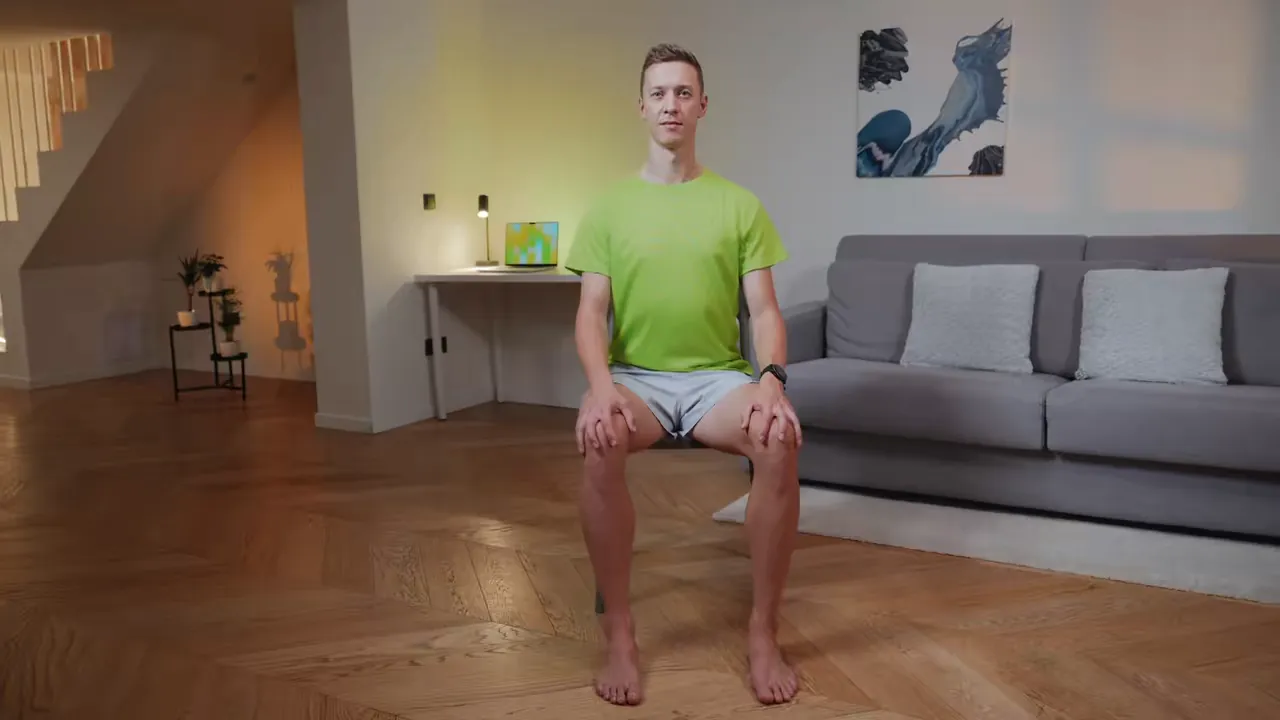
Step 1: Sit tall and hold the chair with one hand.
Keep: Sit tall, with one hand holding the chair. The stretch starts from there.
Avoid: Slumping
Keep: Keep holding the chair, so that shoulder does not ride up towards your ear.
Avoid: Letting go of the chairIf the shoulder rides up, the shoulder blade moves closer to the neck and there is less of a stretch.
-
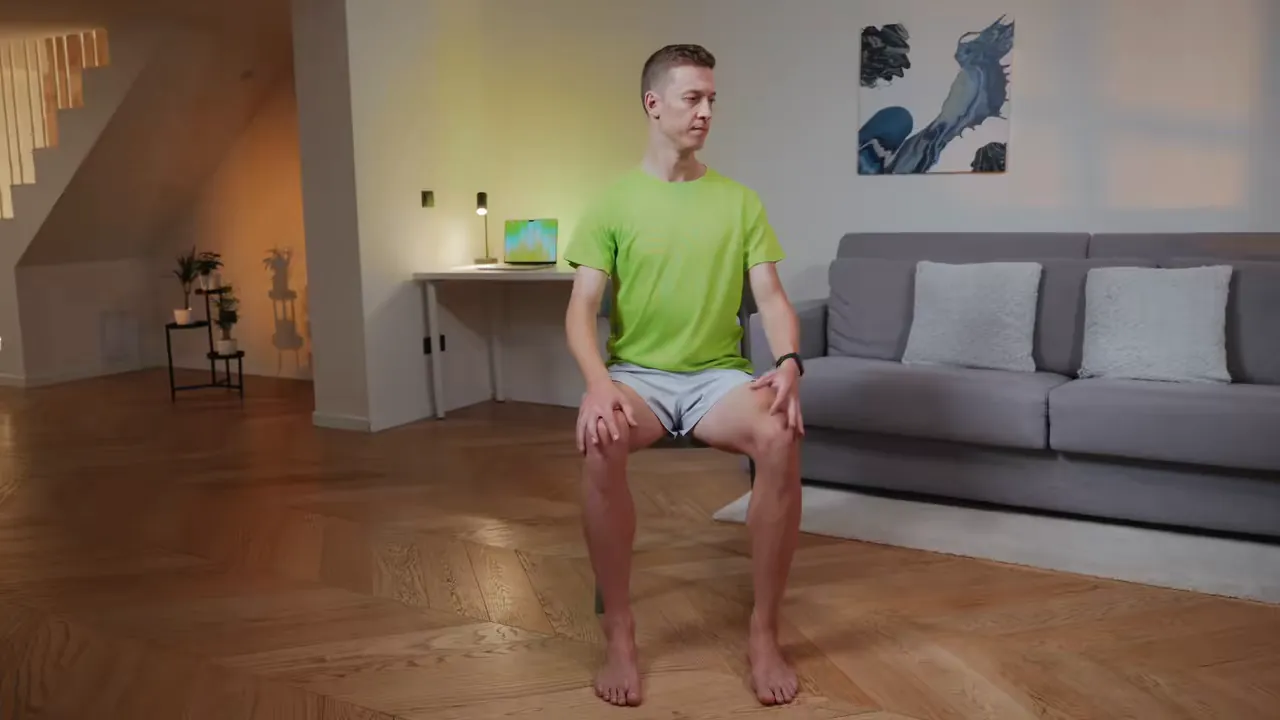
Step 2: Turn your head and lower your nose towards your armpit.
Keep: Turn your head and lower your nose towards your armpit, as the step says.
Avoid: Tilting instead of turningWithout the turn and the lowered nose, it becomes the trapezius stretch.
-
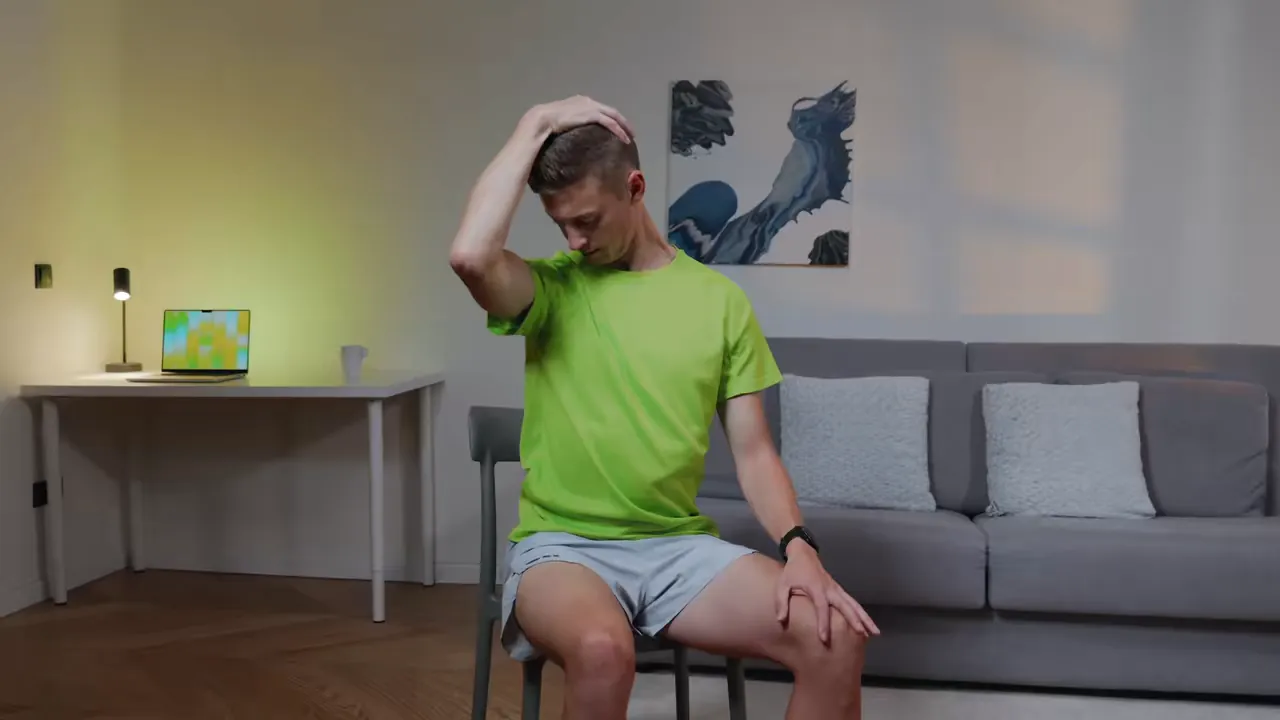
Step 3: Gently deepen it with the other hand.
Keep: The other hand only deepens the stretch gently. It adds a little, it does not haul the head down.
Avoid: Pulling hard with the hand
-
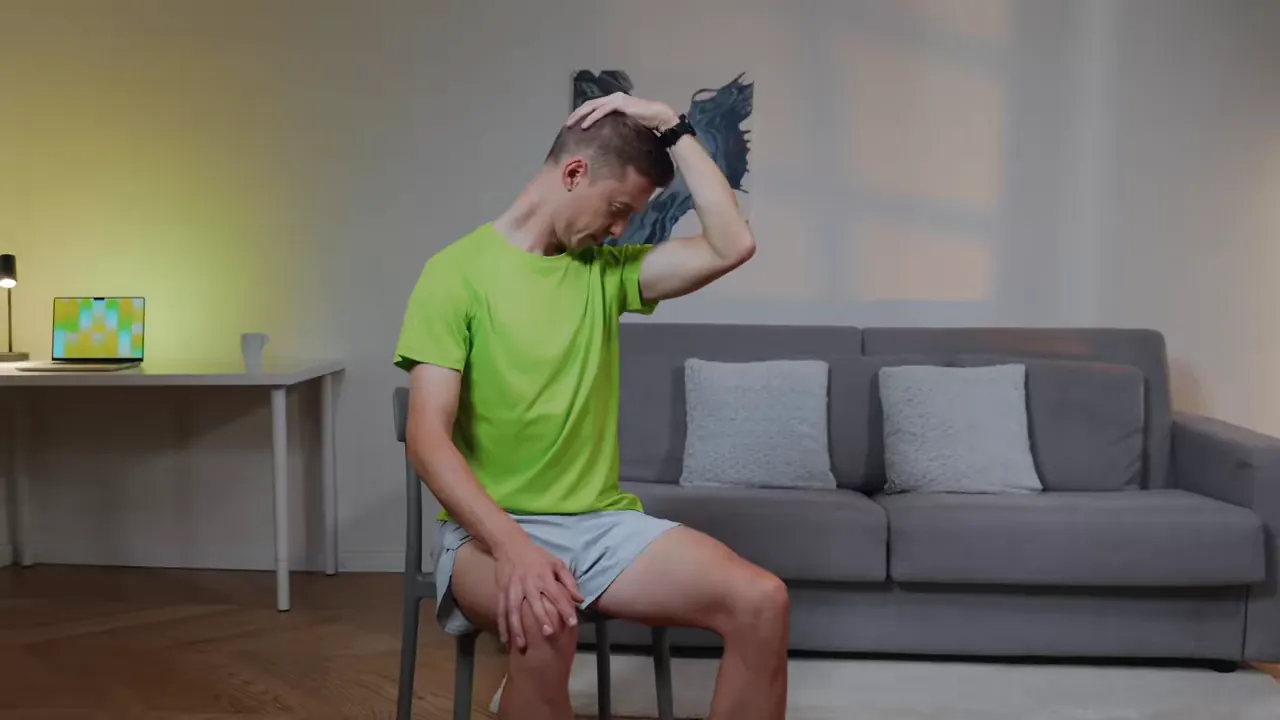
Step 4: Hold, then switch sides.
Keep: Hold, then switch sides, as the last step says.
Avoid: Skipping the second side
Stills from the exercise video in the Bavelu app, with physiotherapist Mgr. Lukáš Kučera.
How it should feel
You should feel a gentle stretch at the back and side of the neck, running down towards the top corner of the shoulder blade, on the side away from the armpit you are looking towards. That is the side whose hand is holding the chair. Then you switch.
Gentle pullRight
A gentle stretch at the back and side of the neck, running down towards the top corner of the shoulder blade.
Sharp pain, tingling or numbnessStop
Sharp pain, or pain, tingling or numbness that travels into the arm or hand, is a reason to stop.
Levator Scapulae Stretch is one of 3 exercises in Stiff Neck
The other 2 are in the app, guided on video by a physiotherapist. The whole session takes about 5 minutes.
- Trapezius Stretch 1:43 · in the app
- Levator Scapulae Stretch On this page
- Neck Half Circles 1:27 · in the app

A levator scapulae stretch is aimed at the band between the neck and the top of the shoulder blade, the place the app describes as where tension builds most. The version on this page is done sitting on a chair, with one hand holding the seat, so it fits into a working day at your desk.
Here is what the muscle is, why the stretch involves a turn as well as a lowered head, how it differs from the more familiar trapezius stretch, and what the small amount of research on it shows.
What the levator scapulae is
The levator scapulae is a strap-like muscle at the side and back of the neck. It starts on the side projections of the top four neck vertebrae, C1 to C4, and runs down to the inner edge of the shoulder blade, from its top corner to where the bony ridge of the shoulder blade begins (Kenhub).
Its main job is to lift the shoulder blade and help hold it steady. Working on one side, it bends the neck towards that side, and working on both sides, it helps tip the neck back (Kenhub). Because it ties the cervical spine to the shoulder blade, and bends the neck backwards and towards its own side, a stretch for it takes the head the other way: forwards and away. The steps above do that with a turn and a lowered nose, while holding the chair stops that shoulder from rising with the head.
Levator scapulae stretch or trapezius stretch?
The two are easy to mix up, and both are in the app’s Stiff Neck session.
- The trapezius stretch is a plain sideways tilt, ear towards shoulder. It works on the upper trapezius, which runs from the back of the skull to the outer end of the collarbone and turns the head to the opposite side as well as bending it to the same side (Kenhub). You feel it along the side of the neck and over the top of the shoulder.
- The levator scapulae stretch adds a turn of the head and a downward look towards the armpit. You feel it further back and lower, in the band running down to the top inner corner of the shoulder blade.
If you only tilt and forget to turn and look down, you are doing the trapezius stretch instead.
What it should feel like
You should feel a gentle stretch at the back and side of the neck, running down towards the top corner of the shoulder blade, on the side away from the armpit you are looking towards. That is the side whose hand is holding the chair. Then you switch.
The other hand only deepens the stretch gently, as the steps say, and the stretch should stay gentle. Sharp pain, or pain, tingling or numbness that travels into the arm or hand, is a reason to stop.
Mistakes that break the steps
- Slumping. The first step is to sit tall, and the stretch starts from there.
- Letting go of the chair. If that shoulder rides up towards your ear, the shoulder blade moves closer to the neck and there is less of a stretch to feel.
- Tilting instead of turning. Without the turn and the lowered nose, it becomes the trapezius stretch.
- Pulling hard with the hand. The step says to deepen it gently. The hand adds a little, it does not haul the head down.
- Skipping the second side. The last step is to switch sides.
What the research says about this stretch
There is very little research on the levator scapulae stretch itself, and none of it shows that it eases neck pain over time.
One small lab study compared stretching the muscle in three positions: sitting, on all fours and lying face down. The 24 university students had been assessed as having a shortened levator scapulae. Measured straight afterwards, the seated stretch improved a measure of the muscle’s length and the range of neck movement, and the authors concluded it was the most effective of the three positions (Jeong et al., 2017). That supports doing it on a chair, but the study looked at one session in young people and measured nothing about pain.
The tight feeling is also less straightforward than it seems. Two ultrasound studies found no difference in levator scapulae stiffness between people with long-term neck pain and people without (Varol et al., 2024; Valera-Calero et al., 2025). The tightness you feel is real, but it may say more about a sensitive area than about a short muscle. The glossary page has more on those studies.
For neck pain in general, a Cochrane review of 27 trials found that stretching on its own may not change pain, while strengthening of the neck, shoulders and upper back had moderate-quality support (Gross et al., 2015). Do stretches help neck pain from desk work? looks at those trials in detail.
Who should be careful
Not every pain near the shoulder blade is a muscle that needs stretching, and this page does not replace a doctor or a physiotherapist.
- Pain that spreads into the arm. Pain above the shoulder blade can come from a compressed nerve root in the neck. In 50 people who had surgery for this, pain above the shoulder blade most often came from the C5 or C6 nerve root, and in 70% the neck or shoulder blade pain came before the arm symptoms (Tanaka et al., 2006). If the ache comes with pain, pins and needles or numbness in the arm or hand, see a GP before stretching it.
- Worsening arm symptoms, balance problems or a severe headache. Contact your GP practice urgently, or call 111 if it is closed, if numbness, pins and needles, weakness or clumsiness in one or both arms is getting worse, if your balance or walking has changed since the neck pain started, or if neck pain comes with a severe headache (NHS inform).
- A recent injury, a diagnosed neck condition or recent neck surgery. Get an injury checked first, and after surgery or a diagnosis, follow your own healthcare professional’s advice (NHS inform).
- Dizziness, blurred vision or ringing in the ears with neck pain are a reason to contact your GP (NHS inform).
Stop if it hurts. NHS inform advises stopping neck exercises if they make your symptoms worse or cause new pain, and stopping straight away if you feel unwell (NHS inform). See a GP if neck pain or stiffness has not gone after a few weeks (NHS). Other causes of pain in this area are covered in pain between the shoulder blades, shoulder pain from computer work and neck pain from desk work.
The rest of the Stiff Neck session
In the app, this stretch is part of the Stiff Neck session, about five minutes on a chair, alongside the Trapezius Stretch and Neck Half Circles, a slow movement covered in stretches for a stiff neck. It also appears in the Neck Release and Neck and Shoulders sessions.
Like all of Bavelu’s sessions, it was designed and filmed by physiotherapists led by Mgr. Lukáš Kučera, and the app guides you through it on video. If the spot by your shoulder blade keeps aching, that is worth a physiotherapist’s assessment rather than more stretching.
Questions people ask
Where should I feel a levator scapulae stretch?
At the back and side of the neck, running down towards the top inner corner of the shoulder blade, on the side away from the armpit you are looking towards. That is the side whose hand holds the chair. It should be a gentle stretch, with nothing sharp and nothing spreading into the arm.
What is the difference between a levator scapulae stretch and a trapezius stretch?
The trapezius stretch is a sideways tilt of the ear towards the shoulder. The levator scapulae stretch adds a turn of the head and a downward look towards the armpit, so the stretch is felt further back, towards the shoulder blade. Both are in the app's Stiff Neck session.
Is it better to stretch the levator scapulae sitting or lying down?
A small lab study of 24 university students compared three positions and concluded that sitting was the most effective for immediate changes in a measure of the muscle's length and in neck movement. It measured only the moments after one stretch, not pain over time.
Why does the top of my shoulder blade still hurt after stretching?
Pain at that spot does not always come from a tight muscle. Ultrasound studies have found no difference in levator scapulae stiffness between people with and without long-term neck pain, and pain above the shoulder blade can come from a nerve root in the neck. If it persists or spreads into the arm, see a GP or physiotherapist.
Terms on this page
- Levator scapulaeThe strap-like muscle from the side of the neck to the upper corner of the shoulder blade.
- TrapeziusThe large muscle over the back of the neck and shoulders, and the most common seat of desk-work neck tension.
- Cervical spineThe seven vertebrae of the neck, C1 to C7, from the base of the skull to the top of the chest.
Sources
- Kenhub. Levator scapulae muscle.
- Kenhub. Trapezius muscle.
- Jeong HJ et al. Stretching position can affect levator scapular muscle activity, length, and cervical range of motion in people with a shortened levator scapulae. Physical Therapy in Sport, 2017.
- Varol U et al. Levator scapulae stiffness measurement reliability in individuals with and without chronic neck pain by experienced and novel examiners. Sensors, 2024.
- Valera-Calero JA et al. Association among clinical severity indicators, psychological health status and elastic properties of neck muscles in patients with chronic mechanical neck pain. European Spine Journal, 2025.
- Tanaka Y et al. Cervical roots as origin of pain in the neck or scapular regions. Spine, 2006.
- Gross A et al. Exercises for mechanical neck disorders. Cochrane Database of Systematic Reviews, 2015.
- NHS inform. Neck problems.
- NHS inform. Exercises for neck problems.
- NHS. Neck pain.
This page explains a topic in general terms. It is not a diagnosis and does not replace a doctor or physiotherapist. If something hurts badly, keeps getting worse or comes with numbness, weakness or fever, see a doctor.