Exercises · Upper back
Posture exercises for people who sit all day
There is no single correct posture to train yourself into. Exercise can make your back stronger and help you move easily between positions, which is a more honest goal than fixing your shape.
Sea Lion
A backbend lying on your front that strengthens the muscles along the spine and opens the chest.
- 2:26
- On a mat
- Upper Back
- Chest
Move slowly. Stop if it hurts, or if you feel tingling or numbness.
-
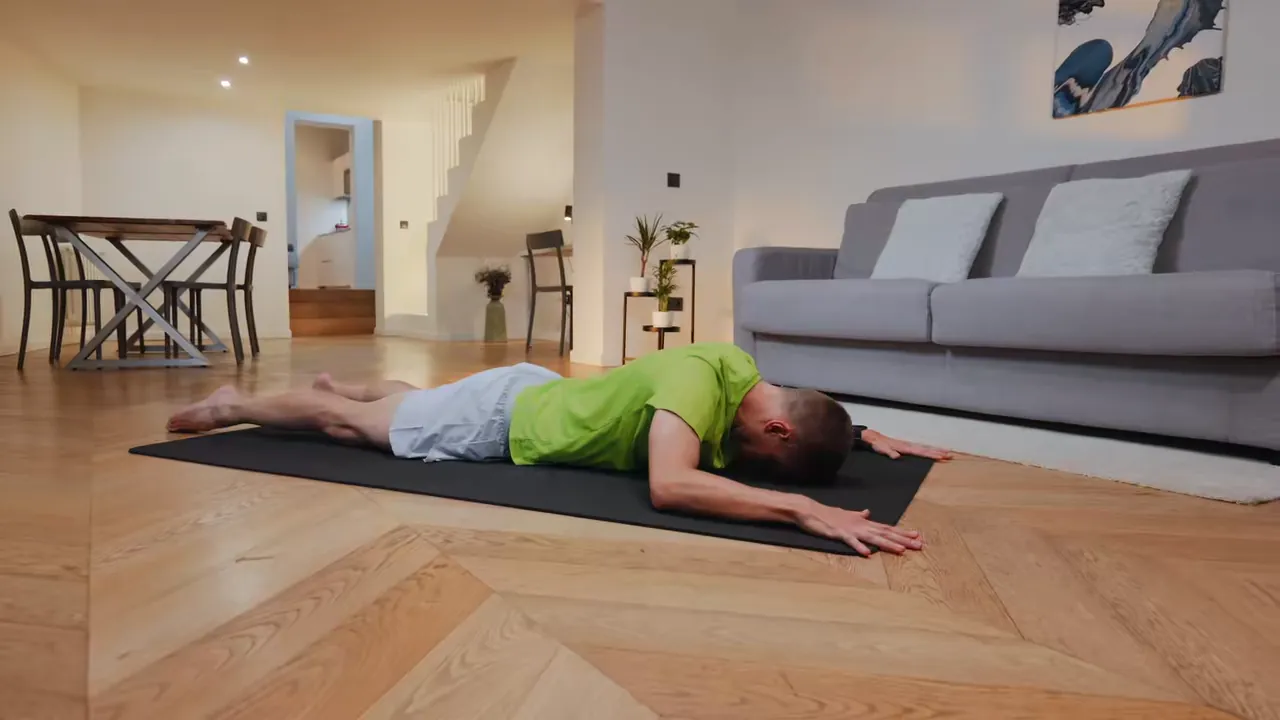
Step 1: Lie on your front with your arms along your body.
Keep: Lie on your front with your arms along your body.
Avoid: Arms away from your sides
-
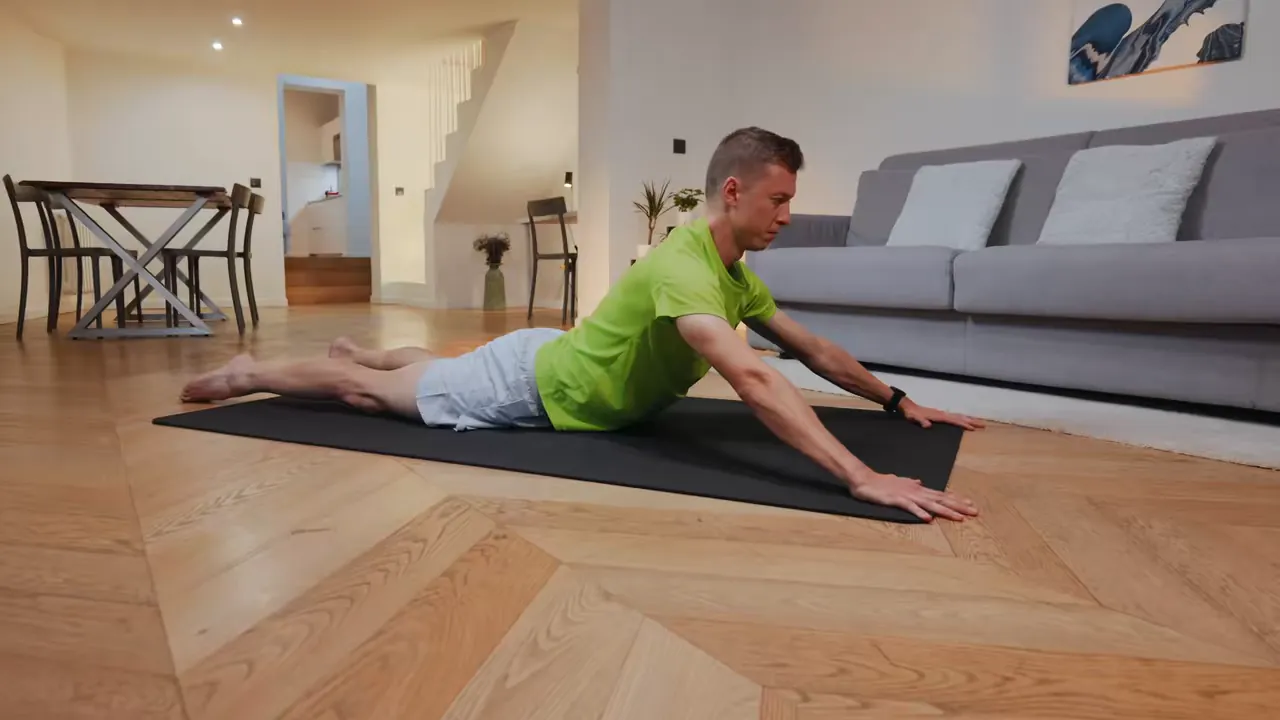
Step 2: Breathe in and lift your chest and arms off the mat.
Keep: Lift your chest and arms off the mat on a breath in.
Avoid: Holding your breath
-
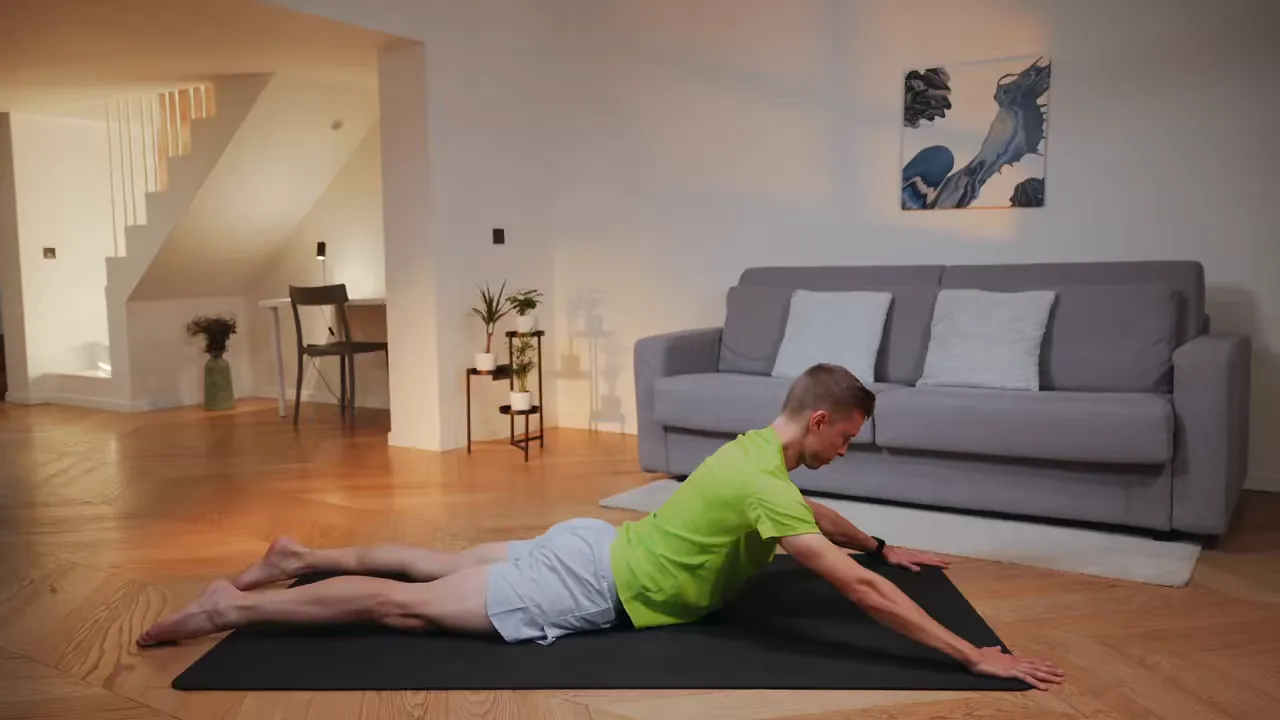
Step 3: Draw your shoulder blades together and keep your gaze down.
Keep: Draw your shoulder blades together as you lift.
Avoid: Forgetting the shoulder blades
Keep: Keep your gaze down.
Avoid: Looking up or ahead
-
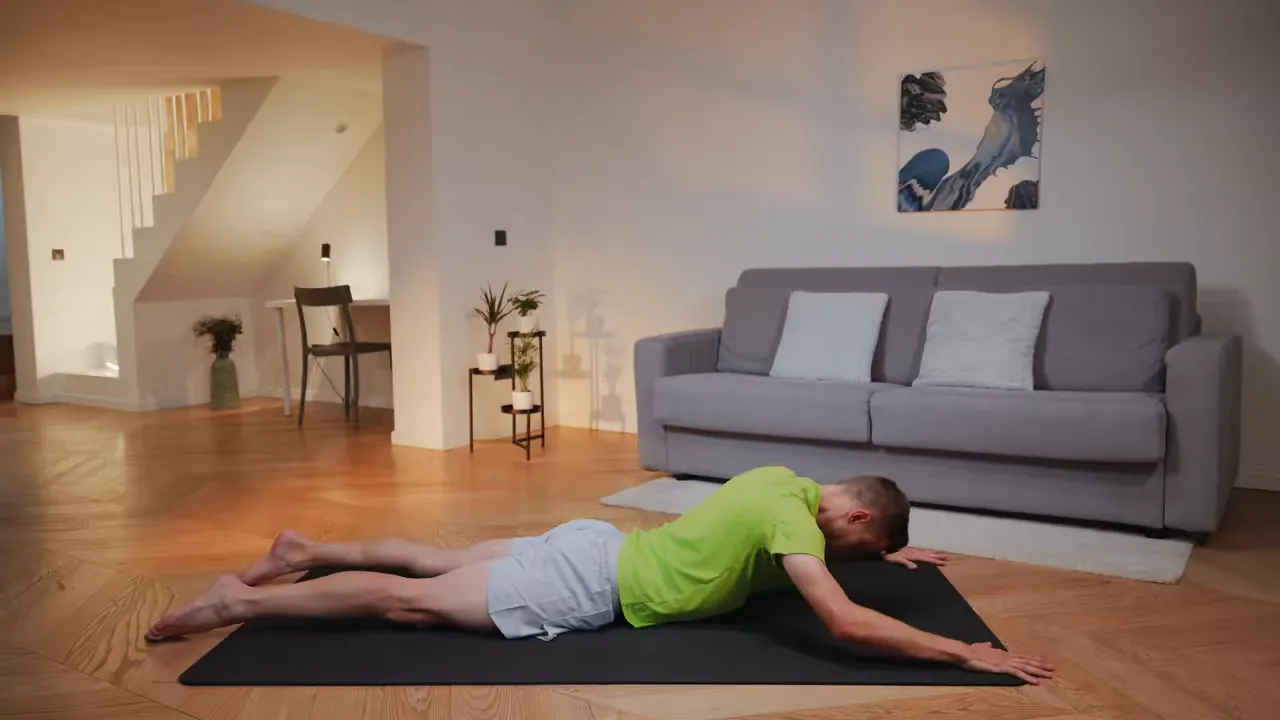
Step 4: Breathe out and lower down slowly.
Keep: Breathe out and lower down slowly.
Avoid: Dropping down
Stills from the exercise video in the Bavelu app, with physiotherapist Mgr. Lukáš Kučera.
How it should feel
Gentle pullRight
You should feel the muscles along your back and between your shoulder blades working; it is effort, not pain.
Sharp pain, tingling or numbnessStop
A pinch in the lower back, or pain or tingling running into a leg, is a reason to stop.
Sea Lion is one of 4 exercises in Chest Opener
The other three are in the app, guided on video by a physiotherapist. The whole session takes about 8 minutes.
- Sphinx 2:04 · in the app
- Cobra 2:20 · in the app
- Sea Lion On this page
- Shoulders - Arc Over the Head 1:24 · in the app

Most posture exercises come with a promise to fix the way you sit or stand. That promise runs ahead of the evidence. There is no single correct posture to train yourself into, and the link between posture and pain is weaker than the posture industry suggests. What exercise can do is strengthen the muscles that hold you up and help you move easily between positions, which is a more honest goal.
The exercise on this page, the Sea Lion, comes from the app’s Chest Opener session. It is a backbend lying on your front, which the app describes as strengthening the muscles along the spine and opening the chest. The steps above are the app’s own.
Is there a correct posture?
Not one that the research can point to.
- Physiotherapists’ own professional body says no. The Chartered Society of Physiotherapy puts it plainly: “There is no perfect posture or right or wrong desk set up.” The key, it says, is to keep moving: “Your best posture is your next posture!” (CSP)
- Physiotherapists do not agree on one ideal. In a survey, 544 physiotherapists in Greece picked the best sitting posture from seven options. Between them, three different postures took 97.5% of the votes, mostly versions of sitting upright with a curve in the lower back. The authors noted that there is no strong evidence that any specific posture leads to better health (Korakakis et al., 2019).
- The shape of the spine and pain. A review of 54 studies found no strong evidence that the curves of the spine, seen from the side, are linked with any health outcome, spinal pain included. Most of the studies were of low quality (Christensen & Hartvigsen, 2008).
None of this makes posture meaningless. A rounded upper back and forward head posture are real and measurable, and both pages explain what is known about them. But “straighter” and “less pain” are two different goals. For braces and straps that hold you in one position, see Do posture correctors work?, and for the debate about phones and necks, Is “text neck” real?
What posture exercises can and cannot change
Exercise can change how you measure. Whether that changes how you feel is less clear.
- The upper back curve. A meta-analysis of ten randomised trials with 539 participants found that exercise programmes reduced the forward curve of the upper back in the seven trials that measured it, with no clear effect on the curve of the lower back. The authors suggested that strengthening, rather than stretching, may matter more for the upper back curve, and called for more trials (González-Gálvez et al., 2019).
- Angles versus pain. A 2026 meta-analysis pooled 28 trials with 901 people with upper crossed syndrome, the pattern of a forward head and rounded shoulders. Corrective exercise produced large improvements in the angles of the head, shoulders and upper back, but its effects on pain, function, muscle activity and balance were inconclusive (Khorramroo et al., 2026).
So exercise can shift the angles, and that shift did not reliably bring less pain. A more useful aim is a back that is strong enough to hold you comfortably in many positions and moves easily between them.
What the Sea Lion is designed to do
Many stretches take you into a position and let you rest there. The Sea Lion is different: the muscles along your spine, the erector spinae, lift your chest and arms off the mat, which is why the app describes it as strengthening. That puts it on the strengthening side of the line drawn by the review above, although we found no trial of the Sea Lion itself.
You should feel the muscles along your back and between your shoulder blades working as you lift, and the front of your chest opening. It is effort, not pain. A pinch in the lower back, or pain or tingling running into a leg, is a reason to stop.
Each of these mistakes breaks one of the steps above:
- Looking up or ahead. The step says to keep your gaze down.
- Holding your breath. You lift on a breath in and lower on a breath out.
- Forgetting the shoulder blades. The step asks you to draw them together as you lift.
- Dropping down. The last step says to lower down slowly.
Habits that matter more than any one exercise
If there is no single correct posture, the habit worth building is changing position often. The CSP suggests taking regular breaks to move, setting an alarm to remind you, and getting away from your desk for phone calls (CSP). The guide to microbreaks looks at how often to move.
If you are curious about your own alignment, the wall posture test is a simple self-check, not a diagnosis. For the neck in particular, see forward head posture exercises.
Who should be careful
Skip this exercise, or check with a doctor, physiotherapist or midwife first, if any of these apply.
- Pregnancy. The Sea Lion is done lying on your front. The NHS advises listening to your body in pregnancy and notes that, as your bump grows, you may find it more comfortable to switch to different types of exercise. If you have a health condition, speak to your midwife about which activities are safe for you (NHS).
- A recent back injury or back surgery.
- Back pain that spreads into a leg, or comes with numbness, tingling or weakness. Get it checked first. Call 999 or go to A&E if back pain comes with pain, tingling, weakness or numbness in both legs, loss of feeling around the genitals or anus, or changes in bladder or bowel control (NHS).
- Osteoporosis or spinal fractures. The UK consensus statement on exercise for osteoporosis recommends spinal extension exercise to improve posture (Brooke-Wavell et al., 2022). But the Royal Osteoporosis Society advises seeing a physiotherapist if you have spinal fractures that are causing pain or other symptoms (ROS).
Whatever the reason, stop if it hurts. NHS advice on exercises and stretches for back pain is to stop if the pain gets worse and see a GP (NHS).
The rest of the Chest Opener session
In the app, the Sea Lion is the third of four exercises in the Chest Opener session, which takes about eight minutes. Before it come the Sphinx and the Cobra, and after it Shoulders - Arc Over the Head.
Bavelu’s sessions are designed and filmed by physiotherapists, led by Mgr. Lukáš Kučera, and the whole session is guided on video in the app. With AirPods, the app also notices when your head leans forward and lets you know: a cue to move, not a position to hold. How AirPods can track your head posture explains what the sensor can and cannot see.
Questions people ask
Can exercises fix bad posture?
Exercise programmes have changed measured posture in trials, such as the angle of the head or the curve of the upper back. But in people with upper crossed syndrome, those changes did not reliably come with less pain or better function. There is also no single correct posture to aim for.
What is the best exercise for posture?
No single exercise has been shown to be the best. A review of trials on the upper back curve suggested strengthening may matter more than stretching, and physiotherapists' advice is also to change position often. The Chartered Society of Physiotherapy puts it as: your best posture is your next posture.
Does bad posture cause back pain?
The evidence for that is weak. A review of 54 studies found no strong evidence that the curves of the spine are linked with spinal pain, and even physiotherapists disagree about which sitting posture is best. Long hours in any one position are a more useful thing to change.
Can I do the Sea Lion when pregnant?
It is done lying on your front, which gets harder as the bump grows. The NHS advises listening to your body in pregnancy and notes that you may find it more comfortable to switch to different types of exercise. Speak to your midwife about what is safe for you.
Terms on this page
Sources
- Chartered Society of Physiotherapy. Working from home: easy exercises. Last reviewed 7 May 2019.
- Korakakis V et al. Physiotherapist perceptions of optimal sitting and standing posture. Musculoskeletal Science and Practice, 2019.
- Christensen ST, Hartvigsen J. Spinal curves and health: a systematic critical review of the epidemiological literature dealing with associations between sagittal spinal curves and health. Journal of Manipulative and Physiological Therapeutics, 2008.
- González-Gálvez N, Gea-García GM, Marcos-Pardo PJ. Effects of exercise programs on kyphosis and lordosis angle: a systematic review and meta-analysis. PLOS ONE, 2019.
- Khorramroo F, Rostami M, Bafrouei MJ. Corrective exercises strongly improve posture but fail to produce consistent clinical or functional benefits in patients with upper crossed syndrome: a systematic review and meta-analysis of randomized controlled trials. BMC Sports Science, Medicine and Rehabilitation, 2026.
- NHS. Exercise in pregnancy. Last reviewed 24 September 2026.
- NHS. Back pain. Last reviewed 5 March 2026.
- Brooke-Wavell K et al. Strong, steady and straight: UK consensus statement on physical activity and exercise for osteoporosis. British Journal of Sports Medicine, 2022.
- Royal Osteoporosis Society. How to exercise safely for bones. Last reviewed 1 June 2026.
This page explains a topic in general terms. It is not a diagnosis and does not replace a doctor or physiotherapist. If something hurts badly, keeps getting worse or comes with numbness, weakness or fever, see a doctor.