Exercises · Neck
Stretches for a stiff neck you can do sitting down
When your neck feels stiff, gentle movement is usually the advice, not keeping it still. This slow seated exercise from the app's Stiff Neck session is designed to loosen it without tipping your head back.
Neck Half Circles
Slow half circles of the head while seated to loosen a stiff neck.
- 1:27
- On a chair
- Neck
Move slowly. Stop if it hurts, or if you feel tingling or numbness.
-
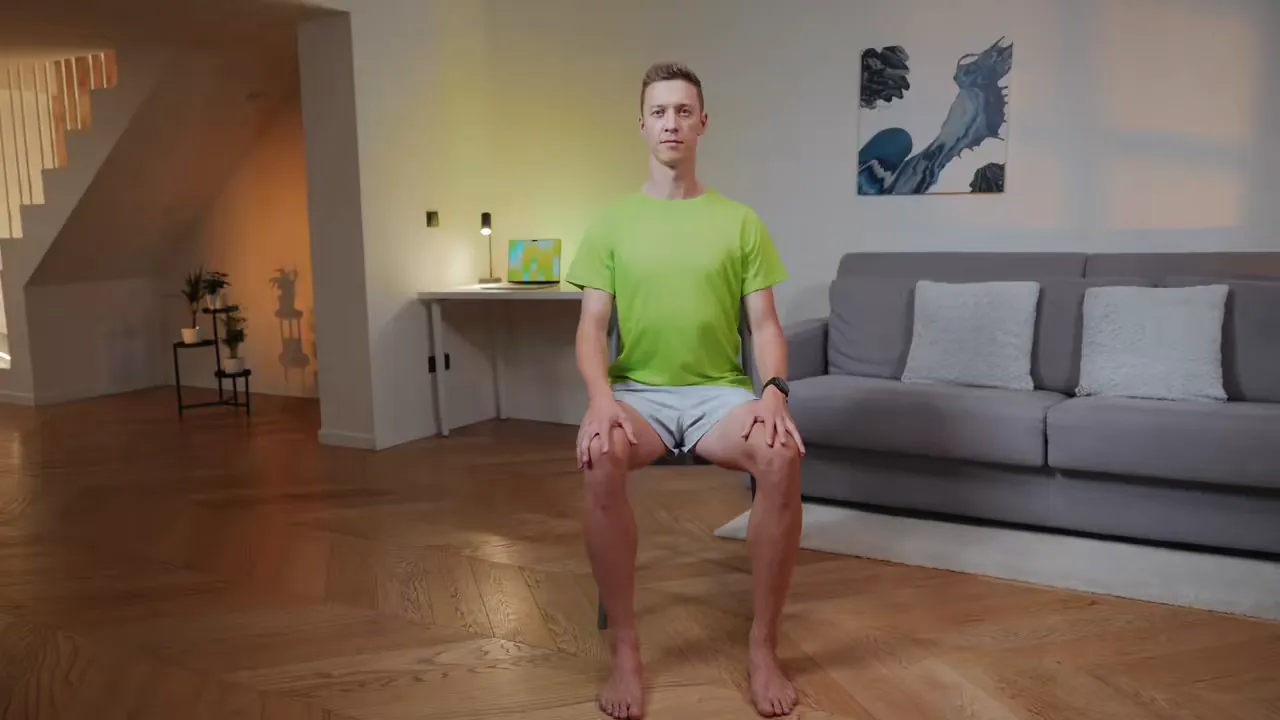
Step 1: Sit upright on a chair.
Keep: Sit upright on the chair. The movement starts from there.
Avoid: Slumping
-
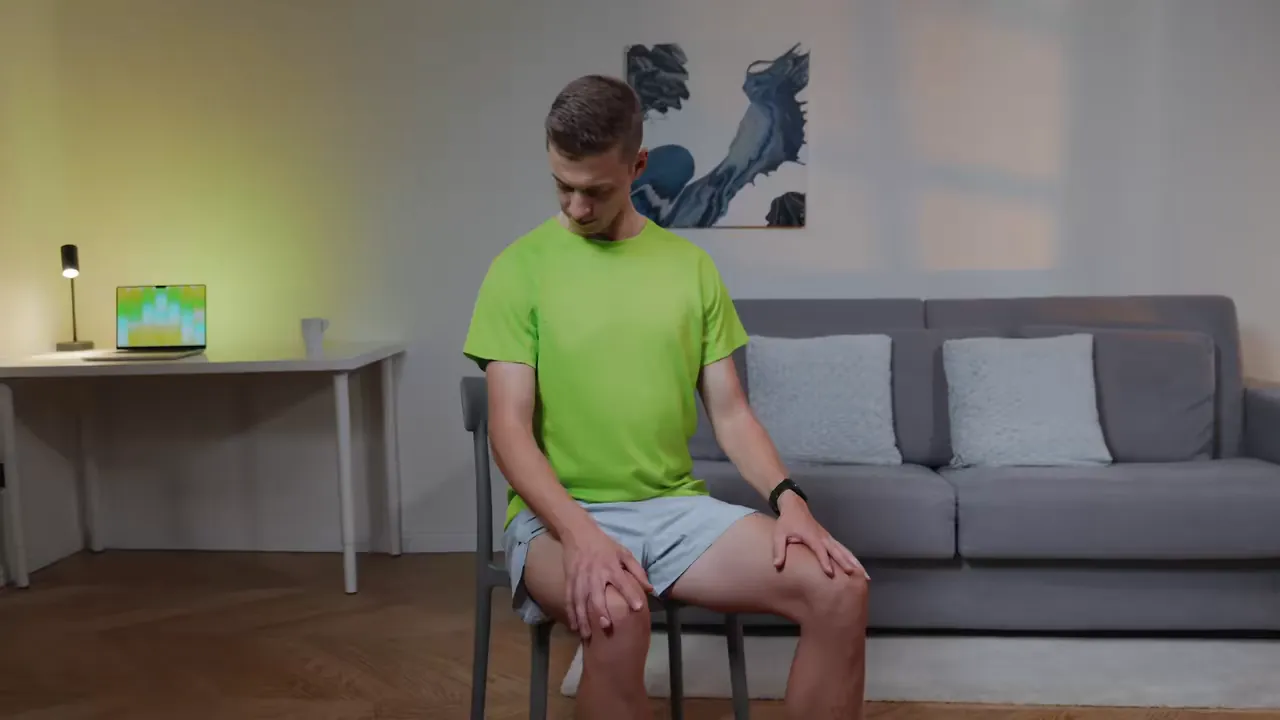
Step 2: Lower your chin to your chest.
Keep: The chin lowers towards the chest, but it is never pushed into pain.
Avoid: Forcing the chin down
-
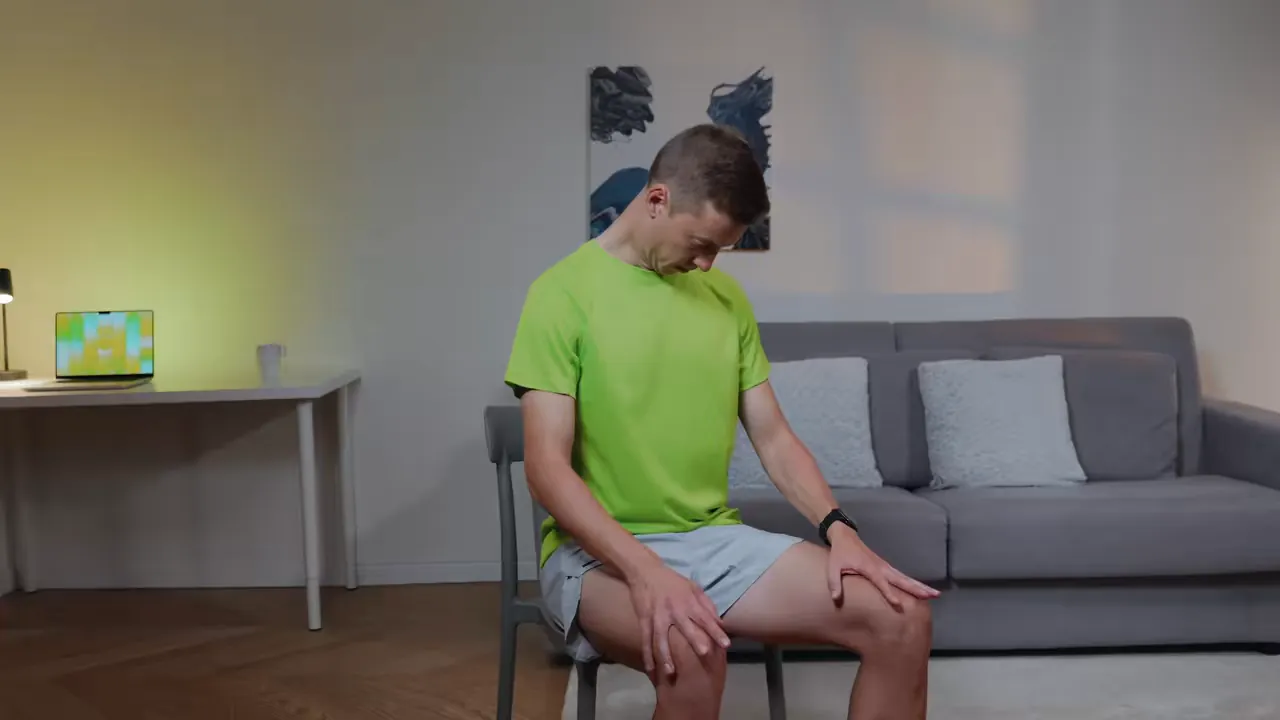
Step 3: Slowly roll your head across the front from one shoulder to the other.
Keep: Roll the head slowly and smoothly across the front, from one shoulder to the other.
Avoid: Going too fastSpeed turns it into a swing, which is not what the steps ask for.
-
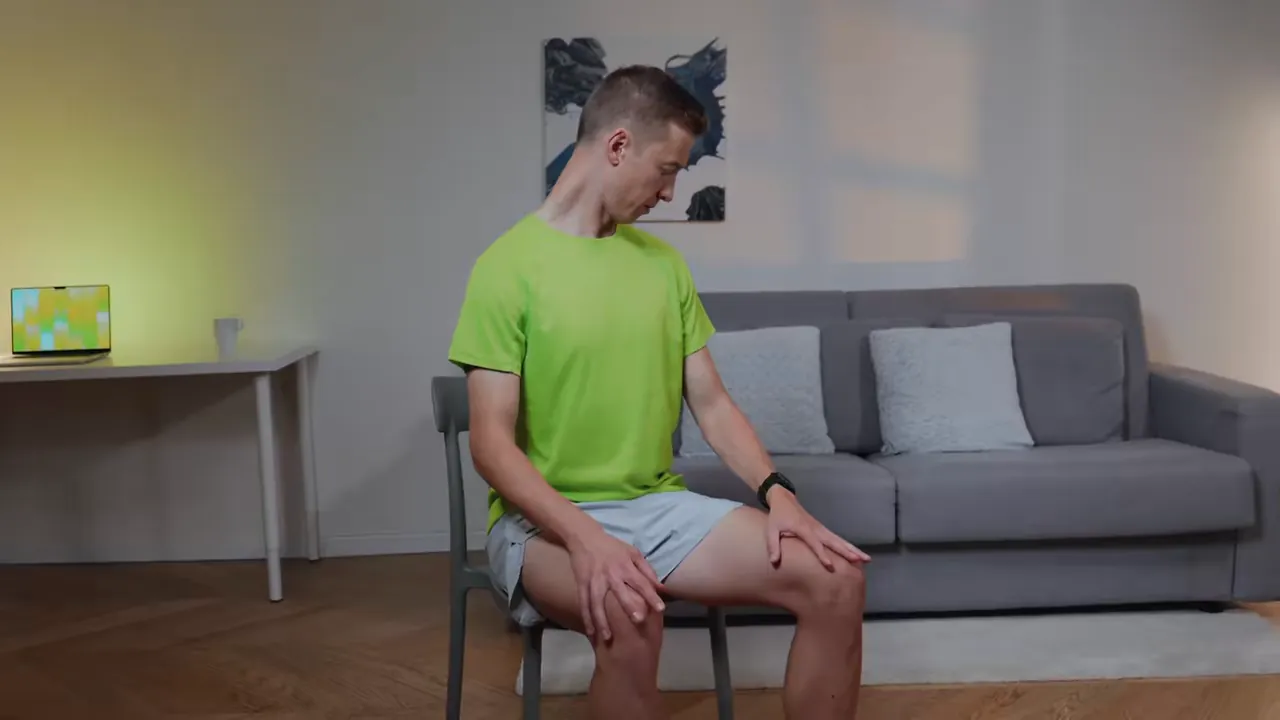
Step 4: Repeat smoothly without tipping the head back.
Keep: Repeat smoothly, rolling across the front only, without tipping the head back.
Avoid: Tipping the head backA full circle that drops the head backwards is a different exercise from the one the physiotherapists designed.
Stills from the exercise video in the Bavelu app, with physiotherapist Mgr. Lukáš Kučera.
How it should feel
This is a movement rather than a held stretch. As your head rolls slowly across the front, you may feel a gentle stretch at the back of the neck and along each side in turn. A stiff neck may feel tight and slow for the first few half circles. NHS inform notes that neck exercises can increase symptoms slightly at the beginning but should get easier with regular practice (NHS inform).
Gentle pullRight
Stay within what is comfortable: a gentle pull is fine.
Sharp pain, tingling or numbnessStop
A sharp pain, a catch that makes you stop, or tingling into an arm is not fine.
Neck Half Circles is one of 3 exercises in Stiff Neck
The other 2 are in the app, guided on video by a physiotherapist. The whole session takes about 5 minutes.
- Trapezius Stretch 1:43 · in the app
- Levator Scapulae Stretch 1:47 · in the app
- Neck Half Circles On this page

Stretches for a stiff neck are a slightly odd idea when your neck does not want to move at all. But gentle movement is what most NHS advice suggests, and the exercise on this page is built for exactly that moment. It is a slow half circle of the head, done sitting on a chair, and it stays in front of you the whole time.
Here is when it fits, what it should feel like, the mistakes that change it, and the signs that a stiff neck needs a doctor rather than a stretch.
What kind of stiff neck is this for?
Stiffness tends to arrive in one of three ways, and they need different things.
- You woke up with it. A neck that locked in an awkward position overnight is one of the most common causes of neck pain the NHS lists (NHS). The page on stiff neck after sleeping covers why it happens, and the guide to sleeping position and pillow covers what to change.
- It builds up through the day. Hours at a screen leave many people stiff by late afternoon. That pattern is covered in neck pain from desk work.
- It comes with a fever, a severe headache or a dislike of bright light. This is not a stretching problem. Read the section on who should be careful below before doing anything else.
This page is about the first two.
Are stretches for a stiff neck a good idea?
For an ordinary stiff neck, gentle movement is the usual advice rather than rest. The NHS advises against wearing a neck collar unless a doctor tells you to, because it is better to keep your neck moving (NHS). NHS inform calls keeping the neck moving an essential part of recovery, and suggests moving it for short periods every hour. It admits this can be hard at first and advises doing what you can and building up over time (NHS inform).
An NHS emergency department leaflet on wry neck, the sudden twisted, stiff neck many people wake up with, says gentle neck exercises are usually advised. It adds that simple painkillers can make the exercises possible and that heat often helps with the muscle stiffness (Royal Berkshire NHS Foundation Trust, 2024).
It is fair to say where this advice comes from. When a Cochrane review pooled 27 trials of exercise for neck pain, it found no evidence either way for exercise in new, short-lived neck pain (Gross et al., 2015). “Keep it moving” is clinical guidance, not something trials of stiff necks have proven.
What it should feel like
This is a movement rather than a held stretch. As your head rolls slowly across the front, you may feel a gentle stretch at the back of the neck and along each side in turn. A stiff neck may feel tight and slow for the first few half circles. NHS inform notes that neck exercises can increase symptoms slightly at the beginning but should get easier with regular practice (NHS inform).
Stay within what is comfortable. A gentle pull is fine. A sharp pain, a catch that makes you stop, or tingling into an arm is not.
Mistakes that change the exercise
Each of these breaks one of the steps above:
- Tipping the head back. The steps say to roll across the front and not to tip the head back. Turning it into a full circle that drops the head backwards is a different exercise from the one the physiotherapists designed.
- Going too fast. The roll is meant to be slow and smooth. Speed turns it into a swing, which is not what the steps ask for.
- Slumping. The first step is to sit upright on the chair, and the movement starts from there.
- Forcing the chin down. The chin lowers towards the chest, but it should never be pushed into pain.
Why necks stiffen at a desk
There is some lab evidence for the end-of-day stiffness many people feel. In a small lab study, 25 healthy women sat at a computer for 90 minutes while researchers used ultrasound to measure the stiffness of four muscles at the back of the neck and shoulders. The upper trapezius, the muscle over the side of the neck and top of the shoulder, became steadily stiffer the longer they sat. After a set of neck and shoulder exercises, both the muscle stiffness and the women’s neck and shoulder pain went down (Nitta et al., 2025).
That is a small study in healthy people, with no comparison group, and it tested its own exercise routine rather than this exercise. It cannot tell you whether the exercise or simply stopping sitting made the difference. But it fits the NHS advice not to keep your neck in the same position for a long time when sitting at a desk (NHS), and it is a reason to move before the stiffness has built up, not only after. The guide to microbreaks has ways to fit that into a working day.
Who should be careful
A stiff neck is usually not serious, but some stiff necks are. This page does not replace a doctor or a physiotherapist.
- Stiffness with fever, a severe headache or light sensitivity. Call 999 or go to A&E if you have a stiff neck and cannot look at bright lights, a very painful headache, a very high or very low temperature or shivers, confusion, or a rash that does not fade when you press it. These can be signs of meningitis (NHS). Do not try to stretch it out.
- After an injury. If the stiffness started after a fall, a car accident or a blow to the head or neck, get it checked first (NHS inform).
- Arm symptoms. Contact your GP practice urgently, or call 111 if it is closed, if numbness, pins and needles, weakness or clumsiness in one or both arms is getting worse, if your balance or walking has changed since the neck pain started, or if it comes with a severe headache (NHS inform). The wry neck leaflet also advises seeing a GP for pain that spreads down the arm into the hand.
- Dizziness. If moving your head makes you dizzy, stop. NHS inform advises contacting your GP if neck pain comes with dizziness, blurred vision or ringing in the ears.
- A diagnosed neck condition or recent neck surgery. Follow your own healthcare professional’s advice (NHS inform).
- If you cannot turn your head, do not drive or cycle until you can (NHS).
Stop if it hurts. NHS inform’s advice is to stop neck exercises if they make your symptoms worse or cause new pain. See a GP if a wry neck is not improving after a few days (Royal Berkshire NHS Foundation Trust, 2024), or if neck pain or stiffness has not gone after a few weeks (NHS). If you are thinking of seeing a physiotherapist privately, see how much physiotherapy costs.
The rest of the Stiff Neck session
In the app, Neck Half Circles is one of three exercises in the Stiff Neck session, which takes about five minutes on a chair. The other two are the Trapezius Stretch, a sideways stretch for the side of the neck and top of the shoulder, and the Levator Scapulae Stretch, which works on the band between the neck and the top of the shoulder blade. Whether stretching helps longer-term neck pain is a separate question, covered in Do stretches help neck pain from desk work?
In Bavelu, the session is guided on video by the physiotherapists who designed and filmed it, led by Mgr. Lukáš Kučera. It is meant for everyday stiffness, and it is not a diagnosis or treatment for a neck that needs a doctor to find the cause.
Questions people ask
Should I stretch a stiff neck or rest it?
For an ordinary stiff neck, NHS advice is to keep it moving and not to wear a collar unless a doctor tells you to. An NHS emergency department leaflet on wry neck says gentle neck exercises are usually advised, and that painkillers and heat can make moving easier. Move gently, within what is comfortable.
Why does this exercise not go all the way round?
The app's steps keep the movement in a half circle across the front and say not to tip the head back. That is how the physiotherapists designed it. If you have seen full neck circles elsewhere, follow the steps above for this one.
How long does a stiff neck last?
An NHS leaflet on wry neck says it usually gets better on its own after a few days, though it sometimes takes a little longer. NHS inform says most new neck problems improve within 8 weeks. See a GP if it is not improving after a few days or you are worried.
When is a stiff neck an emergency?
Call 999 or go to A&E if a stiff neck comes with a very high or very low temperature, a very painful headache, being unable to look at bright lights, confusion, or a rash that does not fade when you press it. The NHS lists these as possible signs of meningitis.
Terms on this page
Sources
- NHS. Neck pain.
- NHS inform. Neck problems.
- NHS inform. Exercises for neck problems.
- Royal Berkshire NHS Foundation Trust, Emergency Department. Acute torticollis (wry neck). Patient leaflet, 2024.
- Gross A et al. Exercises for mechanical neck disorders. Cochrane Database of Systematic Reviews, 2015.
- Nitta A et al. Time-dependent changes in the stiffness of the neck extensor muscles with prolonged sitting and the effect of exercise. Journal of Back and Musculoskeletal Rehabilitation, 2025.
- NHS. Meningitis.
This page explains a topic in general terms. It is not a diagnosis and does not replace a doctor or physiotherapist. If something hurts badly, keeps getting worse or comes with numbness, weakness or fever, see a doctor.