Exercises · Neck
Neck stretches for people who sit all day
A seated stretch for the side of the neck and the top of the shoulder, from the app's Neck Release session. Here is what it should feel like, and what the research says neck stretches can and cannot do.
Trapezius Stretch
A head tilt with the hand's help to release the upper trapezius.
- 1:43
- On a chair
- Neck
- Shoulders
Move slowly. Stop if it hurts, or if you feel tingling or numbness.
-
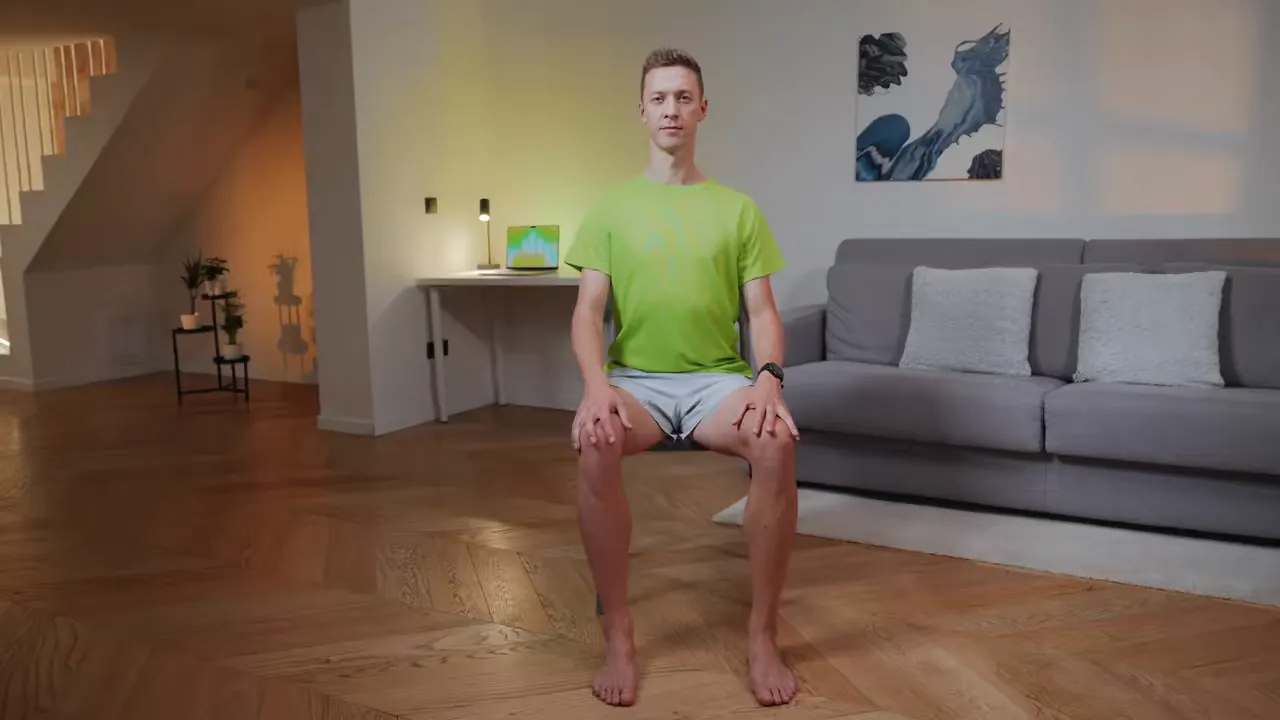
Step 1: Sit tall and hold the chair with one hand.
Keep: Sit tall, with one hand holding the chair. The rest of the stretch starts from there.
Avoid: Slumping
-
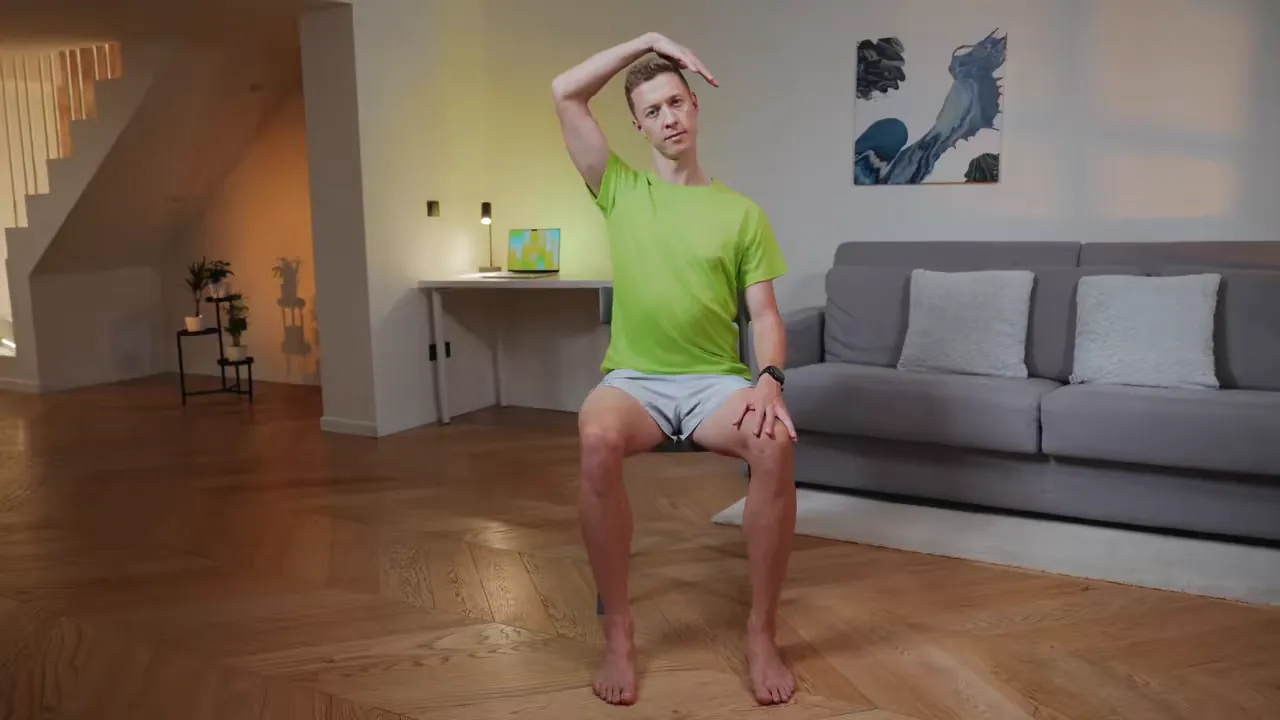
Step 2: Rest the other hand on your head.
Keep: The hand on your head is there to add a little, gently. It is not there to pull.
Avoid: Pulling with the handLet it add a little, rather than pulling the head down.
-
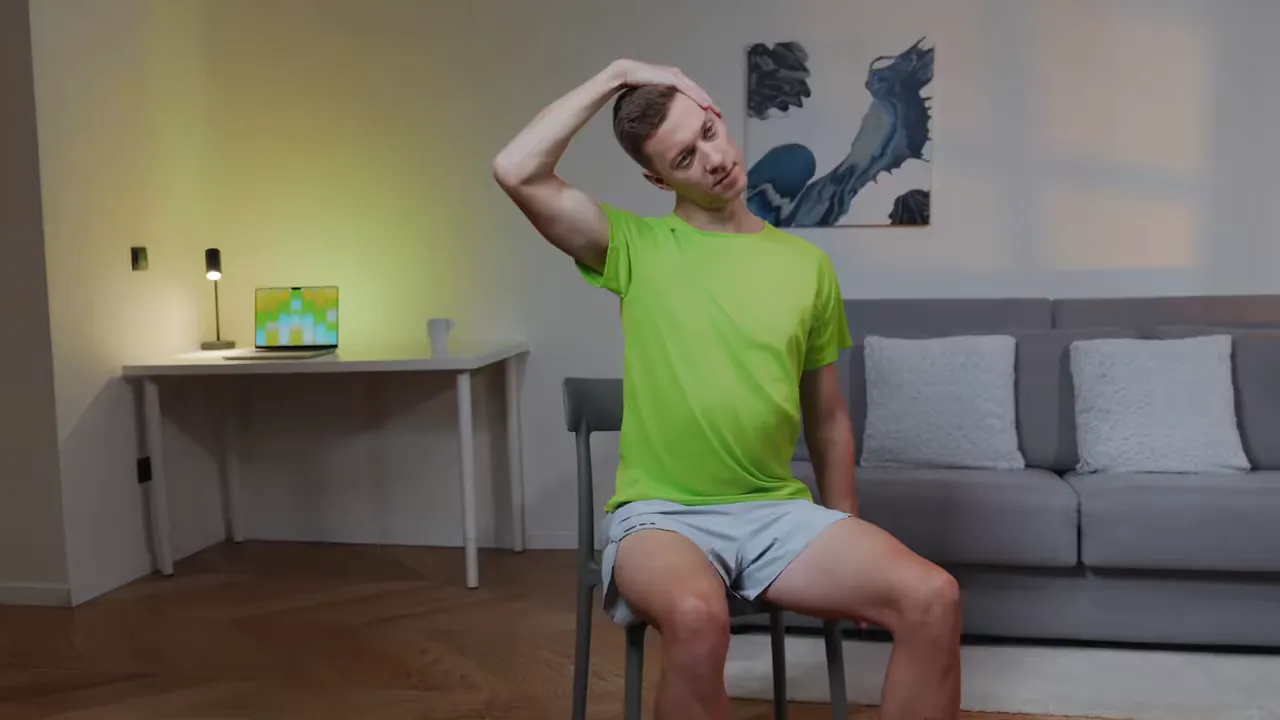
Step 3: Tilt your ear to your shoulder and let the hand gently deepen it.
Keep: Tilt your ear to your shoulder and keep holding the chair, so that shoulder does not creep up towards your ear.
Avoid: Letting go of the chairIf the shoulder rises, there is less of a stretch to feel.
Keep: This one is a tilt only, with no turn of the head.
Avoid: Turning the faceTurning the head and looking down towards the armpit is a different exercise, the levator scapulae stretch.
-
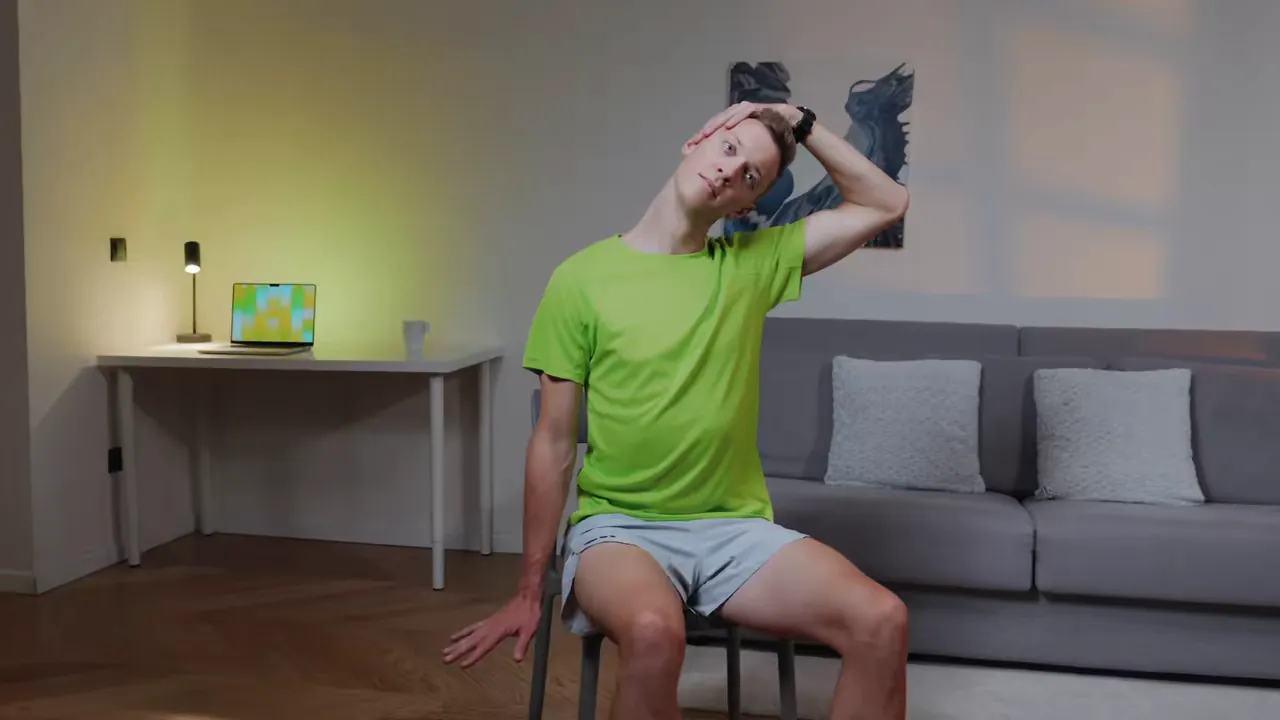
Step 4: Hold, then switch sides.
Keep: Hold, then switch sides, as the last step says.
Avoid: Doing one side only
Stills from the exercise video in the Bavelu app, with physiotherapist Mgr. Lukáš Kučera.
How it should feel
You should feel a gentle stretch along the side of the neck and over the top of the shoulder, on the side away from the tilt. That is the side whose hand is holding the chair. Then the sides swap.
Gentle pullRight
A gentle pull is the right level.
Sharp pain, tingling or numbnessStop
Sharp pain, or tingling and numbness that run into the arm or hand, are not part of it, and are a reason to stop.
Trapezius Stretch is one of 4 exercises in Neck Release
The other three are in the app, guided on video by a physiotherapist. The whole session takes about 7 minutes.
- Neck Half Circles 1:27 · in the app
- Trapezius Stretch On this page
- Levator Scapulae Stretch 1:47 · in the app
- Short Neck Muscle Stretch 1:53 · in the app

Neck stretches are what most people reach for when the ache starts at the desk: a hand on the head, a tilt, a moment of relief before the next email. The stretch on this page is one a physiotherapist would recognise straight away. It targets the upper part of the trapezius, the muscle over the side of the neck and the top of the shoulder, and you do it sitting on your chair.
Below is what the stretch is aimed at, what it should feel like, the mistakes that undo it, and what the trials say about neck stretches for people who sit all day.
What this neck stretch works on
The upper trapezius runs from the back of the skull and the ligament at the back of the neck to the outer third of the collarbone. Working on one side, it lifts the shoulder blade, bends the head and neck towards that side and turns the head the other way (Kenhub).
Tilting the head sideways, away from one shoulder, moves the upper trapezius on that side the opposite way to how it works. That is why the app describes this stretch as a head tilt, with the hand’s help, to release the upper trapezius. It is the muscle many desk workers point to when they say their neck is tight. The glossary page on the trapezius explains why it tends to ache after long hours at a screen.
What it should feel like
You should feel a gentle stretch along the side of the neck and over the top of the shoulder, on the side away from the tilt. That is the side whose hand is holding the chair. Then the sides swap.
The hand on your head is there to add a little, gently, as the steps above say. It is not there to pull. A gentle pull is the right level. Sharp pain, or tingling and numbness that run into the arm or hand, are not part of it, and are a reason to stop.
Common mistakes
Each of these breaks one of the steps above:
- Slumping. The first step is to sit tall, and the rest of the stretch starts from there.
- Letting go of the chair. Holding on keeps that shoulder from creeping up towards your ear as you tilt. If the shoulder rises, there is less of a stretch to feel.
- Pulling with the hand. The step says the hand deepens the tilt gently. Let it add a little, rather than pulling the head down.
- Turning the face. This one is a tilt only. Turning the head and looking down towards the armpit is a different exercise, the levator scapulae stretch, which works on the muscle running down to the shoulder blade.
- Doing one side only. The last step is to switch sides.
When to fit neck stretches into your day
Because it is done on a chair with no equipment, this is a stretch for the gaps: between meetings, while a file uploads, at the end of a long run of typing.
That matches the general advice. The NHS lists sitting at a desk for a long time among the common causes of neck pain, and advises not keeping your neck in the same position for long (NHS). For a new neck problem, NHS inform suggests moving your neck for short periods every hour (NHS inform). The UK Health and Safety Executive’s guidance for screen users says short breaks taken often are better than longer ones taken rarely, and that a break should let you get up and move around, or at least stretch and change posture (HSE).
So a seated stretch is a good start, and standing up now and then is still worth doing. The guide to microbreaks has ideas for building both into a workday, and if your screen is pulling your head forward all day, setting up your monitor is the other half of the job.
Do neck stretches actually help?
Some, with limits worth knowing.
In one trial, 96 office workers with neck pain of at least 5 out of 10 for three months or more were all given an ergonomics leaflet. Half were also taught neck and shoulder stretches to do twice a day, five days a week, for four weeks. Both groups improved, but pain fell 1.4 points more on a 10-point scale in the stretching group, and neck function improved more too (Tunwattanapong et al., 2016). Four weeks is short, and the comparison was a leaflet, not another kind of exercise.
The wider picture is more cautious. A Cochrane review of 27 trials with 2,485 people found low-quality evidence that stretching on its own may not change pain or function in the short term. Strengthening of the neck, shoulders and upper back had moderate-quality support, and programmes that combined strengthening with stretching helped too (Gross et al., 2015). A 2024 review of eight trials in office workers with long-term neck pain came to a similar view about strengthening, while rating the certainty of that evidence as low (Jones et al., 2024).
The fair reading: a stretch like this is a reasonable way to break up a long sitting spell, and stretching has helped office workers in at least one trial. If your neck has hurt for months, it is unlikely to be the whole answer. Do stretches help neck pain from desk work? goes through these trials in more detail, and Is two minutes of exercise enough? looks at the short strengthening routine that worked for office workers.
Who should be careful
A gentle neck stretch is not right for every neck, and this page is not a substitute for a doctor or a physiotherapist.
- A diagnosed neck condition or recent neck surgery. NHS inform advises following the advice of your own healthcare professional rather than general exercises (NHS inform).
- A recent injury. If the pain started after a fall, an accident or a blow to the head or neck, get it checked before you stretch it (NHS inform).
- Symptoms in the arms. Contact your GP practice urgently, or call 111 if it is closed, if you have clumsy hands, or numbness, pins and needles or weakness in one or both arms that is getting worse. The same applies to balance or walking problems since the neck pain started, or neck pain with a severe headache (NHS inform).
- Dizziness, blurred vision or ringing in the ears with neck pain are a reason to contact your GP, not to keep stretching (NHS inform).
- Feeling unwell. NHS inform advises trying neck exercises only if you feel well enough, and stopping straight away if you start to feel unwell.
Stop if it hurts. NHS inform’s rule for neck exercises is to stop if they make your symptoms worse or cause new pain. A little short-lived muscle soreness can happen with new exercises, but your neck should be no worse the morning after (NHS inform). See a GP if neck pain or stiffness has not gone after a few weeks (NHS). The full list of warning signs is on the page about neck pain from desk work.
The rest of the Neck Release session
In the app, this stretch is one of four in the Neck Release session, which takes about seven minutes. The other three are Neck Half Circles, a slow movement for a stiff neck (see stretches for a stiff neck), the Levator Scapulae Stretch, and the Short Neck Muscle Stretch for the small muscles under the skull, which is on the page about forward head posture exercises.
Bavelu’s sessions are designed and filmed by physiotherapists, led by Mgr. Lukáš Kučera, and the whole session is guided on video in the app. It is exercise guidance, not a diagnosis or treatment, so if your neck keeps hurting, a physiotherapist can assess it and add the strengthening work the trials support.
Questions people ask
Where should I feel this neck stretch?
Along the side of the neck and the top of the shoulder, on the side away from the tilt. That is the side whose hand is holding the chair. It should feel like a gentle stretch, never a sharp pain, and nothing should spread into your arm or hand.
Should neck stretches hurt?
No. A gentle pull is fine, pain is not. NHS inform advises stopping neck exercises if they make your symptoms worse or cause new pain, and says exercise should not leave your neck pain worse overall the next morning.
How often should I do neck stretches?
There is no agreed dose. In one trial with office workers, the stretching programme was done twice a day, five days a week, for four weeks. NHS inform's general advice for a new neck problem is to move your neck for short periods every hour rather than staying in one position.
Are neck stretches enough on their own?
Probably not for neck pain that has lasted months. A Cochrane review of 27 trials found that stretching alone may not change pain, while strengthening of the neck, shoulders and upper back had moderate-quality support. A stretch is a sensible part of a routine, not the whole of it.
Terms on this page
Sources
- Kenhub. Trapezius muscle.
- Tunwattanapong P, Kongkasuwan R, Kuptniratsaikul V. The effectiveness of a neck and shoulder stretching exercise program among office workers with neck pain: a randomized controlled trial. Clinical Rehabilitation, 2016.
- Gross A et al. Exercises for mechanical neck disorders. Cochrane Database of Systematic Reviews, 2015.
- Jones LB, Jadhakhan F, Falla D. The influence of exercise on pain, disability and quality of life in office workers with chronic neck pain: a systematic review and meta-analysis. Applied Ergonomics, 2024.
- NHS. Neck pain.
- NHS inform. Neck problems.
- NHS inform. Exercises for neck problems.
- UK Health and Safety Executive. Working safely with display screen equipment: work routine and breaks.
This page explains a topic in general terms. It is not a diagnosis and does not replace a doctor or physiotherapist. If something hurts badly, keeps getting worse or comes with numbness, weakness or fever, see a doctor.