Blog
Are standing desks worth it?
A sit-stand desk can cut an hour or more of sitting from your day. It works best as a way to change position often, not as a reason to stand for hours. Here is what the studies found.
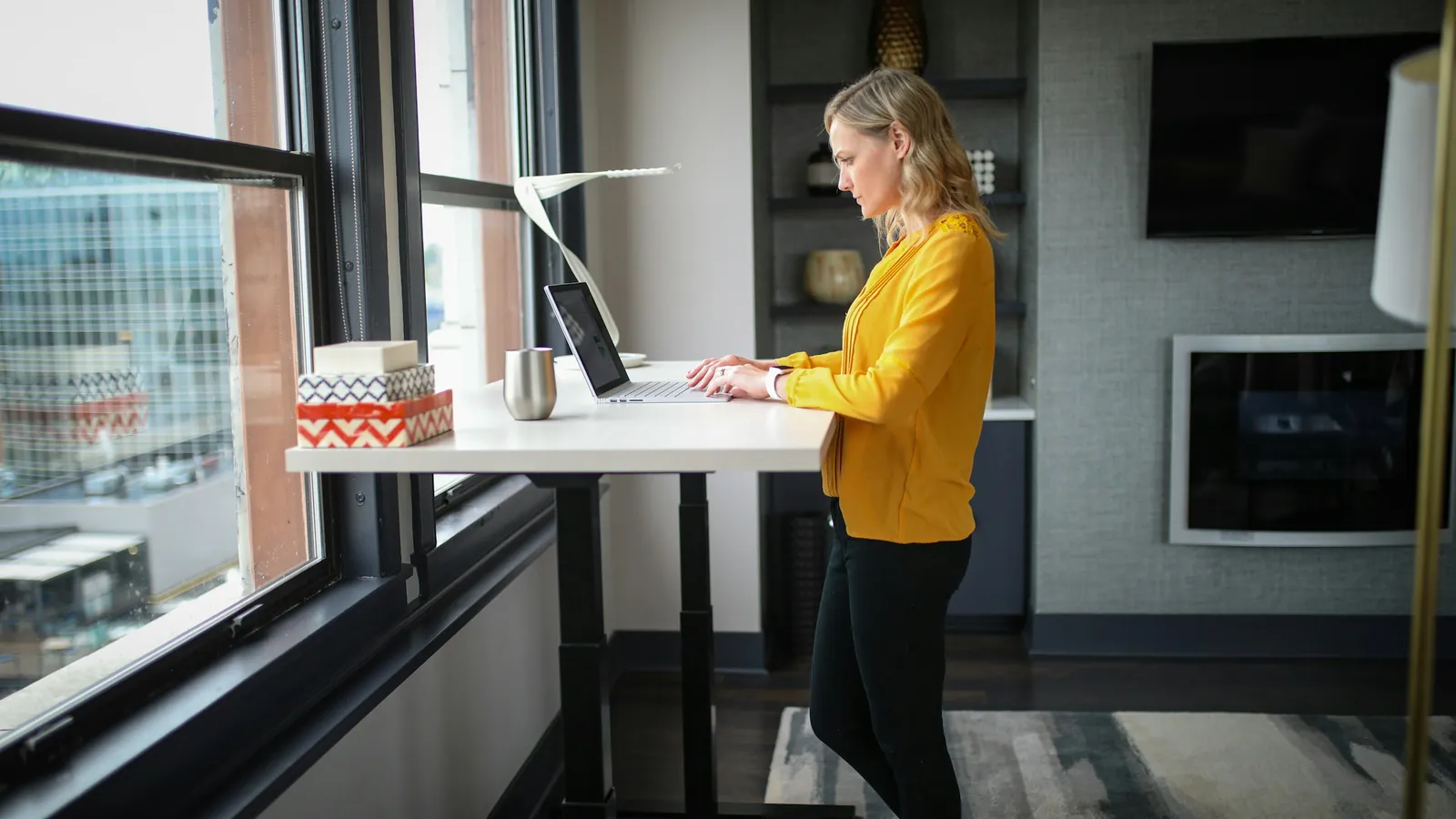
Are standing desks worth it? For many people who sit all day, yes, as long as you use one to change position through the day rather than to stand for hours. In trials, sit-stand desks cut sitting at work by about an hour or more a day, and they may ease lower back discomfort a little. They burn very few extra calories, and standing still for long periods brings problems of its own. Here is what the research found, how long to stand, and when a cheaper change might do the same job.
What does a standing desk actually change?
The main thing a sit-stand desk changes is how long you sit. A Cochrane review of 34 studies with 3,397 workers found that sit-stand desks reduced sitting at work by about 100 minutes a day in the first three months, and by about 57 minutes a day between three and twelve months. The authors rated the evidence as low quality, and no study followed people for longer than a year. Fixed standing desks did no better than sit-stand ones, and treadmill or cycling desks had unclear effects (Shrestha et al., 2018).
A year-long trial at an NHS trust in England shows what that can look like. In the SMArT Work trial, 146 office workers in 37 office groups were split into two arms. One group got a height-adjustable workstation plus a short seminar, sitting and standing targets, feedback and regular coaching; the other carried on as usual. After twelve months, the desk group sat about 83 minutes less per workday than the comparison group. They also reported better job performance, work engagement and quality of life, and less fatigue and anxiety, though sickness absence did not change (Edwardson et al., 2018).
Notice that the desk came with a package of support. That matters, because a desk on its own often ends up used as a sitting desk. Cornell University’s ergonomics guidance notes that use of sit-stand stations declines quickly, with a majority of people sitting all the time after a month, although it does not name the studies behind that (Cornell University Ergonomics Web).
Do standing desks help back pain?
A little, possibly, and mainly by breaking up long sits.
- A review of eight studies found a small reduction in low back discomfort with sit-stand desks, roughly 0.3 to 0.5 points on a 10-point scale. All the participants were free of back pain at the start, and the authors noted that no studies had looked at people who already have back pain, or at how much standing is needed (Agarwal et al., 2018).
- In a five-day lab study, 23 overweight or obese office workers did their usual work either seated or switching between sitting and standing every 30 minutes. When they switched, they reported less fatigue and 32% less lower back discomfort. Concentration was rated higher when seated, and overall productivity was similar (Thorp et al., 2014).
The catch is that standing too much is linked to back trouble as well. A review of 49 studies with more than 88,000 people found that standing for more than four hours a workday was linked to low back symptoms, with about 1.3 times the odds. Most of those studies were snapshots, so the authors called their conclusions tentative (Coenen et al., 2018). And in a lab study of 20 adults doing two hours of standing computer work, discomfort rose in every body area measured, reaction times slowed and lower legs swelled, although creative problem-solving improved (Baker et al., 2018).
There is much less research on standing desks and the neck. Whichever way you work, the screen still needs to be at the right height; see how to set up your monitor. If your lower back is the problem, lower back pain from sitting covers what else helps.
Is standing healthier than sitting?
Not in the ways people often hope.
Calories. A review of 46 studies with 1,184 people found that standing burns about 0.15 kcal a minute more than sitting. For a 65 kg person, swapping six hours of sitting for standing adds about 54 kcal a day. The authors calculated that this could add up over a year if nothing else changed (Saeidifard et al., 2018).
Heart and circulation. Among 83,013 adults in the UK Biobank who wore wrist accelerometers, time spent standing was not linked to a lower risk of heart disease or stroke. Standing for more than two hours a day was linked to a higher risk of circulation problems such as varicose veins and chronic venous insufficiency, about 11% higher for every extra half hour (Ahmadi et al., 2024). In Ontario, a study that followed 7,320 workers for about twelve years found that jobs involving mostly standing were linked to roughly twice the risk of heart disease of jobs involving mostly sitting (Smith et al., 2018). Those were jobs spent on your feet all day, not office workers switching position, but they are a reminder that standing still is not the opposite of sitting.
Cornell’s guidance puts it bluntly: standing all day is unhealthy, and simply standing is not enough; movement is what gets blood flowing through the muscles. For the bigger picture on sitting and health, see Is sitting the new smoking?
How long should you stand at a standing desk?
No trial has tested the ideal split, so the advice comes from expert opinion and short studies.
- An international expert statement suggested that desk workers aim first for two hours a day of standing and light activity, such as light walking, during working hours, and build up to four hours. The authors were open that the evidence behind it was largely observational or short-term (Buckley et al., 2015).
- Alan Hedge at Cornell recommends a cycle of about 20 minutes sitting, 8 minutes standing and 2 minutes moving. Over a 7.5-hour day, that adds up to about five hours of sitting, two hours of standing, half an hour of moving and 16 changes from sitting to standing (Hedge, Cornell). Cornell’s main sit-stand page adds that the exact timing is not critical: the aim is a change of posture every 20 to 30 minutes.
- The lab study above switched every 30 minutes, and the problems in the observational data appeared beyond two hours a day of standing for circulation and beyond four hours a workday for the lower back.
Put together, a sensible starting point is a couple of hours of standing a day, spread out in short spells, with some movement each time you change position. Both the Cornell guidance and the lab study put the weight on changing often rather than on a daily total. The standing desk schedule helps you split a day between sitting, standing and moving.
Getting the set-up right
A standing desk set to the wrong height just moves the strain elsewhere. Your sitting and standing heights are different, and so is the right height for the screen. The desk height calculator gives starting points for a chair, a sitting desk, a standing desk and the top of the screen from your body height. Your chair still matters for the hours you sit, so see office chair setup, and if you work from home, the home office guide. The workstation checklist runs through the rest of your desk, based on UK guidance on ergonomics for screen work.
Cheaper ways to sit less
A desk is not the only way to cut sedentary behaviour. In the same Cochrane review, one study found that short breaks of one to two minutes every half hour reduced sitting at work by about 40 minutes a day compared with two 15-minute breaks. Computer prompts combined with information made no clear difference in the first three months but did in one study at three to twelve months. Information or counselling on its own made no clear difference in the short term (Shrestha et al., 2018). The evidence for all of these was low quality.
Our guide to microbreaks looks at how often to move, and the desk break timer can prompt you. A few hip stretches in a break are a simple way to change position after a long sit. If you are deciding for a whole office, the SMArT Work result suggests that desks plus support do more than desks alone; see our page for teams.
So, are standing desks worth it?
A sit-stand desk is likely to be worth it if you sit for most of your working day, you will actually switch position several times a day, and you want a simple way to break up long sits. It may take the edge off lower back discomfort.
It is probably not worth it if you expect it to help you lose weight, to cure existing back pain, or if you plan to stand for hours at a time. And if the budget is tight, regular short breaks and a well set-up chair and screen go a long way. How much of your year do you spend sitting? puts your own hours in perspective.
When to see a doctor
A new desk is not a treatment. The NHS advises seeing a GP if back pain has not improved after a few weeks, stops you doing your day-to-day activities, or is worse at night. Call 999 or go to A&E if back pain comes with numbness or weakness in both legs, loss of feeling around your genitals or anus, or changes in bladder or bowel control (NHS).
Bavelu’s desk routines of two to four minutes, designed and filmed by physiotherapists, fit into the moments when you change position.
Questions people ask
How long should you stand at a standing desk?
No trial has tested an ideal amount. An international expert statement suggested building up to two hours a day of standing and light activity during work, and eventually four. A pattern recommended by Alan Hedge at Cornell University works out at about two hours of standing in a 7.5-hour day, in short spells, with regular movement. Studies link standing for more than four hours a workday with more low back symptoms.
Do standing desks help with back pain?
They may help a little. A review of eight studies in people without back pain found a small reduction in low back discomfort with sit-stand desks, and a five-day lab study found less lower back discomfort when people switched between sitting and standing every 30 minutes. There are no good studies yet in people who already have back pain.
Do standing desks help you lose weight?
Not by much. A review of 46 studies found standing burns about 0.15 kcal a minute more than sitting, or roughly 54 kcal over six hours for a 65 kg person. That only adds up over a long time if nothing else changes, such as how much you eat.
Is standing all day bad for you?
It has its own problems. Standing for more than four hours a workday has been linked to low back symptoms, and in a UK study of more than 83,000 adults, standing for more than two hours a day was linked to more circulation problems such as varicose veins. In a lab study, two hours of standing computer work increased discomfort in every body area measured.
Is a standing desk better than taking regular breaks?
They do different jobs and work well together. In the Cochrane review, sit-stand desks reduced sitting at work by about 100 minutes a day in the first three months. In one study in the same review, short breaks of one to two minutes every half hour cut sitting by about 40 minutes a day compared with two longer breaks.
Terms on this page
Sources
- Shrestha N et al. Workplace interventions for reducing sitting at work. Cochrane Database of Systematic Reviews, 2018.
- Edwardson CL et al. Effectiveness of the Stand More AT (SMArT) Work intervention: cluster randomised controlled trial. BMJ, 2018.
- Cornell University Ergonomics Web. Sitting and standing at work.
- Hedge A. Sit-stand working programs. Cornell University Ergonomics Web.
- Agarwal S, Steinmaus C, Harris-Adamson C. Sit-stand workstations and impact on low back discomfort: a systematic review and meta-analysis. Ergonomics, 2018.
- Thorp AA et al. Breaking up workplace sitting time with intermittent standing bouts improves fatigue and musculoskeletal discomfort in overweight/obese office workers. Occupational and Environmental Medicine, 2014.
- Coenen P et al. Associations of occupational standing with musculoskeletal symptoms: a systematic review with meta-analysis. British Journal of Sports Medicine, 2018.
- Baker R et al. A detailed description of the short-term musculoskeletal and cognitive effects of prolonged standing for office computer work. Ergonomics, 2018.
- Saeidifard F et al. Differences of energy expenditure while sitting versus standing: a systematic review and meta-analysis. European Journal of Preventive Cardiology, 2018.
- Ahmadi MN, Coenen P, Straker L, Stamatakis E. Device-measured stationary behaviour and cardiovascular and orthostatic circulatory disease incidence. International Journal of Epidemiology, 2024.
- Smith P et al. The relationship between occupational standing and sitting and incident heart disease over a 12-year period in Ontario, Canada. American Journal of Epidemiology, 2018.
- Buckley JP et al. The sedentary office: an expert statement on the growing case for change towards better health and productivity. British Journal of Sports Medicine, 2015.
- NHS. Back pain. Last reviewed 5 March 2026.
This page explains a topic in general terms. It is not a diagnosis and does not replace a doctor or physiotherapist. If something hurts badly, keeps getting worse or comes with numbness, weakness or fever, see a doctor.
