Exercises · Hips
Hip stretches for people who sit all day
One you can do at your desk, in work clothes. Below it: which part of the hip it works, what sitting does and doesn't do to your hips, and when to check with a physiotherapist first.
Chair Pigeon
Pigeon on a chair - a hip stretch you can do in the office.
- 1:29
- On a chair
- Hips
- Lower Back
Move slowly. Stop if it hurts, or if you feel tingling or numbness.
-
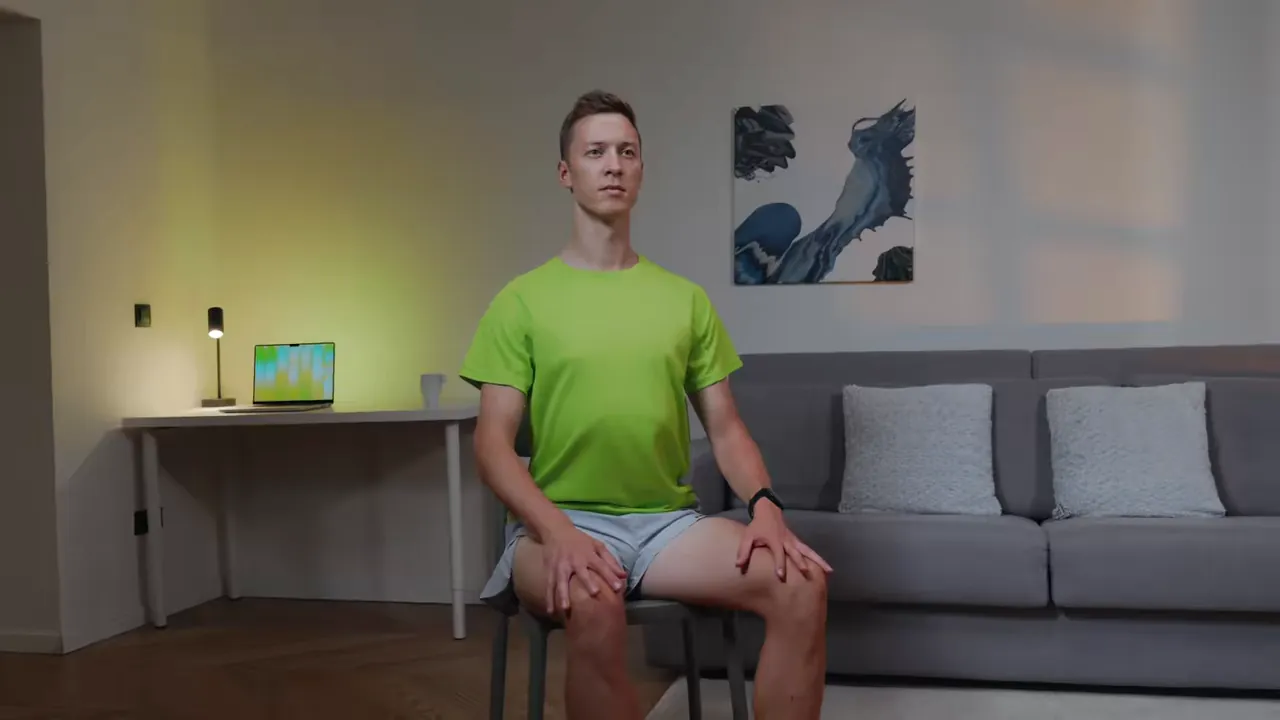
Step 1: Sit upright on a chair.
Keep: Sit upright on the chair, and begin each side sitting tall.
Avoid: Starting from a slump
-
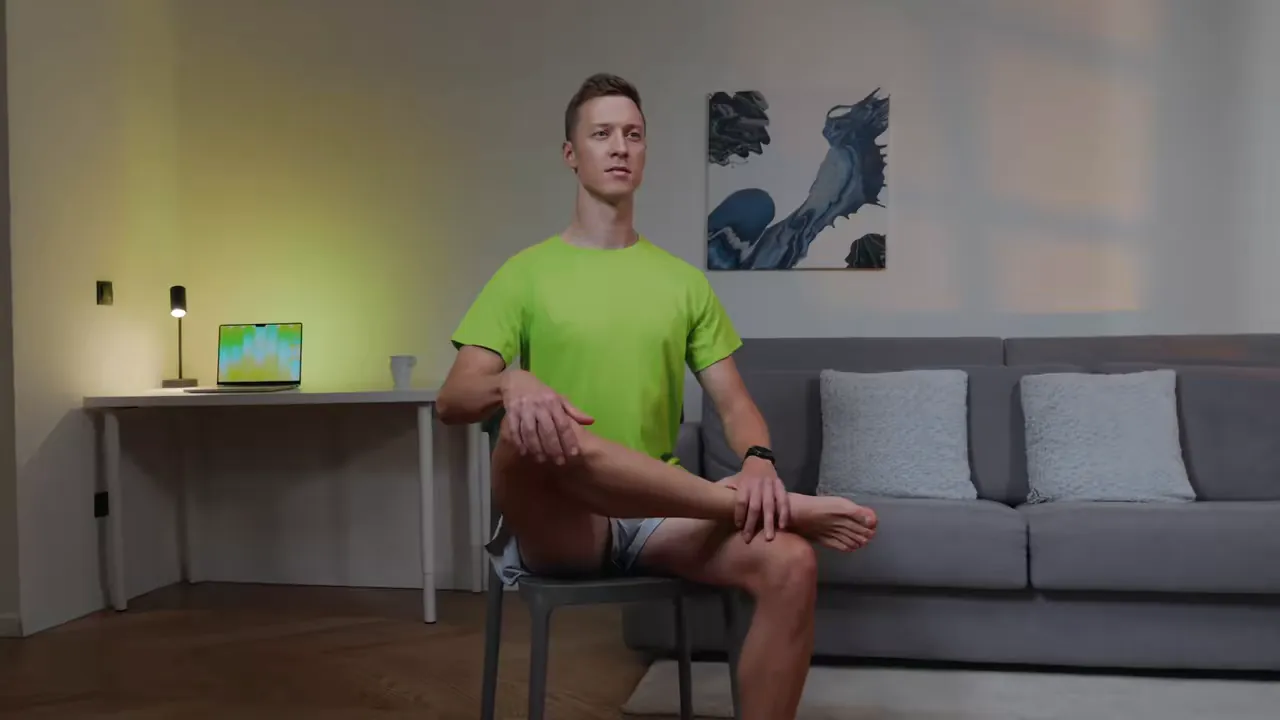
Step 2: Rest one ankle on the opposite knee.
Keep: Rest one ankle on the opposite knee.
Avoid: Ankle not resting on the knee
-
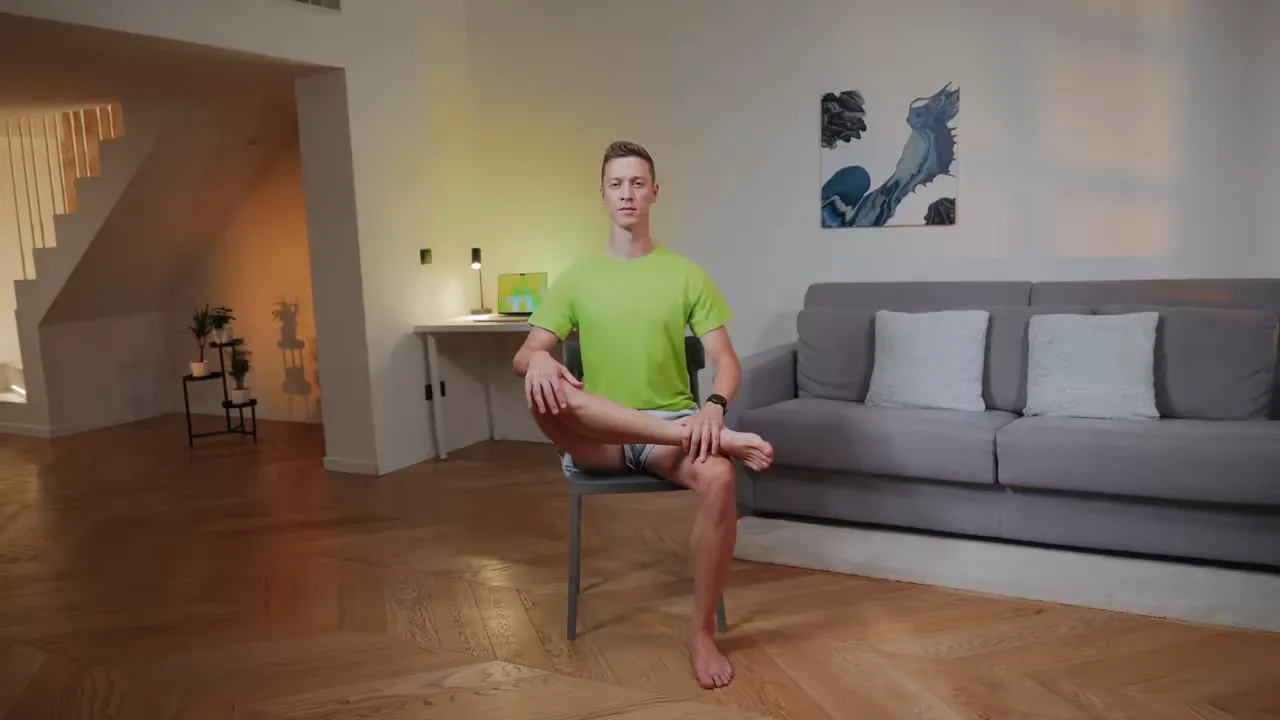
Step 3: Keeping your back straight, lean forward slightly.
Keep: Keep your back straight as you lean.
Avoid: Rounding your back to go lowerCurling forward to get lower turns a hip stretch into a slump.
Keep: Lean forward slightly. A small lean is all the exercise asks for.
Avoid: Leaning too far
-
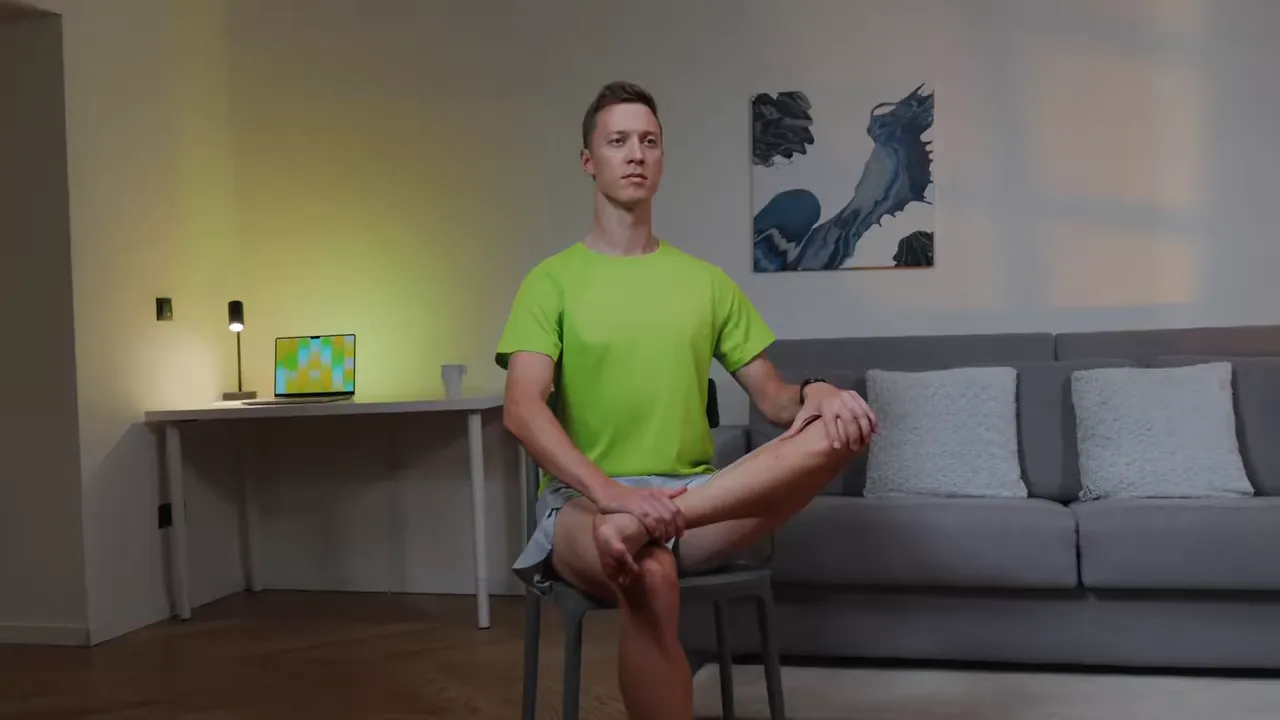
Step 4: Hold, then switch sides.
Keep: Hold, then switch sides.
Avoid: Doing one side only
Stills from the exercise video in the Bavelu app, with physiotherapist Mgr. Lukáš Kučera.
How it should feel
You should feel a gentle stretch in the hip and buttock of the crossed leg, and nothing sharp. Neither knee should hurt, and nothing should tingle down the leg.
Gentle pullRight
A gentle stretch in the hip and buttock of the crossed leg, and nothing sharp.
Sharp pain, tingling or numbnessStop
Neither knee should hurt, and nothing should tingle down the leg.
Chair Pigeon is one of 4 exercises in Quick Chair Reset
The other three are in the app, guided on video by a physiotherapist. The whole session takes about 6 minutes.
- Cat - Cow 1:10 · in the app
- Seated Twist Using the Chair Back 1:58 · in the app
- Chair Pigeon On this page
- Side Bends 1:43 · in the app

A lot of advice on hip stretches for people who sit all day focuses on the front of the hip. The one above works somewhere else. Chair Pigeon, from Bavelu’s Quick Chair Reset session, is a version of the yoga pigeon pose that you do on an ordinary chair, and the app calls it “a hip stretch you can do in the office”. It is designed for the hip and the glutes, the muscles of the buttock, and it needs no mat, no change of clothes and no space beyond your desk.
This page explains what sitting does and doesn’t do to your hips, which part of the hip chair pigeon works, how it should feel, and who should skip it.
What sitting does to your hips, and what it doesn’t
In a chair, your hips stay bent for hours. The popular idea is that this shortens the hip flexors, the muscles at the front of the hip, which then pull on the lower back. The evidence for that is thin. In a study of 118 adults who had not sought care, those with low back pain had slightly less hip extension on the standard test for hip flexor length. Once other factors were accounted for, back pain was no longer independently linked with hip flexor length, and body mass index was the only significant factor (Eimiller et al., 2026). It has not been shown that sitting reliably shortens the hip flexors, and you do not need to believe it does to want to move your hips after a long day.
What sitting certainly involves is long spells without much movement. That is what sedentary behaviour means, and the sitting time calculator shows how many hours of your week it adds up to. Your chair matters too: the NHS advice for people with hip pain includes not sitting in low chairs, because they can put extra pressure on the hips, and trying gentle hip stretching exercises (NHS). How to set up your office chair covers the height.
It also helps to know what a stretch actually changes. A review of the research on stretching concluded that a muscle does lengthen while it is being stretched, but only briefly. The extra range people gain after a single session, or after programmes of three to eight weeks, seems to come mostly from the stretch becoming more comfortable rather than from the muscle becoming longer. Longer programmes had not been studied for this (Weppler & Magnusson, 2010). So the realistic aim of a desk stretch is comfortable movement in the middle of a still day, not reshaping a muscle.
Which part of the hip chair pigeon works
The buttock has two layers of muscle. On the surface are the gluteus maximus, medius and minimus, large muscles that move the thigh backwards and out to the side. Beneath them sits a group of smaller muscles whose main job is to turn the thigh outwards (TeachMeAnatomy).
With one ankle resting on the other knee, the hip of the crossed leg is bent and turned outwards, and the slight lean forward adds to the bend. That is why the stretch is usually felt in the hip and buttock of the crossed leg. It is not a stretch for the hip flexors: in this position the front of the hip is folded, not lengthened. If you want the floor version of the same idea, see pigeon pose.
How chair pigeon should feel
You should feel a gentle stretch in the hip and buttock of the crossed leg, and nothing sharp. Neither knee should hurt, and nothing should tingle down the leg.
The usual mistakes break one of the steps above:
- Rounding your back to go lower. The third step says to keep your back straight as you lean. Curling forward to get lower turns a hip stretch into a slump.
- Leaning too far. The step says to lean forward slightly. A small lean is all the exercise asks for.
- Starting from a slump. The first step is to sit upright on the chair, so begin each side sitting tall.
- Doing one side only. The last step is to switch sides.
In the app it takes about a minute and a half, and its length is shown above.
Hip stretches during the workday
Chair pigeon is one of four exercises in the app’s Quick Chair Reset session, all done on the chair; the rest are listed above. A routine like that fits between calls or after a long stretch of typing.
There is some trial evidence for stretching at work. In a trial of 142 office workers with neck, shoulder and lower back pain, a stretching routine of about 10 to 15 minutes, three times a week, lowered pain scores for the lower back, neck and shoulders over six months compared with a group that had no treatment. The stretches used no load, the people assessing the results knew who was in which group, and a fair number dropped out of the control group, so the result is a start rather than proof (Shariat et al., 2018).
A stretch is also no substitute for getting up. Microbreaks covers how often to move during the day, and desk stretches has more you can do without leaving your seat. If your lower back is what bothers you most, start with lower back stretches.
Who should be careful
Stop if it hurts. A gentle stretch in the hip is the aim; pain in the hip joint, the knee or the lower back is a reason to stop.
Check with a doctor or physiotherapist first if:
- you have had a hip replacement. While the hip recovers, the NHS advises not sitting with your legs crossed and not bending the hip more than 90 degrees, and following the exercises your physiotherapist recommends (NHS). Chair pigeon crosses one leg over the other and leans forward, so leave it out unless your own team says it is fine.
- you have had a recent hip, knee or back injury or operation. Follow the plan you were given.
- pain, tingling or numbness runs from the buttock down the leg. That can be sciatica (NHS), and it needs assessing rather than stretching on your own.
- your hip already hurts. The NHS advises seeing a GP if hip pain stops you doing normal activities or affects your sleep, keeps coming back, has not improved after two weeks of home treatment, or comes with stiffness for more than 30 minutes after waking. Ask for an urgent appointment or call 111 if the hip is hot and swollen or you feel unwell with a high temperature, and call 999 or go to A&E if you have severe hip pain after a fall or injury, or cannot walk or put weight on your leg (NHS).
Chair Pigeon was designed and filmed for Bavelu by physiotherapists, and in the app the whole Quick Chair Reset, just over six minutes, is guided on video while you stay in your chair.
Questions people ask
What is the best hip stretch for people who sit all day?
No single stretch has been shown to be the best. A good one is a stretch you will actually do where you sit, such as a chair pigeon, combined with getting up and moving regularly. Stretching does not undo long hours of sitting on its own.
Does sitting all day tighten your hip flexors?
It is often said, but the evidence is thin. In a study of 118 adults, people with low back pain had slightly less hip extension, but after other factors were taken into account, body mass index was the only factor significantly linked with hip flexor length. It has not been shown that sitting reliably shortens them.
What does chair pigeon stretch?
The app describes it as pigeon pose on a chair, a hip stretch you can do in the office. With one ankle resting on the other knee, the stretch is usually felt in the hip and buttock of the crossed leg. It is not a stretch for the hip flexors at the front of the hip.
Can I do hip stretches after a hip replacement?
Only the ones your physiotherapist or surgical team give you. While the hip recovers, the NHS advises not sitting with your legs crossed and not bending the hip more than 90 degrees, so a chair pigeon is not one to try on your own.
Terms on this page
Sources
- Eimiller K, Vraa M, Sigmund K, Zellmer M. Relationship between hip flexor tightness and low back pain in non-care-seeking individuals. Clinical Biomechanics, 2026.
- NHS. Hip pain in adults. Last reviewed 20 November 2025.
- Weppler CH, Magnusson SP. Increasing muscle extensibility: a matter of increasing length or modifying sensation? Physical Therapy, 2010.
- TeachMeAnatomy. The muscles of the gluteal region.
- Shariat A, Cleland JA, Danaee M, Kargarfard M, Sangelaji B, Tamrin SBM. Effects of stretching exercise training and ergonomic modifications on musculoskeletal discomforts of office workers: a randomized controlled trial. Brazilian Journal of Physical Therapy, 2018.
- NHS. Recovering from a hip replacement. Last reviewed 6 March 2024.
- NHS. Sciatica. Last reviewed 3 December 2024.
This page explains a topic in general terms. It is not a diagnosis and does not replace a doctor or physiotherapist. If something hurts badly, keeps getting worse or comes with numbness, weakness or fever, see a doctor.