Blog
Is a gaming chair good for your back?
The racing-seat look is not what decides it. Here is what the research and workplace guidance say actually matters in a chair, gaming or office.
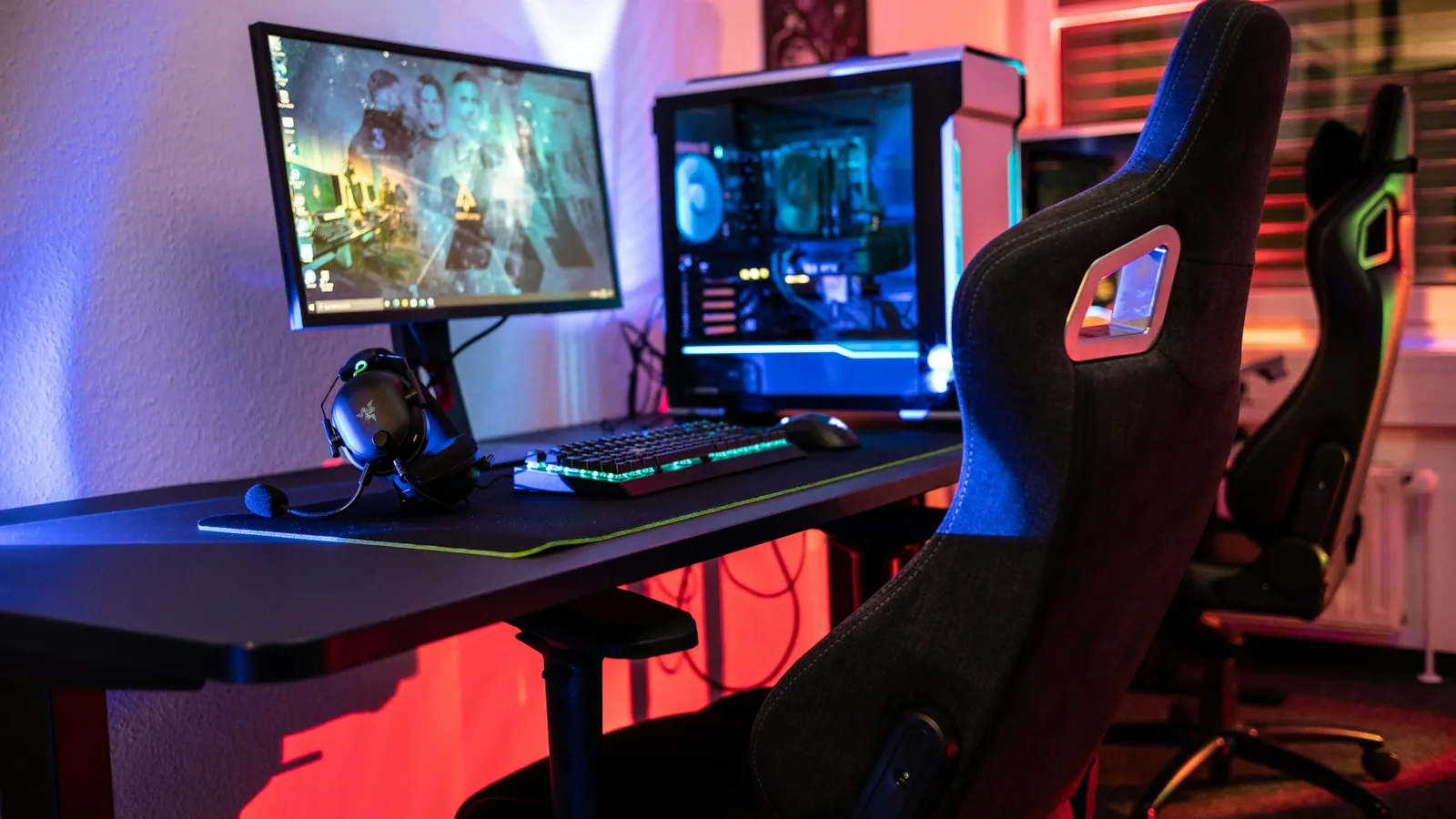
Is a gaming chair good for your back? It can be, but not because it is a gaming chair. What matters in any chair is whether it fits you: a seat at the right height and depth, a backrest you actually lean on with support in the small of your back, armrests that let your shoulders relax, and room to shift position through the day. Some gaming chairs do all of that, and some office chairs don’t. When we searched the medical literature in November 2026, we found no peer-reviewed trial comparing gaming chairs with office chairs for back pain, so the racing-seat styling, the pillows and the deep recline don’t prove anything on their own.
What makes a gaming chair different from an office chair?
Many chairs sold for gaming borrow the look of a racing-car seat: a tall backrest, raised side wings on the seat and back, a deep recline, and two loose cushions on straps, one for the lower back and one for the neck. A typical office chair has a shorter back with the lumbar support built in, and a flatter seat.
Neither shape is what the rules ask for. The UK regulations on display screen work set out what a work chair must do, and the list is short. The chair must be stable and allow “easy freedom of movement and a comfortable position”. The seat must adjust in height, the seat back must adjust in both height and tilt, and a footrest must be available to anyone who wants one (DSE Regulations 1992).
A gaming chair can meet that standard. So the question is the same as for any chair: what can I adjust, and does it fit me? If the backrest itself doesn’t move up and down, the strap-on cushion is standing in for that adjustment, so it only helps if it sits where your lower back needs it and stays there.
How do people actually sit when they game?
A 2026 study compared spine postures and how people used their workstation during gaming with office work, and checked both against ergonomic guidelines. Only its short practitioner summary is freely available, so here is the authors’ advice rather than their numbers.
That advice points at three things. Better monitor placement could reduce the rounding of the upper back (flexion of the thoracic spine) and the tipping back of the head during gaming. Chairs could help by making it easier to sit without the pelvis tilting backwards, by supporting the upper back and neck when people lean forward, and by encouraging them to use the backrest (Davidson et al., 2026).
The last point is the catch with any chair. A tall backrest and a neck pillow only support you while you lean against them. If you perch on the front of the seat and lean in towards the screen, the shape of the chair behind you hardly matters. Where the screen sits matters too, and our monitor setup guide covers height and distance.
Do gamers get more back pain?
Pain is common in people who play for long hours, though the research is young and mostly small. A 2026 meta-analysis found 13 studies on pain in esports players, six of which (553 players) could be pooled. Pain in the past year was reported by 73% and pain in the past week by 44%. The spine was the most affected area at 41%, with neck pain at 48% and wrist pain at 37% in the studies that measured them. The authors ask readers to treat the figures with caution because the studies were few and very different from one another, and they recommend regular breaks from long sitting and better ergonomics (Soffner et al., 2026).
A separate review of ten studies with 789 professional players found lower back pain figures anywhere from 4.7% to 63.8%, depending on the study. More symptoms went together with longer training and with a poor setup, such as having no armrests. Most of the studies were cross-sectional snapshots of moderate quality, which can show a link but not a cause (Schlesiger et al., 2026).
None of these studies tested a type of chair. What they point to is time in the seat and how the station is set up, which applies just as much to a long day of spreadsheets (how much of your year you spend sitting).
Do chairs make a difference to back pain at all?
Somewhat, and more so with know-how. A review of chair interventions found five studies, ranging from 4 to 293 participants. All five reported less self-reported pain straight after the chair change, but the authors rated the evidence as only moderate and could not say whether the effect lasts (van Niekerk et al., 2012).
In an office trial, one group received a highly adjustable chair plus ergonomics training, another got the training only, and a third waited. After 12 months, the chair-plus-training group had less build-up of symptoms over the workday. Training alone did not have that effect (Amick et al., 2003). A chair you know how to adjust seems to be the useful part, not a chair alone.
Armrests deserve a mention, given the esports finding. In a study that followed 632 newly hired computer users, having armrests on the chair was linked to a lower risk of neck and shoulder symptoms (Marcus et al., 2002).
Will a gaming chair give you better posture?
Probably not in the way the marketing suggests. An umbrella review of 41 systematic reviews found no consensus that particular spinal postures, or sitting itself, cause low back pain (Swain et al., 2020). Physiotherapy researchers have pointed out that the common belief that pain comes from sitting “incorrectly” lacks strong evidence, yet a large industry sells products to correct it (Slater et al., 2019). The same applies to posture correctors. A chair can make it easier to sit back with support. It cannot hold you in one perfect shape, and there is no good reason to want it to.
Why moving in your chair may matter more than the chair
One recent trial points at something no chair design alone can provide: change. In a cluster-randomised trial, 133 office workers at high risk of neck and back pain were given either a dynamic seat cushion that encourages shifts in posture, or a placebo seat pad. Over six months, 15% of the cushion group developed neck pain and 10% low back pain, against 65% and 59% in the placebo group. The authors concluded that the key factor was encouraging people to shift position while sitting (Channak et al., 2024). It was one trial of a cushion, not a chair, in a specific high-risk group, and effects that large need confirming. But it fits the guidance.
OSHA makes the same point about adjustability: it gives you support in a variety of sitting postures and “allows variability of sitting positions throughout the workday”. It also warns that a seat that is too small can restrict movement, and asks for one wide enough for most hip sizes (OSHA). If the raised side wings of a bucket-style seat press on your thighs or make it awkward to shift your weight, that works against you.
Changing position in the chair is one half. Getting out of it is the other, since long unbroken sedentary behaviour is what most of these studies have in common. Our guide to microbreaks looks at how often to get up, and the desk break timer can remind you. If you are weighing up a sit-stand desk as well, see Are standing desks worth it?
What to look for in a chair for office work
Whether the label says gaming or office, these are the features OSHA lists (OSHA):
- Seat height that adjusts, so your whole foot rests on the floor or a footrest with the backs of your knees slightly higher than the seat.
- Seat depth that fits, supporting most of the thigh without the front edge touching the backs of your knees. UK HSE guidance suggests a gap of 2 to 3 cm (HSE).
- A backrest that follows your spine, with lumbar support that adjusts in height to fit the small of your back, the inward curve of your lumbar spine, and a recline of at least 15 degrees from vertical that locks or has adjustable tension.
- Armrests that are soft and adjustable, letting your shoulders relax and your elbows stay close to your body. If they stop you getting close to the desk, remove them or stop using them.
- A stable five-leg base with castors that suit your floor.
OSHA also advises trying chairs before you buy. To set one up, work through how to set up your office chair, use the desk height calculator for a starting point, and run the workstation checklist for the rest of the desk.
Do the lumbar and neck pillows help?
The lumbar pillow can do the job OSHA describes, which is to fit into the small of the back. OSHA even suggests a rolled-up towel or removable cushion when a chair has no lumbar support, and HSE suggests a cushion for extra back support. The neck pillow is different: it only supports your head while you recline against it. We found no studies that tested either pillow on its own.
When to see a doctor
Back pain usually improves within a few weeks. The NHS advises seeing a GP if it doesn’t improve after a few weeks of home treatment, stops you doing day-to-day activities or worries you. See a GP too if you have lost weight without trying, there is a lump, swelling or change of shape in your back, the pain doesn’t improve with rest or is worse at night, it is worse when you sneeze, cough or poo, or it comes from between your shoulders rather than your lower back.
Ask for an urgent GP appointment or contact 111 if you feel hot, cold, shivery or generally unwell, or the pain is severe, starts suddenly or is getting worse quickly. Call 999 or go to A&E if you have pain, tingling, weakness or numbness in both legs, loss of feeling around your genitals or anus, changes in your bladder or bowels, chest pain, or if the pain started after a serious accident (NHS).
If your lower back is the problem, lower back pain from sitting goes into causes and what generally helps.
So, is a gaming chair good for your back?
- We found no trial showing a gaming chair is better or worse for your back than an office chair.
- Judge it like any work chair: seat height and depth, backrest height and tilt, lumbar support, armrests.
- A chair only supports you while you sit back in it.
- Shifting position and getting up seem to matter more than the chair’s design.
If long hours at the desk, or the console, leave your lower back stiff, the lower back stretches page has one gentle exercise from the app. Bavelu’s sessions for the lower back, neck and shoulders are designed and filmed by physiotherapists, and its desk routines of two to four minutes fit into the gaps between tasks.
Questions people ask
Are gaming chairs better than office chairs for your back?
We found no peer-reviewed trial that compared the two for back pain. What the guidance asks of any work chair is adjustability: a seat that adjusts in height, a backrest that adjusts in height and tilt, and support in the small of the back. A gaming chair that offers those can do the job, and an office chair that lacks them can't.
Can I use a gaming chair for office work all day?
Yes, if it fits you and adjusts like a good work chair. Check that your feet rest flat, the seat doesn't press into the backs of your knees, the armrests let you get close to the desk, and you can sit back against the backrest. Whatever the chair, getting up and changing position through the day matters too.
Do the lumbar and neck pillows on gaming chairs help?
The lumbar pillow can work like the lumbar support OSHA describes, as long as it sits in the small of your back and stays there. The neck pillow only supports you while you lean back against it, which most people don't do while typing or playing. We found no studies testing these pillows on their own.
Will a gaming chair fix my posture?
No chair fixes posture, and an umbrella review of 41 reviews found no consensus that any particular posture causes back pain. A chair can make it easier to sit back with support and to shift position. Moving often seems to matter more than holding one shape.
Why does my back hurt after gaming?
Long, still sessions are the usual suspect: a review of esports players linked longer training time and a poor setup, such as no armrests, with more musculoskeletal symptoms. Most of that research is cross-sectional, so it shows a link rather than a cause. If the pain doesn't settle after a few weeks of home care, the NHS advises seeing a GP.
Terms on this page
- Lumbar spineThe five vertebrae of the lower back, L1 to L5, with their discs, joints, nerves and muscles.
- Thoracic spineThe twelve vertebrae of the upper and middle back, T1 to T12, where the ribs attach.
- ErgonomicsThe science of designing work, tools and workplaces to suit the people who use them.
- Sedentary behaviourAny waking time spent sitting, reclining or lying while using very little energy.
Sources
- The Health and Safety (Display Screen Equipment) Regulations 1992, Schedule: minimum requirements for workstations. legislation.gov.uk.
- Davidson JM, Zehr JD, Noguchi M, Callaghan JP. Spine postures and workstation interactions in gaming: comparisons with office work and ergonomic guidelines. Ergonomics, 2026.
- Soffner M, Schmidt A, Tomschi F, Hilberg T. Do esports players experience pain? Pain prevalence of esports players: a systematic review and meta-analysis. Sports Medicine - Open, 2026.
- Schlesiger L, Oronowicz J, Lutter C, Tischer T, Seil R, Jasina A. Musculoskeletal disorders in eSports athletes: a systematic review. Journal of Experimental Orthopaedics, 2026.
- van Niekerk SM, Louw QA, Hillier S. The effectiveness of a chair intervention in the workplace to reduce musculoskeletal symptoms: a systematic review. BMC Musculoskeletal Disorders, 2012.
- Amick BC et al. Effect of office ergonomics intervention on reducing musculoskeletal symptoms. Spine, 2003.
- Marcus M et al. A prospective study of computer users: II. Postural risk factors for musculoskeletal symptoms and disorders. American Journal of Industrial Medicine, 2002.
- Swain CTV, Pan F, Owen PJ, Schmidt H, Belavy DL. No consensus on causality of spine postures or physical exposure and low back pain: a systematic review of systematic reviews. Journal of Biomechanics, 2020.
- Slater D, Korakakis V, O'Sullivan P, Nolan D, O'Sullivan K. "Sit up straight": time to re-evaluate. Journal of Orthopaedic and Sports Physical Therapy, 2019.
- Channak S, Speklé EM, van der Beek AJ, Janwantanakul P. The effectiveness of a dynamic seat cushion in preventing neck and low-back pain among high-risk office workers: a 6-month cluster-randomized controlled trial. Scandinavian Journal of Work, Environment & Health, 2024.
- OSHA. Computer Workstations eTool: Chairs.
- UK Health and Safety Executive. Good posture when using display screen equipment.
- NHS. Back pain. Last reviewed 5 March 2026.
This page explains a topic in general terms. It is not a diagnosis and does not replace a doctor or physiotherapist. If something hurts badly, keeps getting worse or comes with numbness, weakness or fever, see a doctor.
