Blog
What are exercise snacks, and do they work?
A minute of hard effort here and there sounds too small to matter. The studies are small too, but they are more interesting than you might expect.
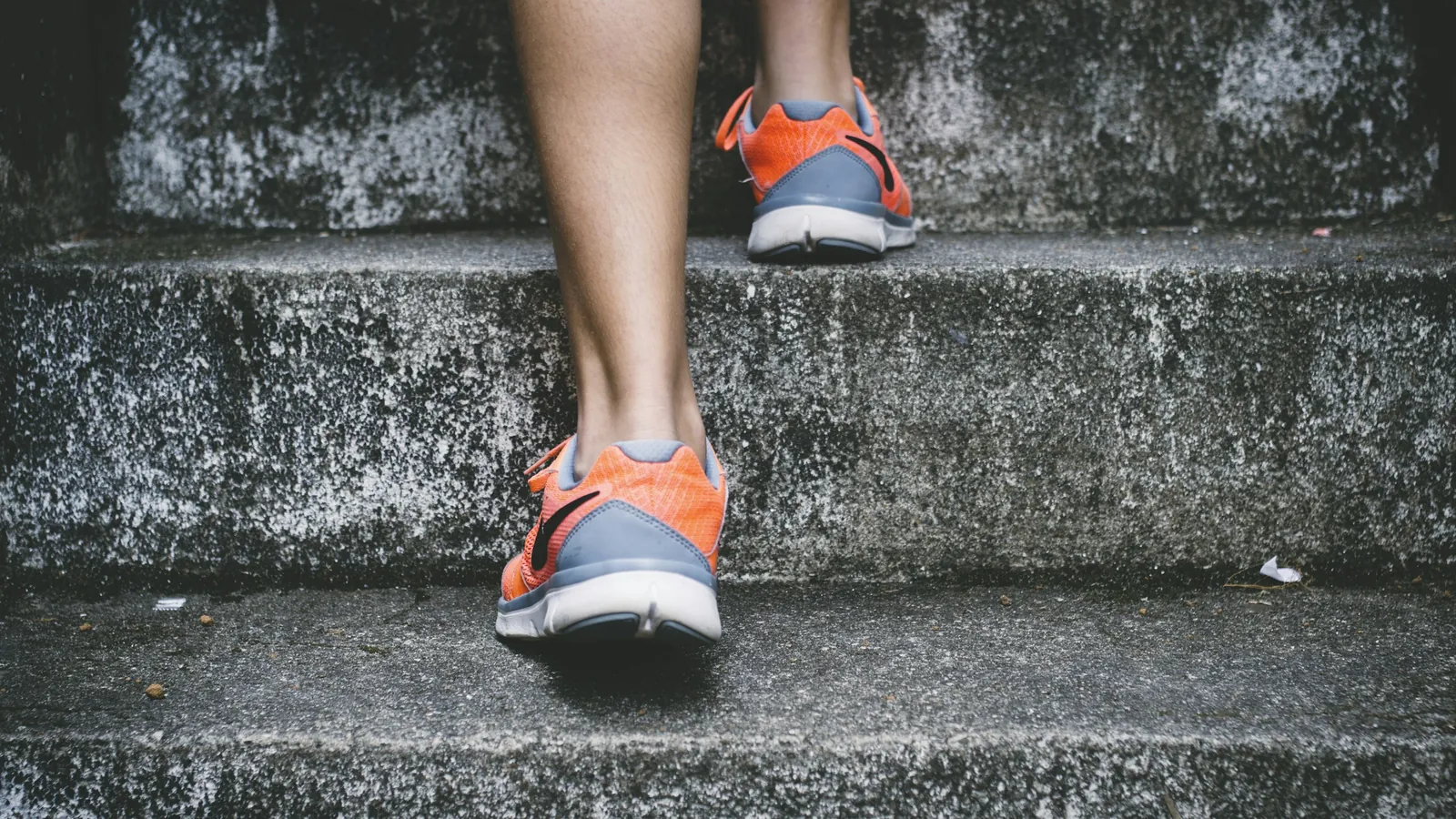
Exercise snacks are very short bouts of purposeful exercise, usually a minute or a few minutes of real effort, spread across the day instead of saved up for one workout. A fast climb up a few flights of stairs counts; a slow stroll to the kettle does not. The idea appeals because it fits around a desk job, and small trials suggest it can improve fitness. Whether it does anything for a sore neck or back is a separate question, and the answer there is much less certain.
What are exercise snacks?
One common definition comes from a 2022 review, which described exercise snacks as isolated bouts of vigorous exercise lasting a minute or less, done periodically through the day. Their hypothesis was that snacks are a feasible, time-efficient way to improve fitness and to offset some of the harm of long hours of sedentary behaviour. They were open about the evidence at the time: small proof-of-concept studies (Islam et al., 2022).
Since then the label has stretched. A scoping review found 33 studies using the idea, with 1,118 participants in total and a median of just 24 people per study. Most were run in a laboratory or at home. The most common snacks were body weight exercises and stair climbing, and where intensity was reported it averaged about 77% of maximum heart rate. The reviewers asked researchers to keep the term for short, purposeful, structured exercise dispersed through the day (Weston et al., 2025).
A 2026 meta-analysis used a slightly looser definition: structured bouts of up to five minutes, at least twice a day, at least three days a week, for at least two weeks (Rodríguez et al., 2026). So when you read about exercise snacks, check what the study meant by a snack.
How are exercise snacks different from microbreaks?
Three ideas overlap here, and they are easy to mix up.
- Microbreaks are short pauses from work. They may involve moving, or simply looking away from the screen. Our guide to microbreaks covers how often to take them.
- Breaking up sitting means interrupting long stretches in the chair with light activity, such as a short walk.
- Exercise snacks add effort. The point is to get your heart rate up or work a muscle hard, briefly.
All three have a place on a long desk day, but the research on one does not automatically apply to the others.
What do the studies on exercise snacks show?
Fitness: the clearest result
In one trial, 24 sedentary young adults were split into two groups of 12. One group climbed a three-flight stairwell of 60 steps vigorously, three times a day with one to four hours between climbs, on three days a week for six weeks. The other group did not train. Peak oxygen uptake, a standard measure of aerobic fitness, was higher in the climbers afterwards, although the authors described the absolute increase as modest (Jenkins et al., 2019).
The 2026 meta-analysis pooled 11 randomised trials with 414 physically inactive participants, whose average ages ranged from about 19 to 74 across the trials. Programmes ran for four to twelve weeks. Exercise snacks improved cardiorespiratory fitness in adults, with moderate certainty of evidence. In older adults there was a small gain in muscular endurance, but the certainty was very low. The review found no significant effect on leg strength, body composition, blood pressure or blood fats. Compliance and adherence were both high, at about 91% and 83% (Rodríguez et al., 2026).
Blood sugar after meals
Snack research has also looked at blood sugar. In a small study, nine people with insulin resistance tried three approaches on separate occasions: 30 minutes of moderate walking before dinner, or six one-minute bursts of intense incline walking before each main meal, or a mix of walking and resistance bursts. The bursts before meals lowered average blood glucose over 24 hours by 0.7 mmol/l, and the effect carried into the following day (Francois et al., 2014).
A related experiment tested lighter breaks. Nineteen adults aged 45 to 65 with overweight or obesity each took part in three sessions: uninterrupted sitting, or sitting broken up every 20 minutes by two minutes of walking at a light or a moderate pace. Both walking patterns lowered the rise in blood glucose and insulin after a sugary, fatty drink compared with uninterrupted sitting (Dunstan et al., 2012).
Both were short studies with fewer than 20 people. They show what happens over a day or two, not over months, and the 2026 meta-analysis did not find longer-term changes in the cardiometabolic markers it pooled.
Everyday bursts and long-term health
The most quoted number comes from an observational study rather than a trial. Researchers used wrist-worn activity trackers to look at 25,241 adults in the UK Biobank who reported no leisure-time exercise. Their average age was about 62, and they were followed for nearly seven years. The researchers looked for short bursts of vigorous activity built into daily life, such as very fast walking between places or climbing stairs.
People who had about three such bursts a day, each lasting one or two minutes, had a 38% to 40% lower risk of death from any cause or from cancer, and a 48% to 49% lower risk of death from heart and circulatory disease, than people with none (Stamatakis et al., 2022).
Those figures are striking, but they show an association, not proof that the bursts caused the difference. The authors say they cannot entirely rule out reverse causation: people who are already unwell may simply move less vigorously. And the bursts were incidental activity, not planned snacks.
Do exercise snacks help back or neck pain?
Most exercise snack research measures fitness and blood sugar, not pain. Whether short bursts of effort help a stiff neck or a sore lower back has barely been studied.
A 2026 systematic review tried. It found six randomised trials with 210 participants in sedentary jobs, comparing short active breaks of 2 to 10 minutes with uninterrupted sitting or passive rest. The breaks included stretching, walking, stair climbing and muscle contractions. Four of the six trials found that the active breaks eased musculoskeletal discomfort, and breaks with targeted stretching, strengthening or moderate effort seemed to do better than gentle walking. But five of the six trials had a high risk of bias, and the designs varied a lot (Zeng et al., 2026). Discomfort during a working day is also not the same as a long-standing pain condition.
The closest thing to a pain trial is not usually called an exercise snack at all. In a trial with 198 office workers who had frequent neck and shoulder pain, two minutes of strengthening with an elastic band on workdays for ten weeks reduced pain by 1.4 points on a 10-point scale compared with a group that received health information (Andersen et al., 2011). We look at that trial, and why the lower back is a different story, in Is two minutes of exercise enough?
What counts as an exercise snack?
The studies have mostly used a few kinds of activity:
- Stair climbing, one of the two most common choices.
- Very fast walking, including the incidental kind in the UK Biobank study.
- Body weight exercises, which need no equipment.
- Resistance with an elastic band, as in the neck and shoulder trial.
What makes them snacks is the effort, not the movement itself. The NHS describes vigorous activity as breathing hard and fast, to the point where you cannot say more than a few words without pausing, and lists walking up the stairs as an example (NHS).
A gentle stretch at your desk is closer to a microbreak than to an exercise snack in the research sense. It does a different job: comfort and a change of position. Our page on desk stretches shows one example, and How often should you stretch? looks at the timing question.
How do exercise snacks fit into a desk day?
The appeal for desk workers is obvious: you do not need a gym, a change of clothes or an hour. But “fits anywhere” is not the same as “happens”. When 20 office workers from a US exercise snack pilot study were interviewed, the most common barriers were time pressure and competing demands. What helped was adapting routines and the fact that snacks need very little space. Among their suggestions for the next version: more reminders (Zamora et al., 2025).
So the practical side is mostly about cues:
- Attach snacks to things you already do. The stairs instead of the lift, or the walk to a meeting. In the blood sugar study the bursts were tied to meals.
- Use a reminder. A desk break timer running in a browser tab makes it harder to sit through the afternoon without noticing.
- Mix the intensity. Not every break needs to be hard. Short pauses have their own value: a review of 22 study samples with 2,335 people found that micro-breaks gave a small lift in vigour and a small drop in fatigue (Albulescu et al., 2022).
- Know your baseline. The sitting time calculator shows how many hours you spend in a chair, and How much of your year do you spend sitting? puts those hours in context.
Do exercise snacks count towards your weekly activity?
Yes. The WHO’s 2020 guidelines dropped the old requirement that activity must come in bouts of at least 10 minutes: moderate to vigorous activity of any length now counts towards the recommended 150 to 300 minutes of moderate activity a week, or 75 to 150 minutes of vigorous activity. The guidelines also recommend muscle-strengthening activity and less sedentary time, and repeat that some activity is better than none (Bull et al., 2020). The NHS adds that several short sessions of very vigorous activity can help you reach your weekly target.
Who should check with a doctor first?
Exercise snacks are brief, but some of them are intense by design. The NHS advises speaking to your GP first if you have not exercised for some time, or if you have medical conditions or concerns, and making sure the activity and its intensity suit your fitness (NHS).
It is also worth knowing that many snack studies did not fully report side effects, according to the scoping review, so there is less information than you might expect about who they do not suit (Weston et al., 2025). If you have back or neck pain, our pages on neck pain from desk work and lower back pain from sitting list the signs that mean it should be checked by a doctor.
The short version
- Exercise snacks are short bouts of real effort spread through the day. Small trials show they can improve aerobic fitness in inactive people. Evidence for other health markers is thin so far.
- For neck and back pain, the direct evidence is limited and mostly low quality, though short regular strengthening has helped neck and shoulder pain in one trial.
- On a desk day, the hard part is remembering. Reminders and existing habits do most of the work.
Bavelu’s desk routines sit at the gentler end of this spectrum: two to four minutes of guided stretching at your desk, designed and filmed by physiotherapists and guided by your AirPods, for the moments between meetings.
Questions people ask
How long is an exercise snack?
There is no single definition. A 2022 review described snacks as bouts of vigorous exercise lasting a minute or less, while a 2026 review of trials counted bouts of up to five minutes done at least twice a day. Either way, the point is that the effort is short and spread across the day.
Do exercise snacks count towards the 150 minutes a week?
The WHO's 2020 guidelines say that moderate to vigorous activity of any bout length now counts towards the weekly target, which replaced the old rule of bouts lasting at least 10 minutes. The NHS also says several short sessions of very vigorous activity can help you reach your weekly target.
Can exercise snacks help back or neck pain?
Most exercise snack studies measured fitness or blood sugar, not pain. A 2026 review of six small trials in people with sedentary jobs found that short active breaks often eased musculoskeletal discomfort compared with uninterrupted sitting, but five of the six trials had a high risk of bias. Separately, a trial of two minutes of daily strengthening reduced neck and shoulder pain in office workers.
Are exercise snacks as good as a proper workout?
They have not been shown to replace one. A 2026 meta-analysis of 11 trials found that snacks improved cardiorespiratory fitness in inactive adults, with moderate certainty, but found no clear effect on leg strength, body composition, blood pressure or blood fats. Think of them as a way to add activity to a sitting day, alongside the rest of your week.
Is it safe to do short bursts of hard exercise?
The NHS advises speaking to your GP first if you have not exercised for some time, or if you have medical conditions or concerns, and choosing an intensity that suits your fitness. A scoping review also noted that many exercise snack studies did not fully report side effects, so there is less data on who they do not suit.
Terms on this page
Sources
- Islam H, Gibala MJ, Little JP. Exercise snacks: a novel strategy to improve cardiometabolic health. Exercise and Sport Sciences Reviews, 2022.
- Weston KL et al. Application of exercise snacks across youth, adult and clinical populations: a scoping review. Sports Medicine - Open, 2025.
- Rodríguez MÁ et al. Effect of exercise snacks on fitness and cardiometabolic health in physically inactive individuals: systematic review and meta-analysis. British Journal of Sports Medicine, 2026.
- Jenkins EM, Nairn LN, Skelly LE, Little JP, Gibala MJ. Do stair climbing exercise "snacks" improve cardiorespiratory fitness? Applied Physiology, Nutrition, and Metabolism, 2019.
- Francois ME et al. 'Exercise snacks' before meals: a novel strategy to improve glycaemic control in individuals with insulin resistance. Diabetologia, 2014.
- Dunstan DW et al. Breaking up prolonged sitting reduces postprandial glucose and insulin responses. Diabetes Care, 2012.
- Stamatakis E et al. Association of wearable device-measured vigorous intermittent lifestyle physical activity with mortality. Nature Medicine, 2022.
- Zeng J et al. Can exercise snacks alleviate musculoskeletal discomfort in prolonged sitting? A systematic review of randomized controlled trials. BMC Public Health, 2026.
- Andersen LL et al. Effectiveness of small daily amounts of progressive resistance training for frequent neck/shoulder pain: randomised controlled trial. Pain, 2011.
- Albulescu P et al. "Give me a break!" A systematic review and meta-analysis on the efficacy of micro-breaks for increasing well-being and performance. PLOS ONE, 2022.
- Zamora AN, Zeitlin AB, Moore JB, Oppezzo M. Exploring perceptions, barriers, and facilitators of participation in an exercise snack intervention among U.S. office workers: findings from a pilot study. American Journal of Health Promotion, 2025.
- Bull FC et al. World Health Organization 2020 guidelines on physical activity and sedentary behaviour. British Journal of Sports Medicine, 2020.
- NHS. Physical activity guidelines for adults aged 19 to 64. Last reviewed 22 May 2024.
This page explains a topic in general terms. It is not a diagnosis and does not replace a doctor or physiotherapist. If something hurts badly, keeps getting worse or comes with numbness, weakness or fever, see a doctor.