Blog
How often should you stretch?
At least two days a week for flexibility, most workdays if your neck or back is the reason, and short breaks through the day. Here is what that rests on, and what stretching really changes.
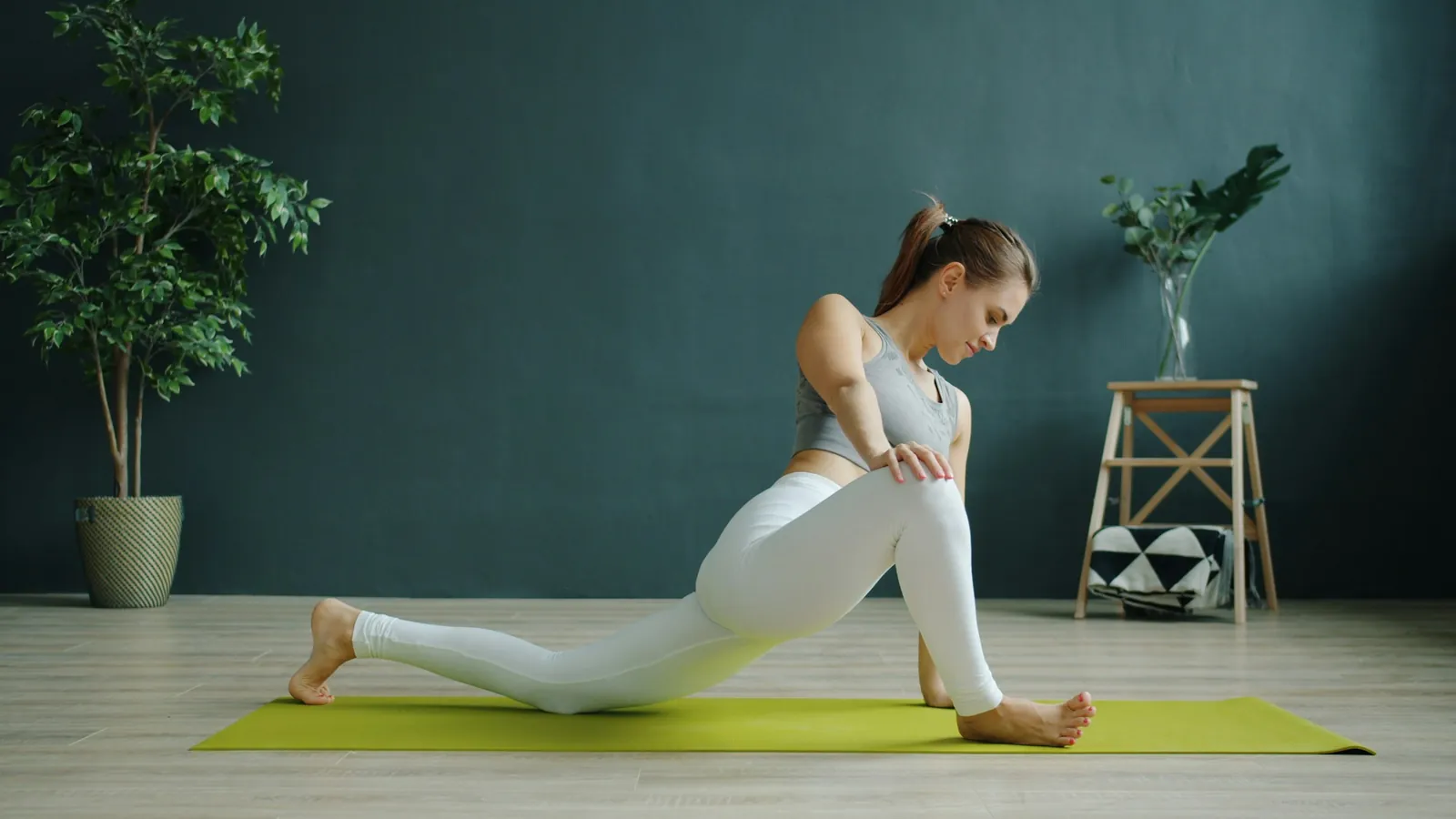
How often should you stretch? For general flexibility, guidelines say at least two days a week, and some studies suggest that most days works a little better. If a stiff neck or back from desk work is the reason, the stretching programmes that helped office workers in trials ran on most workdays, once or twice a day. Through the working day itself, short breaks to move or stretch every hour or so beat one long session. There is no magic number, and keeping it up for weeks matters more than the exact dose.
How often should you stretch for flexibility?
The best-known guidance comes from the American College of Sports Medicine. Its position stand recommends flexibility exercises for each of the major muscle groups on at least two days a week, about a minute in total per exercise, to maintain the range of movement in your joints (Garber et al., 2011). The NHS suggests doing its flexibility routine at least twice a week as well (NHS).
Does more often work better? The research is split.
- A review of 23 studies found that the total time spent stretching across a week mattered more than how long any single session lasted. More stretching days a week went with bigger gains, and the authors concluded that stretching on at least five days a week, for at least five minutes a week in total, may be beneficial (Thomas et al., 2018).
- A larger review of 77 studies confirmed that regular stretching improves range of motion, with a moderate effect compared with not stretching. But it found that neither the weekly volume, the intensity nor the frequency of stretching made a significant difference to the gains (Konrad et al., 2024).
A fair reading: two days a week is the floor most guidance agrees on. Stretching more often may help a little, but doing it consistently over weeks is what all the programmes that worked had in common.
What does stretching actually change?
In a classic experiment, seven healthy adults went through three weeks of hamstring stretching. Afterwards they could straighten the knee further. But when the researchers measured the muscle’s resistance at the same angle as before, nothing had changed: it was no less stiff. What had changed was how much tension people were willing to tolerate before they stopped. The authors called it increased stretch tolerance (Magnusson et al., 1996).
Later work has largely backed this up. A review of the theories concluded that a muscle does lengthen slightly while you stretch it, but that this effect is short-lived, and that the gains after a single session or a programme of three to eight weeks are mostly down to a change in sensation. Programmes longer than eight weeks had not been studied in this way (Weppler & Magnusson, 2010). A meta-analysis of 26 studies lasting three to eight weeks found trivial effects on muscle and tendon stiffness and structure, and concluded that the adaptations happen mostly at a sensory level (Freitas et al., 2018).
In plain terms: when a stretch feels easier after a few weeks, it is mostly your nervous system that has adjusted, not the muscle that has grown longer. That is not a lesser result. Being able to move further with less discomfort is what most desk workers are after.
How often should you stretch for neck or back pain?
Here the trials in office workers are the best guide.
- In a trial of 96 office workers with long-standing neck pain, stretching twice a day, five days a week, for four weeks reduced pain by 1.4 points more on a 10-point scale than an ergonomics brochure alone. People who stretched at least three times a week improved more in neck function than those who did it less often, although that comparison was not randomised (Tunwattanapong et al., 2016).
- In a six-month trial of 142 office workers with neck, shoulder and lower back pain, the stretching group did a 10 to 15 minute routine once a day, three days a week. Their pain scores fell more than in a group with no treatment, and they kept improving between the fourth and sixth month (Shariat et al., 2018).
So the programmes that helped were done on most workdays or every other day, for weeks or months.
There is a bigger caveat, though. When the Cochrane review pooled 27 trials of exercise for neck pain, low-quality evidence suggested that stretching on its own may not change pain in the short term, while programmes that built strength, or combined strengthening and stretching, had better support (Gross et al., 2015). We look at that in Is stretching or strengthening better? and in Do stretches help neck pain?
One trial on strengthening suggests that how you spread exercise across the week may matter less than you think. 447 office workers were split between no training and one hour a week of neck and shoulder strength training for 20 weeks, done as one 60-minute session, three 20-minute sessions or nine 7-minute sessions. Among those who started with neck pain, all three schedules reduced it, with no statistically clear difference between them (Andersen et al., 2012). That was strength training rather than stretching, but it is reassuring if your days only allow short slots.
Keep expectations realistic. A review of workplace stretching programmes found mixed results from studies of fairly low quality. Its authors added two warnings: stretching may mask the warning signs of a workstation problem if nothing else changes, and stretches done badly can cause or aggravate injuries (da Costa & Vieira, 2008).
How often a day should you stretch at your desk?
This is really a question about breaks, and the UK’s Health and Safety Executive has the clearest guidance. There is no legal rule on how long or how often breaks should be, but short breaks often are better than longer ones less often: 5 to 10 minutes every hour is better than 20 minutes every two hours. Breaks or changes of activity should let you get up and move around, or at least stretch and change posture (HSE).
What the evidence cannot yet say is that extra breaks prevent neck or back pain. A 2025 Cochrane review of nine trials with 626 workers, almost all in offices, found that adding breaks may make little or no difference to new neck or back pain in the one trial that measured it, with all the evidence rated very low certainty (Luger et al., 2025). That is a reason to be modest, not a reason to sit still.
A practical pattern for a desk day:
- Every hour or so, a short break to stand, walk or stretch. Our guide to microbreaks goes into the research, and the desk break timer can remind you.
- Most days, or at least two or three times a week, a longer, unhurried session for the areas that bother you. The exercise library explains individual stretches, from neck stretches to upper back stretches, and the desk stretches page covers ones you can do without leaving your chair.
- Twice a week, some strengthening. The NHS adult guidelines ask for strengthening activities that work all the major muscle groups on at least two days a week, and the neck trials favour it.
If evenings suit you better, stretches before bed looks at a wind-down routine after a day at a desk.
Is it OK to stretch every day?
For most people, yes. One of the office trials above used twice-daily stretching, and one review found more stretching days a week went with bigger gains (Thomas et al., 2018). What matters is that it stays gentle: a stretch should feel like a stretch, not pain. If a movement makes your symptoms worse, stop it and get advice rather than pushing through.
When to see a doctor
Stretching is for everyday stiffness, not for symptoms that need a diagnosis. The NHS advises seeing a GP if neck pain or stiffness has not gone after a few weeks, if painkillers have not worked, if you are worried, or if you have other symptoms such as pins and needles or a cold arm (NHS). For the back, see a GP if the pain has not improved after a few weeks or is worse at night, and call 999 or go to A&E if it comes with numbness or weakness in both legs, loss of feeling around your genitals or anus, or changes in bladder or bowel control (NHS). There is more on both in neck pain from desk work and lower back pain from sitting.
The short version
- For flexibility: at least two days a week; most days may help a little more.
- For a sore neck or back: the programmes that helped ran on most workdays for weeks, and the evidence is stronger when strengthening is added.
- At your desk: short breaks every hour or so, rather than one long one.
- What changes: mostly your tolerance to the stretch, more than the muscle itself.
Bavelu’s daily session comes in a short and a full version, and its desk routines take two to four minutes, all designed and filmed by physiotherapists.
Questions people ask
How often should you stretch to improve flexibility?
The American College of Sports Medicine recommends flexibility exercises for each major muscle group on at least two days a week, and the NHS suggests its flexibility routine at least twice a week. A review of 23 studies found that stretching on at least five days a week was linked to bigger gains, although a larger review of 77 studies found that frequency made no clear difference.
How many times a day should you stretch at work?
There is no tested number. UK health and safety guidance says short, frequent breaks are better than longer, occasional ones, for example 5 to 10 minutes every hour rather than 20 minutes every two hours, and that breaks should let you move around or at least stretch and change posture. A short break every hour or so is a reasonable habit, though the evidence that extra breaks prevent pain is weak.
Is it bad to stretch every day?
For most people, no. Trials in office workers have used programmes done twice a day on workdays, and one review linked more stretching days a week with bigger gains in range of motion. Stretching should feel gentle: stop if it causes pain, and see a doctor or physiotherapist if a movement keeps making your symptoms worse.
Does stretching make your muscles longer?
Not much, at least in the short term. Studies of programmes lasting three to eight weeks found little or no change in the muscle or tendon itself. The extra range comes mostly from stretch tolerance: your nervous system lets you go further before the stretch feels too uncomfortable.
How long before stretching makes a difference?
In the studies, gains in range of motion were measured after programmes of three to eight weeks. In office workers with neck pain, a stretching programme was tested over four weeks in one trial and six months in another. Results vary from person to person, and none of these studies can tell you how quickly your own pain will change.
Terms on this page
Sources
- Garber CE et al. American College of Sports Medicine position stand. Quantity and quality of exercise for developing and maintaining cardiorespiratory, musculoskeletal, and neuromotor fitness in apparently healthy adults: guidance for prescribing exercise. Medicine and Science in Sports and Exercise, 2011.
- NHS. Flexibility exercises. Last reviewed 20 November 2023.
- Thomas E, Bianco A, Paoli A, Palma A. The relation between stretching typology and stretching duration: the effects on range of motion. International Journal of Sports Medicine, 2018.
- Konrad A et al. Chronic effects of stretching on range of motion with consideration of potential moderating variables: a systematic review with meta-analysis. Journal of Sport and Health Science, 2024.
- Magnusson SP et al. A mechanism for altered flexibility in human skeletal muscle. The Journal of Physiology, 1996.
- Weppler CH, Magnusson SP. Increasing muscle extensibility: a matter of increasing length or modifying sensation? Physical Therapy, 2010.
- Freitas SR et al. Can chronic stretching change the muscle-tendon mechanical properties? A review. Scandinavian Journal of Medicine and Science in Sports, 2018.
- Tunwattanapong P, Kongkasuwan R, Kuptniratsaikul V. The effectiveness of a neck and shoulder stretching exercise program among office workers with neck pain: a randomized controlled trial. Clinical Rehabilitation, 2016.
- Shariat A et al. Effects of stretching exercise training and ergonomic modifications on musculoskeletal discomforts of office workers: a randomized controlled trial. Brazilian Journal of Physical Therapy, 2018.
- Gross A et al. Exercises for mechanical neck disorders. Cochrane Database of Systematic Reviews, 2015.
- Andersen CH et al. Influence of frequency and duration of strength training for effective management of neck and shoulder pain: a randomised controlled trial. British Journal of Sports Medicine, 2012.
- da Costa BR, Vieira ER. Stretching to reduce work-related musculoskeletal disorders: a systematic review. Journal of Rehabilitation Medicine, 2008.
- Health and Safety Executive. Working safely with display screen equipment: work routine and breaks.
- Luger T et al. Work-break interventions for preventing musculoskeletal symptoms and disorders in healthy workers. Cochrane Database of Systematic Reviews, 2025.
- NHS. Physical activity guidelines for adults aged 19 to 64. Last reviewed 22 May 2024.
- NHS. Neck pain and stiff neck. Last reviewed 27 April 2023.
- NHS. Back pain. Last reviewed 5 March 2026.
This page explains a topic in general terms. It is not a diagnosis and does not replace a doctor or physiotherapist. If something hurts badly, keeps getting worse or comes with numbness, weakness or fever, see a doctor.
