Exercises · Hips
Pigeon pose: what it stretches and how it should feel
A deep stretch for the hip and glutes, done on the floor. Below the steps: where you should feel it, the mistakes that move it into the knee, and who should pick a gentler version.
Pigeon
A deep hip and glute stretch that also takes pressure off the lower back.
- 4:12
- On a mat
- Hips
- Lower Back
Move slowly. Stop if it hurts, or if you feel tingling or numbness.
-
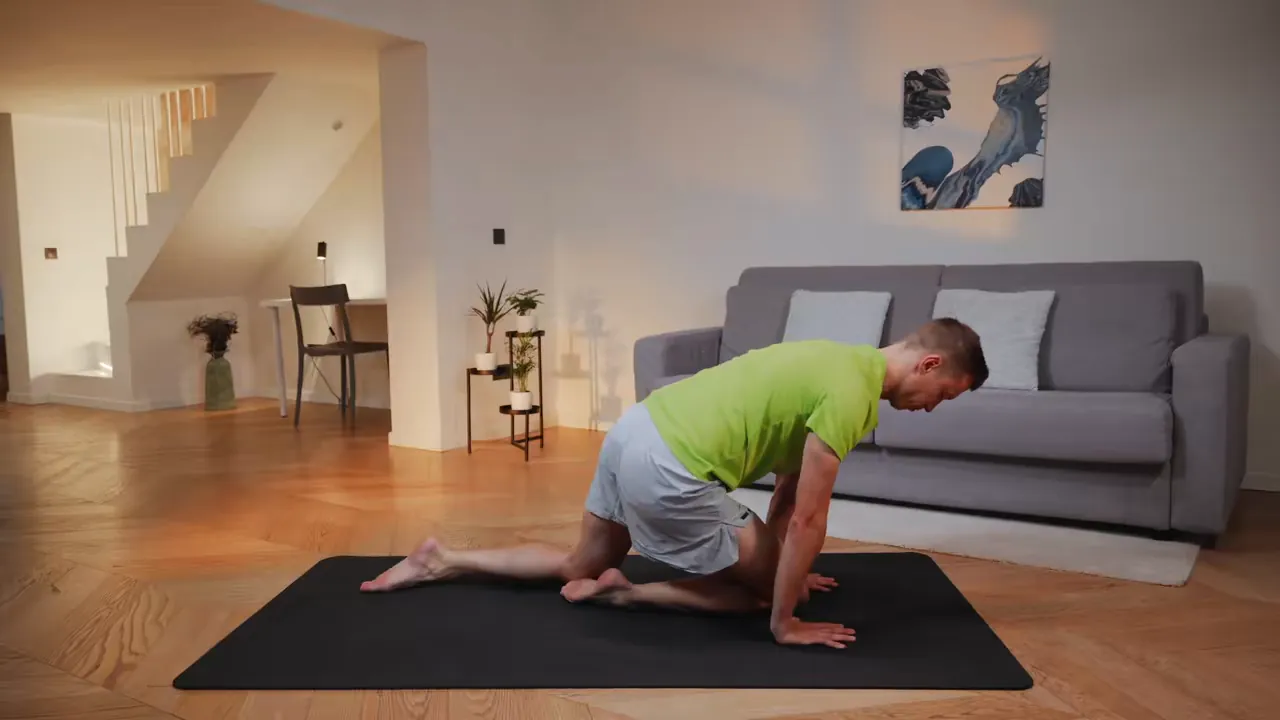
Step 1: From a plank, bring one knee forward behind your wrist.
Keep: From a plank, bring one knee forward behind your wrist.
Avoid: Struggling to place the kneeIf it will not go there without discomfort, take that as a sign to try a gentler version first.
-
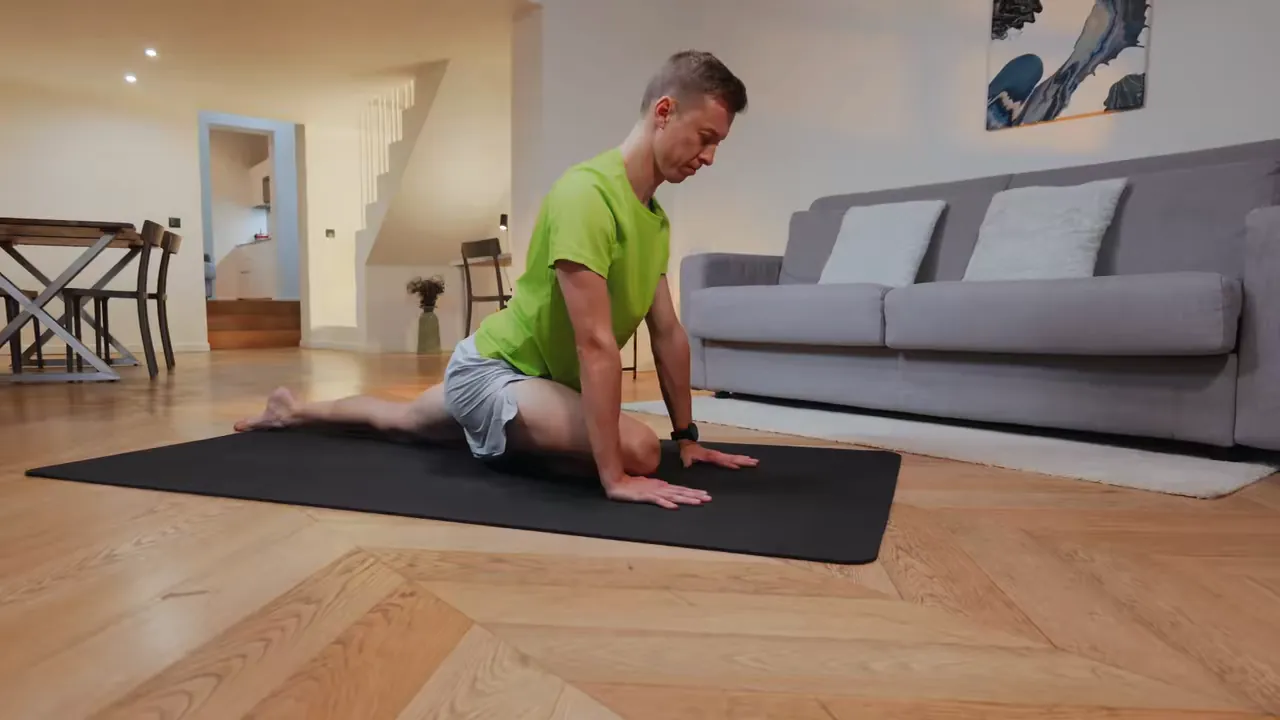
Step 2: Slide the other leg straight back along the mat.
Keep: Slide the other leg straight back along the mat.
Avoid: Back leg not straight back
-
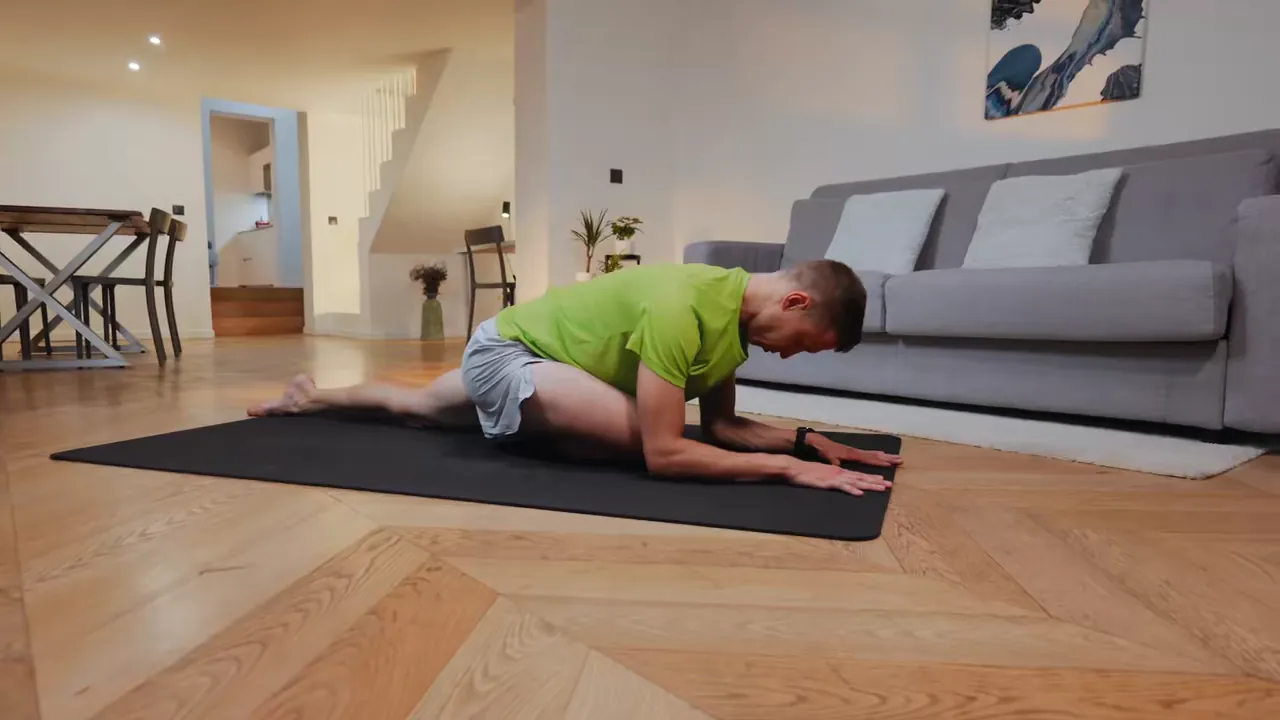
Step 3: Square your hips and fold over the front leg.
Keep: Square your hips rather than rolling onto the hip of the front leg.
Avoid: Hips not squareLetting the pelvis roll or twist changes where the stretch goes.
Keep: Fold over the front leg only as far as you choose. The chest does not need to reach the floor.
Avoid: Forcing the fold
-
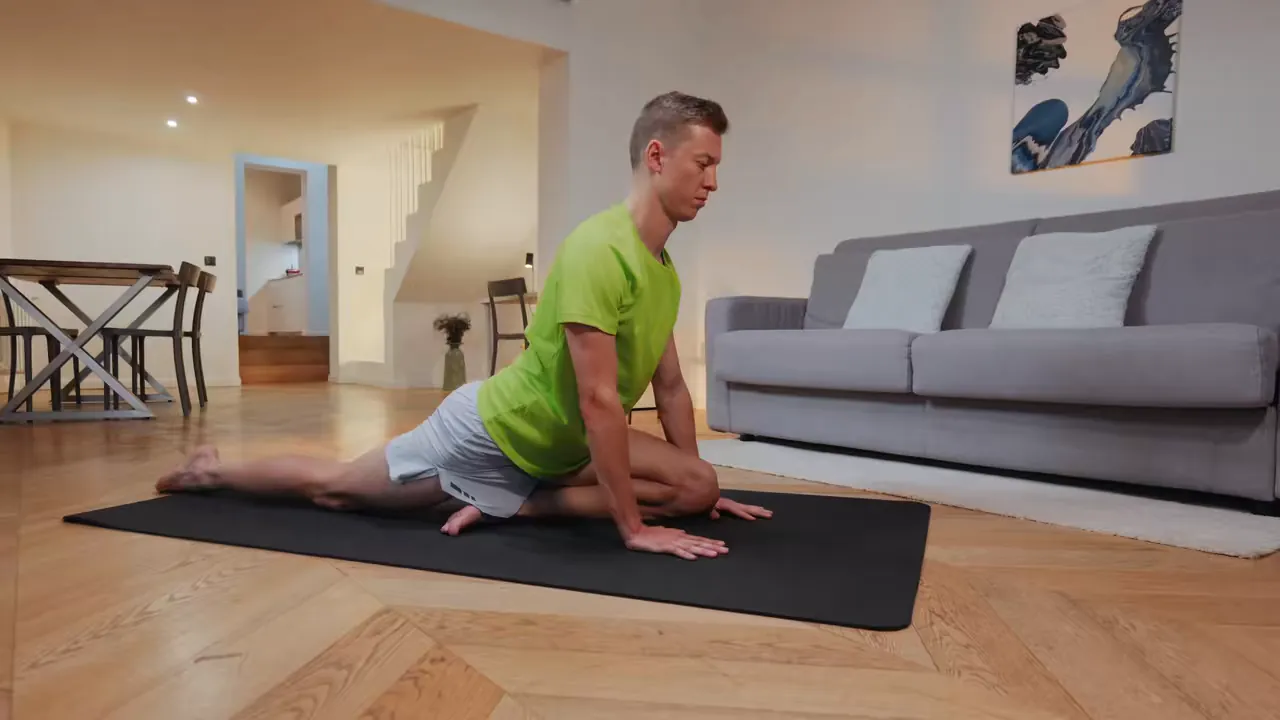
Step 4: Breathe into the hip, then switch sides.
Keep: Breathe into the hip, then switch sides.
Avoid: Holding your breath
Stills from the exercise video in the Bavelu app, with physiotherapist Mgr. Lukáš Kučera.
How it should feel
Gentle pullRight
A clear but comfortable stretch in the hip and buttock of the front leg, with your breathing steady.
Sharp pain, tingling or numbnessStop
Pain in the knee, a sharp pain anywhere, or tingling or numbness down a leg are reasons to come out of the pose.
Pigeon is one of 4 exercises in Hips and Lower Back
The other three are in the app, guided on video by a physiotherapist. The whole session takes about 11 minutes.
- Pigeon On this page
- Frog 2:38 · in the app
- Reclined Pigeon 2:34 · in the app
- Inward Leg Rotation 1:46 · in the app

Pigeon pose comes from yoga. The version above is the first exercise in Bavelu’s Hips and Lower Back session, where the app describes it as “a deep hip and glute stretch”. Deep is the right word. Pigeon asks a lot of the front hip and knee, which is why it is worth knowing where you should feel it, which mistakes move the strain somewhere else, and when a gentler version makes more sense.
What pigeon pose stretches
In pigeon, the front leg is bent with the knee forward and the hip turned outwards, while the back leg lies straight behind you. The stretch is designed for the hip and glutes of the front leg.
The buttock has two layers of muscle: the large gluteus maximus, medius and minimus near the surface, which move the thigh backwards and out to the side, and a group of smaller muscles underneath whose main job is to turn the thigh outwards (TeachMeAnatomy). With the hip bent and turned outwards and the body folded over it, the stretch is usually felt deep in the buttock and around the outside of the hip of the front leg.
It is not mainly a stretch for the hip flexors. The front hip is folded, which is the position the hip flexors shorten into, and the app lists pigeon as a hip and glute stretch. The glossary entry explains why the idea that sitting tightens the hip flexors has less evidence behind it than its popularity suggests.
Pigeon is also one of the longer exercises in the app, at just over four minutes including both sides. It is a stretch you breathe into, as the last step says, rather than one you move through.
Where you should feel it, and where you shouldn’t
You should feel a clear but comfortable stretch in the hip and buttock of the front leg, with your breathing steady. You should not feel it in the knee. The front knee is bent and turned, and some people feel the strain there instead of in the hip. Pain in the knee, a sharp pain anywhere, or tingling or numbness down a leg are reasons to come out of the pose.
The usual mistakes break one of the steps above:
- Hips not square. The third step asks you to square your hips. Rolling onto the hip of the front leg, or letting the pelvis twist, changes where the stretch goes.
- Forcing the fold. The third step says to fold over the front leg, not to get your chest to the floor. How far you fold is yours to decide.
- Holding your breath. The last step is to breathe into the hip.
- Struggling to place the knee. The first step brings the front knee forward behind your wrist. If you cannot get it there without discomfort, take that as a sign to try a gentler version first.
Gentler versions: reclined and chair pigeon
The app has two easier relatives of pigeon. Reclined Pigeon, later in the same session, is described in the app as “a gentler pigeon lying on your back, kind to the back and knees”. Chair Pigeon, for the office, has its own page under hip stretches. If the floor version bothers your knees, or getting down to a mat and back up is hard, those are the ones to look at.
Is pigeon pose safe? What the research says about yoga
No study has looked at pigeon pose on its own, but the safety of yoga has been studied.
- In trials, about as safe as other exercise. A review of 94 randomised trials of yoga, with 8,430 participants, found no difference in the frequency of side effects or serious side effects between yoga and usual care or other exercise. Yoga did have more minor side effects than psychological or education programmes (Cramer et al., 2015).
- Injuries do happen, more with age. US hospital emergency departments saw 29,590 yoga-related injuries between 2001 and 2014, according to national injury surveillance data. The trunk was the most commonly injured area (46.6%), and sprains and strains made up 45.0% of diagnoses. In 2014 the injury rate was 57.9 per 100,000 people doing yoga aged 65 and over, against 11.9 among those aged 18 to 44 (Swain & McGwin, 2016). These figures cover all yoga, not this pose, and only injuries serious enough for an emergency department.
So the research gives no reason to think yoga-style stretching is riskier than other exercise for most people, while older people and anyone with a joint problem have more reason to start gently and stay within what is comfortable.
Where pigeon fits
Pigeon is a floor exercise that suits the end of the day. The app’s Hips and Lower Back session sits with its evening wind-down routines and finishes with Inward Leg Rotation, which has its own page under lower back stretches. If you want a calm routine for the last hour before sleep, see stretches before bed. Stretching is only one side of looking after your hips: the glute bridge works the glutes rather than lengthening them, and the exercises section has more.
Who should be careful
Stop if it hurts, and do not push through pain in the knee or hip. Check with a doctor or physiotherapist before trying pigeon if:
- you have a knee problem or have had knee surgery. The front knee is deeply bent and turned. The NHS advises getting help from 111 if your knee locks, gives way, is badly swollen or you cannot put weight on it, and seeing a GP if knee pain has not improved within a few weeks (NHS).
- you have had a hip replacement. While the hip recovers, the NHS advises not bending it more than 90 degrees and not sitting with your legs crossed (NHS). Pigeon bends the front hip well past that, so only do it if your surgical team says so.
- you have osteoporosis or have had a spinal fracture. Folding over the front leg rounds the spine forward. A UK consensus statement recommends avoiding postures with a high degree of spinal flexion, and notes reports of spinal fractures linked with some yoga positions involving extreme forward bending (Brooke-Wavell et al., 2022). A physiotherapist can tell you which version suits you.
- you are pregnant. Folding forward presses the trunk towards the front leg and the floor. The NHS advises telling your instructor you are pregnant, stopping if you feel uncomfortable, and speaking to your midwife if you have a health condition (NHS).
- pain, tingling or numbness runs down a leg, or your back pain comes with any of the warning signs listed under lower back pain from sitting. Get that assessed first. If you are weighing up a private appointment, see how much physiotherapy costs.
The rest of the Hips and Lower Back session is listed above. In the app it runs for about eleven minutes, designed and filmed for Bavelu by physiotherapists and guided on video from the first exercise to the last.
Questions people ask
What does pigeon pose stretch?
Mainly the hip and glutes of the front leg, which is bent and turned outwards. The app describes it as a deep hip and glute stretch. It is not mainly a hip flexor stretch, because the front hip is folded rather than lengthened.
Why does pigeon pose hurt my knee?
The front knee is bent and turned out, and some people feel the strain there instead of in the hip. If you feel it in the knee rather than the hip, stop. A gentler version, such as a reclined or chair pigeon, may suit you better, and knee pain that does not settle within a few weeks is worth showing to a GP or physiotherapist.
Is pigeon pose safe?
For most people, yoga-style stretching appears to be about as safe as other exercise: a review of 94 trials found no more side effects with yoga than with usual care or exercise. Injuries do happen, more often in people aged 65 and over, so stay within what is comfortable and skip the pose if you have a knee or hip problem, a recent hip replacement or osteoporosis, until a physiotherapist says it is fine.
Is pigeon pose good for lower back pain?
It has not been tested on its own for back pain. The app pairs it with lower back exercises in its Hips and Lower Back session, but it is designed as a hip and glute stretch. Stop if it makes back pain worse, and see the warning signs on our lower back pain page.
Terms on this page
Sources
- TeachMeAnatomy. The muscles of the gluteal region.
- Cramer H, Ward L, Saper R, Fishbein D, Dobos G, Lauche R. The safety of yoga: a systematic review and meta-analysis of randomized controlled trials. American Journal of Epidemiology, 2015.
- Swain TA, McGwin G. Yoga-related injuries in the United States from 2001 to 2014. Orthopaedic Journal of Sports Medicine, 2016.
- NHS. Knee pain. Last reviewed 21 December 2023.
- NHS. Recovering from a hip replacement. Last reviewed 6 March 2024.
- Brooke-Wavell K et al. Strong, steady and straight: UK consensus statement on physical activity and exercise for osteoporosis. British Journal of Sports Medicine, 2022.
- NHS. Exercise in pregnancy. Last reviewed 24 September 2026.
This page explains a topic in general terms. It is not a diagnosis and does not replace a doctor or physiotherapist. If something hurts badly, keeps getting worse or comes with numbness, weakness or fever, see a doctor.