Blog
Is it bad to crack your neck?
The pop is a gas cavity forming inside a joint, and it is not known to cause arthritis. Forcing your own neck to crack is a different matter: serious harm is rare, but it happens. Here is what the evidence shows.
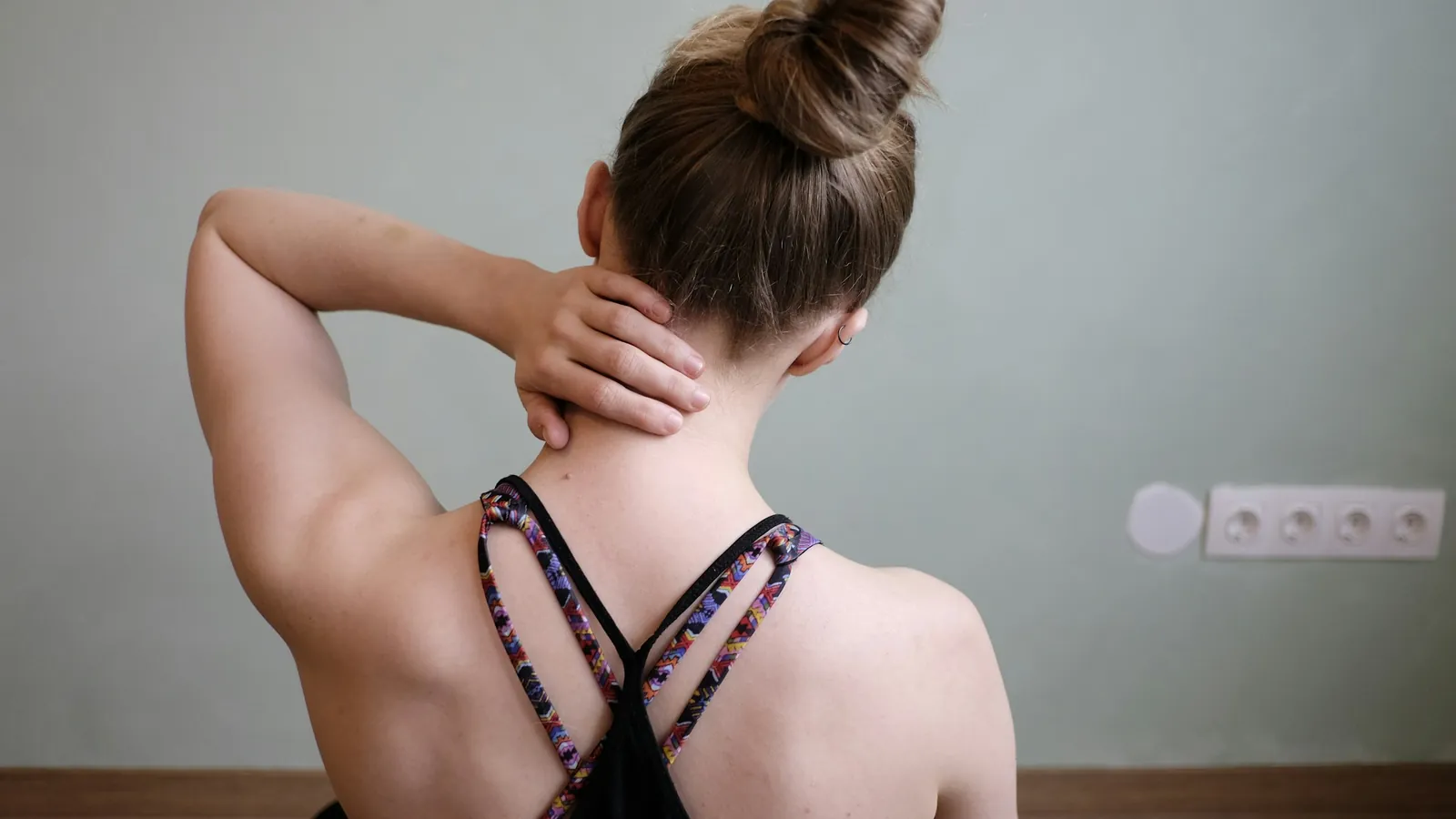
Is it bad to crack your neck? A crack that happens on its own as you turn your head is not known to do any harm. Deliberately forcing your neck to crack, especially by twisting your head with your hands, is a different matter. Serious problems are rare, but published cases include torn arteries and strokes, and the pop itself is not what makes a stiff joint feel better. Here is what the sound is, what the research found, and what to do instead when your neck feels stiff after a day at a desk.
What is the cracking sound?
The sound has a name: cavitation. When the two surfaces of a joint are pulled apart quickly, a gas-filled cavity forms in the fluid inside it.
For decades, researchers argued about which part of that makes the noise. A 1947 X-ray study put it down to the cavity forming. In 1971 another team disputed that, and the collapse of a bubble became the usual explanation (Kawchuk et al., 2015).
In 2015, researchers filmed ten knuckle joints inside an MRI scanner while pulling on the fingers until they cracked. The sound came at the moment the joint surfaces separated and a cavity appeared, and the cavity was still visible afterwards. Their conclusion was that the crack comes from the cavity forming, not from a bubble bursting. The same paper describes the well-known pause afterwards: once a joint has cracked, it cannot crack again until about 20 minutes have passed (Kawchuk et al., 2015).
The debate is not quite over. A 2018 mathematical model found that the sound could be explained by the bubble partly collapsing, with some of it left behind (Chandran Suja & Barakat, 2018). Either way, the noise comes from gas and fluid inside the joint.
Does the same thing happen in the spine?
It appears so. Each vertebra in your neck, the cervical spine, and in the rest of your back is linked to the next by a pair of small joints at the back, the facet joints. In a study of 40 healthy young adults, researchers scanned the lower back before and after spinal manipulation. Facet joints that cracked had opened up more than those that did not, 0.56 mm against 0.22 mm on average. But the crack only told them that a joint had opened, not by how much (Cramer et al., 2012).
Does cracking your joints cause arthritis?
Most of the research is on knuckles, and it is reassuring.
- In a study of 215 people aged 50 to 89 who had hand X-rays, about one in five cracked their knuckles. Osteoarthritis in the hand was no more common in crackers than in non-crackers (18% against 22%), and even decades of the habit made no difference (deWeber et al., 2011).
- An older study of 300 people aged 45 and over also found no extra arthritis in habitual knuckle crackers, but it did find more hand swelling and weaker grip. The crackers were also more likely to do manual work, bite their nails, smoke and drink, so it is hard to say what caused what (Castellanos & Axelrod, 1990).
For the neck, there are no comparable long-term studies. A 2026 review noted that there is no population data at all describing the habit (Meyer et al., 2026).
Is it bad to crack your neck on purpose?
This is where the real concern lies, and it is not arthritis.
The 2026 review searched the medical literature up to May 2024 for cases of harm after people manipulated their own necks. It found 24 published cases. Most were men, with an average age of 34. Half had started with neck pain or stiffness, and most had used their own hands. Twelve involved a torn neck artery, called a cervical artery dissection, and twelve a stroke; some people had both. Four cases were rated catastrophic, and two people died. Almost all the problems began within two days (Meyer et al., 2026).
Two things keep this in proportion. The authors found no evidence that such events are common, and rated the certainty that self-manipulation can cause serious harm as very low. And they could not tell whether the cracking caused the harm, made worse a tear that had already started, or was simply something people did to ease the early symptoms of a tear nobody had yet diagnosed.
That last possibility matters because of what an artery tear feels like. The American Heart Association describes cervical artery dissections as among the most common causes of stroke in young and middle-aged adults, and lists symptoms that include a headache on one side, pain at the back of the neck and a pulsing sound in the ear (Biller et al., 2014). Neck pain and headache are common symptoms of a tear in the arteries at the back of the neck, and such a tear often comes before the stroke itself (Cassidy et al., 2008). In other words, the first sign can feel much like an ordinary stiff neck.
Research on professional manipulation tells a similar story. An Ontario study looked at 818 vertebrobasilar strokes, which involve the arteries that run up the back of the neck to the brain, over more than 100 million person-years. People under 45 who had such a stroke were about three times more likely than others to have seen a chiropractor beforehand, but also about three times more likely to have seen their family doctor. The authors concluded that people with headache and neck pain from an early artery tear were seeking help before the stroke (Cassidy et al., 2008). A later review found a small statistical link between chiropractic care and artery tears, based on very low-quality evidence, and no convincing evidence that one causes the other (Church et al., 2016).
So the risk from any single crack is very small. But half the cases in the review began with neck pain or stiffness, and a new or unusual neck pain, especially with a headache, is exactly when getting it checked matters more than getting a pop.
Does cracking your neck actually help?
The pop feels like a release, but studies of spinal manipulation suggest the sound itself is not what helps.
- In 71 people with low back pain, those whose manipulation produced a pop improved no more than those whose did not (Flynn et al., 2003).
- In another 70 people with low back pain, a pop made no difference to pain, disability or movement at any point (Flynn et al., 2006).
- In 78 people with neck pain treated with manipulation of the upper back, the number of pops was not related to how much they improved (Cleland et al., 2007).
And the effect of a single manipulation appears to be short-lived. The Cochrane review of 51 trials found that, for neck pain lasting weeks or months, a single neck manipulation by a practitioner relieved pain straight afterwards but not at short-term follow-up, based on low to very low-quality evidence (Gross et al., 2015). Those were trained practitioners who examined people first. The NHS also notes that chiropractic may not be safe if you take blood-thinning medicines, are at increased risk of bleeding or stroke, have very weak or seriously damaged bones or joints, or have a nerve condition such as peripheral neuropathy (NHS).
What about cracking your back?
The same cavitation happens in the facet joints of the lower back, the lumbar spine, as the study above showed. The serious artery problems in the self-manipulation review involved the arteries of the neck, and that review covered only the neck; we did not find a comparable review of people cracking their own backs. What the low back studies do show is that a pop made no difference to how much people improved with manipulation, so there is nothing to gain from chasing one.
If your mid-back feels stiff from hours at a screen, gentle movement is a calmer option than forcing it. Our pages on thoracic spine mobility exercises and the cat-cow stretch explain movements for the thoracic spine, the part of the back between your neck and your lower back.
Why does my neck feel like it needs to crack?
For desk workers, a common reason is staying in one position for too long. The NHS lists bad posture, such as sitting at a desk for a long time, and sleeping with the neck in an awkward position among the common causes of neck pain. Its advice is to keep the neck moving rather than resting it in a collar, and to try neck flexibility exercises (NHS).
That points to a better habit than cracking:
- Move it gently. Our pages on stretches for a stiff neck and neck stretches explain movements you can do sitting down, and Do stretches help neck pain? looks at the evidence.
- Change position more often. Our guide to microbreaks covers how often to move during the workday.
- Check your screen. Where your monitor sits shapes how you hold your head for hours at a time; see how to set up your monitor.
- Look at your pillow if the stiffness is worst in the morning: stiff neck after sleeping.
If you find yourself cracking your neck many times a day to get relief, that is worth mentioning to a GP or physiotherapist. Neck pain from desk work covers the common causes in more detail.
When to see a doctor
Some warning signs, often called red flags, need help straight away. Call 999 if you notice signs of a stroke: one side of the face drooping, weakness or numbness in one arm, slurred or confused speech, dizziness or falling over, blurred vision or loss of sight, or a severe headache. Call even if the signs came within the last 24 hours and have now stopped (NHS). Because a torn neck artery can show up as a one-sided headache, pain at the back of the neck or a pulsing sound in the ear (Biller et al., 2014), get those checked by a doctor promptly, especially if they start soon after cracking your neck or a neck injury.
See a GP if neck pain or stiffness has not gone after a few weeks, painkillers have not helped, you are worried, or you have other symptoms such as pins and needles or a cold arm (NHS, neck pain). For the back, call 999 or go to A&E if back pain comes with numbness or weakness in both legs, loss of feeling around your genitals or anus, or changes in bladder or bowel control (NHS).
The bottom line
- The pop is cavitation, a gas cavity forming in the fluid inside a joint.
- Cracking is not known to cause arthritis, at least in the knuckles, where it has been studied.
- Forcing your own neck to crack carries a small risk of serious harm, mostly from artery tears. Leave it alone when the neck pain is new or comes with a headache.
- The pop is not what helps. Gentle movement and fewer hours in one position are the better habit.
Bavelu’s neck sessions are guided stretching and mobility, designed and filmed by physiotherapists, for the days your neck feels stiff and you want to move it rather than force it.
Questions people ask
What is the popping sound when you crack your neck?
It is cavitation: when the surfaces of a joint are pulled apart quickly, a gas-filled cavity forms in the fluid inside it. An MRI study of knuckles found the sound happens as the cavity forms, though one modelling study argues it comes from the bubble partly collapsing. After a crack, a joint usually cannot crack again for about 20 minutes.
Is it bad to crack your neck every day?
There are no long-term studies of people who habitually crack their necks. Pops that happen on their own as you move are not known to cause harm. Forcing a crack by twisting your head with your hands has been followed by serious problems such as artery tears and strokes in published case reports, although these are rare and it is not clear the cracking caused them.
Can cracking your neck cause a stroke?
It is possible but rare. A 2026 review found 24 published cases of harm after neck self-manipulation: 12 involved a torn neck artery and 12 a stroke, some both, and two people died. The authors could not tell whether the cracking caused these, worsened a tear already under way, or was something people did to ease its early symptoms.
Does cracking your knuckles or neck cause arthritis?
For knuckles, studies have found no link: in 215 people aged 50 to 89, arthritis was no more common in knuckle crackers, even after decades of the habit. One older study did find more hand swelling and weaker grip in habitual crackers. There are no comparable studies for the neck.
Is it bad to crack your back?
The same gas cavity forms in the small joints of the back. There is little research on people cracking their own backs, and the serious artery problems seen after neck self-manipulation involve arteries in the neck. Studies of spinal manipulation found that hearing a pop made no difference to how much people improved, so there is no need to chase it.
Terms on this page
- Zygapophyseal jointsThe facet joints: small paired joints at the back of the spine that guide and limit its movement.
- Cervical spineThe seven vertebrae of the neck, C1 to C7, from the base of the skull to the top of the chest.
- OsteoarthritisWear in the joints and discs; in the spine it is called spondylosis and is common with age.
- Lumbar spineThe five vertebrae of the lower back, L1 to L5, with their discs, joints, nerves and muscles.
- Thoracic spineThe twelve vertebrae of the upper and middle back, T1 to T12, where the ribs attach.
- Red flagsWarning signs that back or neck pain could have a serious cause and needs a doctor promptly.
Sources
- Kawchuk GN et al. Real-time visualization of joint cavitation. PLOS ONE, 2015.
- Chandran Suja V, Barakat AI. A mathematical model for the sounds produced by knuckle cracking. Scientific Reports, 2018.
- Cramer GD et al. Quantification of cavitation and gapping of lumbar zygapophyseal joints during spinal manipulative therapy. Journal of Manipulative and Physiological Therapeutics, 2012.
- deWeber K, Olszewski M, Ortolano R. Knuckle cracking and hand osteoarthritis. Journal of the American Board of Family Medicine, 2011.
- Castellanos J, Axelrod D. Effect of habitual knuckle cracking on hand function. Annals of the Rheumatic Diseases, 1990.
- Meyer KW et al. Adverse events following cervical spine self-manipulation: a systematic review. PM&R, 2026.
- Biller J et al. Cervical arterial dissections and association with cervical manipulative therapy: a statement for healthcare professionals from the American Heart Association/American Stroke Association. Stroke, 2014.
- Cassidy JD et al. Risk of vertebrobasilar stroke and chiropractic care: results of a population-based case-control and case-crossover study. Spine, 2008.
- Church EW et al. Systematic review and meta-analysis of chiropractic care and cervical artery dissection: no evidence for causation. Cureus, 2016.
- Flynn TW, Fritz JM, Wainner RS, Whitman JM. The audible pop is not necessary for successful spinal high-velocity thrust manipulation in individuals with low back pain. Archives of Physical Medicine and Rehabilitation, 2003.
- Flynn TW, Childs JD, Fritz JM. The audible pop from high-velocity thrust manipulation and outcome in individuals with low back pain. Journal of Manipulative and Physiological Therapeutics, 2006.
- Cleland JA, Flynn TW, Childs JD, Eberhart S. The audible pop from thoracic spine thrust manipulation and its relation to short-term outcomes in patients with neck pain. Journal of Manual and Manipulative Therapy, 2007.
- Gross A et al. Manipulation and mobilisation for neck pain contrasted against an inactive control or another active treatment. Cochrane Database of Systematic Reviews, 2015.
- NHS. Herbal medicines and complementary therapies (chiropractic). Last reviewed 1 May 2026.
- NHS. Neck pain and stiff neck. Last reviewed 27 April 2023.
- NHS. Symptoms of a stroke. Last reviewed 12 September 2024.
- NHS. Back pain. Last reviewed 5 March 2026.
This page explains a topic in general terms. It is not a diagnosis and does not replace a doctor or physiotherapist. If something hurts badly, keeps getting worse or comes with numbness, weakness or fever, see a doctor.
