Exercises · Upper back
Thoracic spine mobility exercises for a stiff mid-back
The ribs limit how far your mid-back bends forwards and backwards, but its middle section can turn. This rotation on all fours works on that turn. Here is how it should feel, and what mobility work can and cannot do.
Thoracic Rotation on All Fours
A rotation that brings movement back to a stiff mid-back and opens the chest.
- 1:59
- On a mat
- Upper Back
- Chest
Move slowly. Stop if it hurts, or if you feel tingling or numbness.
-
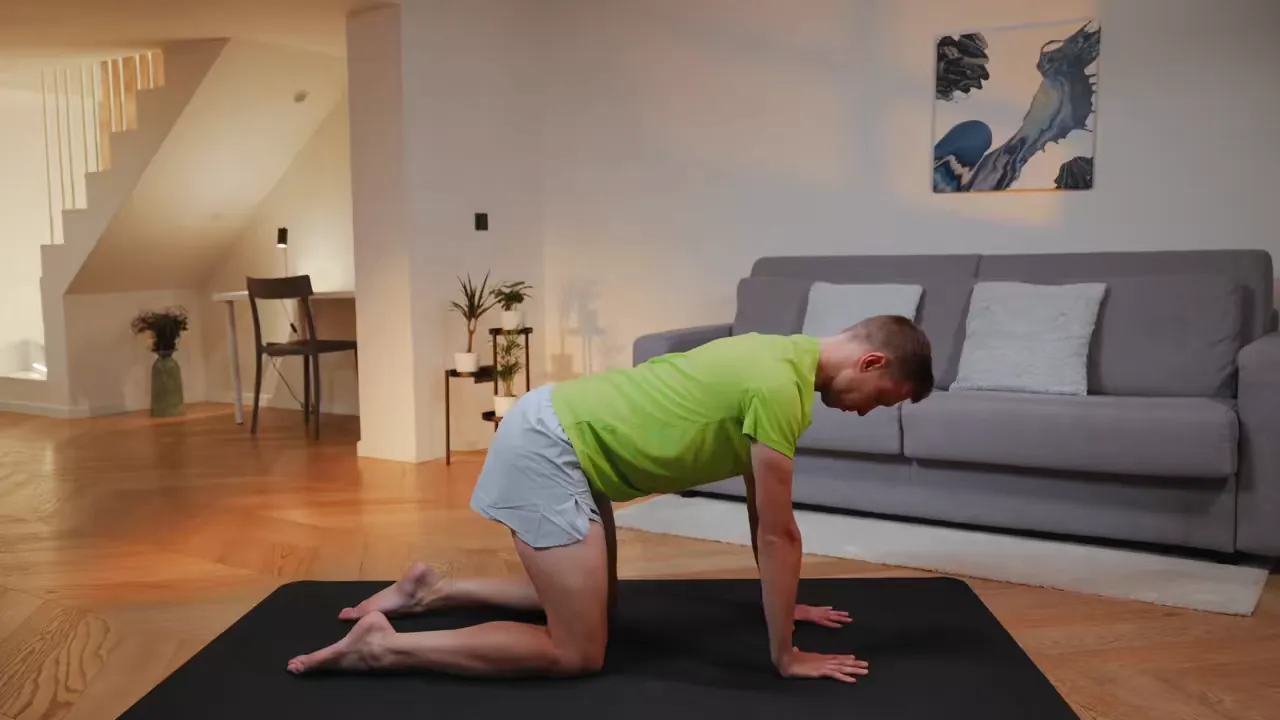
Step 1: Come onto all fours.
Keep: Come onto all fours.
Avoid: Skipping the all-fours start
-
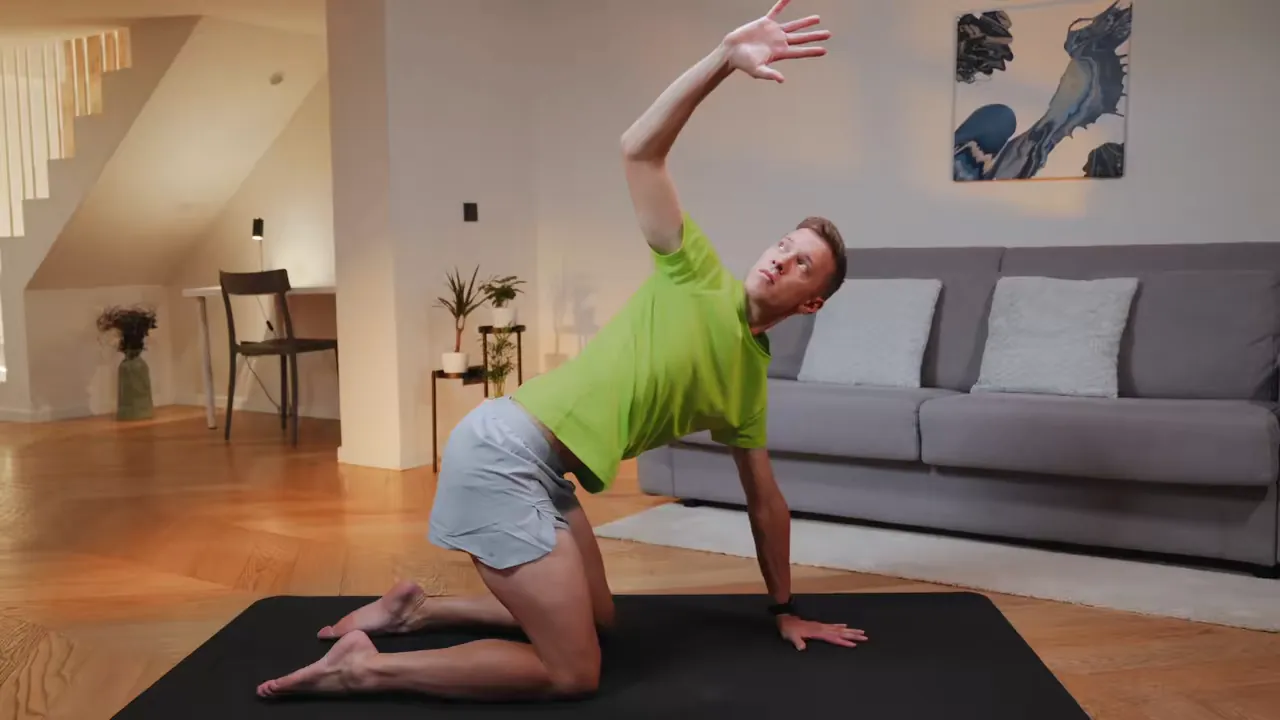
Step 2: Lift one arm and turn your chest and gaze after it towards the ceiling.
Keep: Turn your chest after the arm, not just lift it.
Avoid: Moving only the arm
Keep: Your gaze follows the arm towards the ceiling.
Avoid: Keeping your eyes on the floor
-
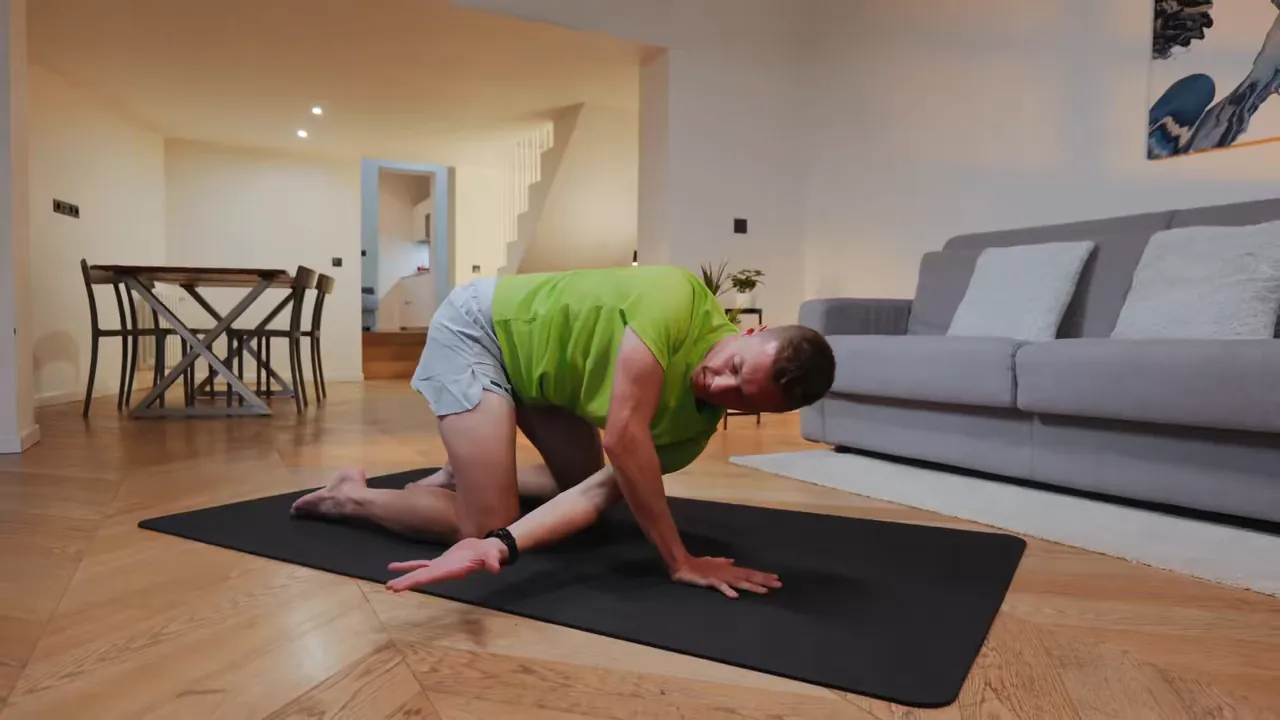
Step 3: Slowly bring the arm down and thread it under your body.
Keep: Bring the arm down slowly before threading it under your body.
Avoid: Rushing the return
-
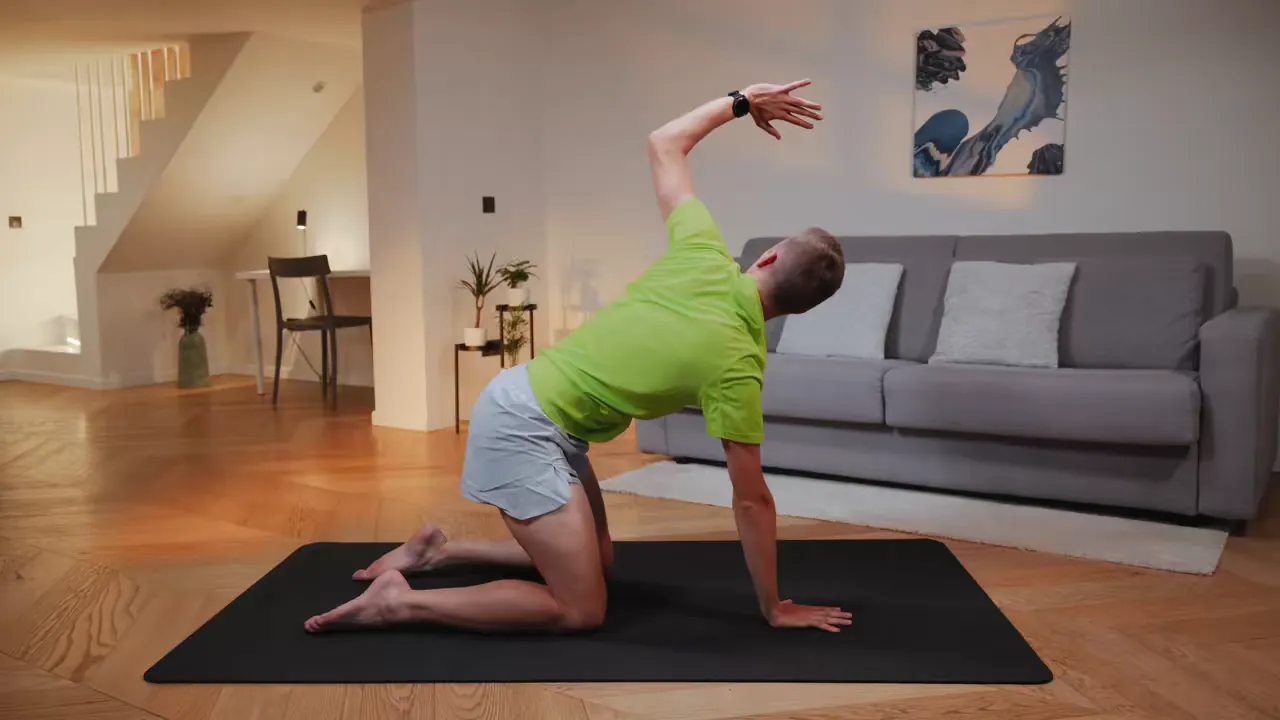
Step 4: Repeat, then switch sides.
Keep: Repeat, then switch sides.
Avoid: Doing one side only
Stills from the exercise video in the Bavelu app, with physiotherapist Mgr. Lukáš Kučera.
How it should feel
As your arm lifts and your chest and gaze follow it, you should feel the turn through the middle of your back and an opening across the front of your chest. It should feel like easy, controlled movement. It should never be sharp, and nothing should run down your arm as tingling or numbness.
Gentle pullRight
It should feel like easy, controlled movement.
Sharp pain, tingling or numbnessStop
It should never be sharp, and nothing should run down your arm as tingling or numbness.
Thoracic Rotation on All Fours is one of 4 exercises in Thoracic Mobility
The other three are in the app, guided on video by a physiotherapist. The whole session takes about 8 minutes.
- Cat Mobility on All Fours 1:51 · in the app
- Thoracic Rotation on All Fours On this page
- Chest Rotation on the Forearm 1:38 · in the app
- Marichyasana Twist 2:02 · in the app

Thoracic spine mobility exercises aim to get the middle of your back moving again after hours spent in much the same position. The one on this page, Thoracic Rotation on All Fours, comes from the app’s Thoracic Mobility session. The app describes it as a rotation that brings movement back to a stiff mid-back and opens the chest.
The steps above are the app’s own. This page explains how the movement should feel, why rotation suits this part of the spine, and what trials have found about mobility exercises for the upper back.
How the thoracic spine moves
The thoracic spine is the twelve vertebrae from T1 to T12, between the neck and the lower back. Each one has joints for the ribs, and together they form the gentle backward curve of the upper back, the thoracic kyphosis. The angle of the ribs and the shape of the bony points along the back of the spine substantially limit how far this region bends forwards and backwards. Within it, the vertebrae from T5 to T8 can rotate the most (Waxenbaum et al., 2026).
Turning is the movement the featured exercise works on. Rather than arching and rounding, it turns your chest one way as your arm rises towards the ceiling, and the other way as the arm threads under your body. Arching and rounding have their own exercise, Cat Mobility on All Fours, which opens the same session; see also the cat-cow stretch.
How the rotation on all fours should feel
As your arm lifts and your chest and gaze follow it, you should feel the turn through the middle of your back and an opening across the front of your chest. It should feel like easy, controlled movement. It should never be sharp, and nothing should run down your arm as tingling or numbness.
Each of these mistakes breaks one of the steps above:
- Moving only the arm. The step asks you to turn your chest after the arm, not just to lift it.
- Keeping your eyes on the floor. Your gaze follows the arm towards the ceiling.
- Rushing the return. The step says to bring the arm down slowly before threading it under your body.
- Doing one side only. The last step is to switch sides.
Do thoracic spine mobility exercises help neck or shoulder pain?
This is where claims online tend to run ahead of the research.
- People with neck pain often have a stiffer upper back. A review of nine studies comparing people with and without neck pain found reduced thoracic mobility in the groups with neck pain. A more rounded upper back went with a more forward head, but not consistently with more neck pain or disability, and the studies could not show which came first (Joshi et al., 2019).
- Adding mobility work changed movement more than pain. In a 2026 trial, 54 people with long-term neck pain did six weeks of neck stabilisation exercises, and half of them also did thoracic mobility exercises. Both groups improved. The added mobility work brought no extra benefit for pain or neck muscle strength, but it did bring greater gains in posture, spinal mobility, neck-related disability and arm and shoulder function (Kuzu et al., 2026). Results were measured only at the end of the six weeks.
- Exercise or hands-on treatment? In a small trial of 26 office workers with neck pain lasting more than 12 weeks, everyone had neck mobilisation and deep neck muscle exercises. Half also did thoracic mobility exercises and the other half had thoracic manipulation. Pain and disability improved similarly in both groups (Seo et al., 2022). With no group that had neither, the trial cannot say how much either one added.
For the shoulder, the studies are about range rather than pain: sitting upright rather than slouched lets you lift your arm further, at least in the moment. Our page about shoulder stretches covers them.
The fair reading is that mobility exercises for the mid-back change how the back moves and may help everyday function, but they have not been shown to do more for pain than other exercise. If your neck pain has lasted months, they are better seen as one part of a programme than as a treatment on their own.
Mobility is not the same as straightening your back
A forward curve in the upper back is part of how the spine is built, as described above. Mobility exercises move the spine; they are not designed to flatten that curve, so be wary of claims that a few rotations will straighten a rounded back. If the shape of your back is what concerns you, rounded upper back explains the difference between a postural hunch and a structural curve, and posture exercises looks at what exercise can and cannot change. The wall posture test is a quick self-check, not a diagnosis.
When to do it
You need a mat and some floor space, so this suits the start or end of the day, or a break away from your desk. In the app it is the second of four exercises in the Thoracic Mobility session, which takes about seven and a half minutes. It comes after Cat Mobility on All Fours and before Chest Rotation on the Forearm, a deeper rotation covered on our page about stretches for between the shoulder blades, and the Marichyasana Twist. For something you can do on a chair, see upper back stretches.
Who should be careful
Skip this exercise, or check with a doctor or physiotherapist first, if any of these apply.
- Pain in your wrists or knees when you put weight through them. The exercise starts on all fours.
- A recent injury or operation on your back, shoulder or ribs.
- Pain, tingling, numbness or weakness in an arm. The NHS advises seeing a GP for neck pain that comes with pins and needles or a cold arm (NHS).
- Pain high in the back, or back pain with chest pain. The NHS lists back pain coming from the top of your back, between the shoulders, as a reason to see a GP, and back pain with chest pain as a reason to call 999 (NHS). The page about pain between the shoulder blades has the full list of warning signs.
- Osteoporosis. A UK consensus statement on exercise for osteoporosis says twisting movements should be safe if they are done smoothly and comfortably (Brooke-Wavell et al., 2022). If you have had spinal fractures or many broken bones, the Royal Osteoporosis Society suggests talking to a doctor or physiotherapist before you start exercising (ROS).
Whatever the reason, stop if it hurts. NHS advice on exercises and stretches for back pain is to stop if the pain gets worse and see a GP (NHS).
Where it fits in Bavelu
Bavelu’s sessions are designed and filmed by physiotherapists, led by Mgr. Lukáš Kučera, and the whole Thoracic Mobility session is guided on video in the app, along with sessions for the neck, shoulders and lower back. It is exercise guidance, not a diagnosis or a treatment, so upper back pain with any of the warning signs above should be checked by a doctor first.
Questions people ask
What is thoracic spine mobility?
It is how freely the middle section of your spine, between the neck and the lower back, can bend, arch and turn. The ribs and the shape of the vertebrae limit bending forwards and backwards here, while the vertebrae from T5 to T8 can rotate the most within this region.
Do thoracic mobility exercises help neck pain?
They may help how the back moves more than how much it hurts. People with neck pain often have a stiffer upper back, but in a 2026 trial of 54 people, adding thoracic mobility exercises to neck exercises improved posture, mobility, disability and arm function without any extra drop in pain.
How often should I do thoracic mobility exercises?
There is no agreed dose. The trials described on this page ran for about six weeks and measured the results straight afterwards, so regular practice over weeks is closer to what was tested than a single session.
Are thoracic rotation exercises safe with osteoporosis?
A UK consensus statement on exercise for osteoporosis says twisting movements should be safe if done smoothly and comfortably. If you have had spinal fractures or many broken bones, the Royal Osteoporosis Society suggests talking to a doctor or physiotherapist before you start.
Terms on this page
Sources
- Waxenbaum JA, Reddy V, Margetis K. Anatomy, Back, Thoracic Vertebrae. StatPearls (NCBI Bookshelf), 2026.
- Joshi S, Balthillaya G, Neelapala YVR. Thoracic posture and mobility in mechanical neck pain population: a review of the literature. Asian Spine Journal, 2019.
- Kuzu Ş, Canli M, Canli I, Özüdoğru A, Alkan H. Integrating thoracic mobility into cervical rehabilitation improves mobility, function, and posture in non-specific chronic neck pain: a randomized controlled trial. Journal of Back and Musculoskeletal Rehabilitation, 2026.
- Seo J, Song C, Shin D. A single-center study comparing the effects of thoracic spine manipulation vs mobility exercises in 26 office workers with chronic neck pain: a randomized controlled clinical study. Medical Science Monitor, 2022.
- NHS. Neck pain. Last reviewed 27 April 2023.
- NHS. Back pain. Last reviewed 5 March 2026.
- Brooke-Wavell K et al. Strong, steady and straight: UK consensus statement on physical activity and exercise for osteoporosis. British Journal of Sports Medicine, 2022.
- Royal Osteoporosis Society. How to exercise safely for bones. Last reviewed 1 June 2026.
This page explains a topic in general terms. It is not a diagnosis and does not replace a doctor or physiotherapist. If something hurts badly, keeps getting worse or comes with numbness, weakness or fever, see a doctor.