Exercises · Lower back
Child's pose: what it does and how it should feel
A kneeling rest that lets the back round gently and the breath slow down. Below the steps: what it does and doesn't do, how it should feel, and who should skip it.
Child's Pose Relaxation
A calm resting pose to finish, letting the back and the breath settle.
- 1:45
- On a mat
- Back
- Lower Back
Move slowly. Stop if it hurts, or if you feel tingling or numbness.
-
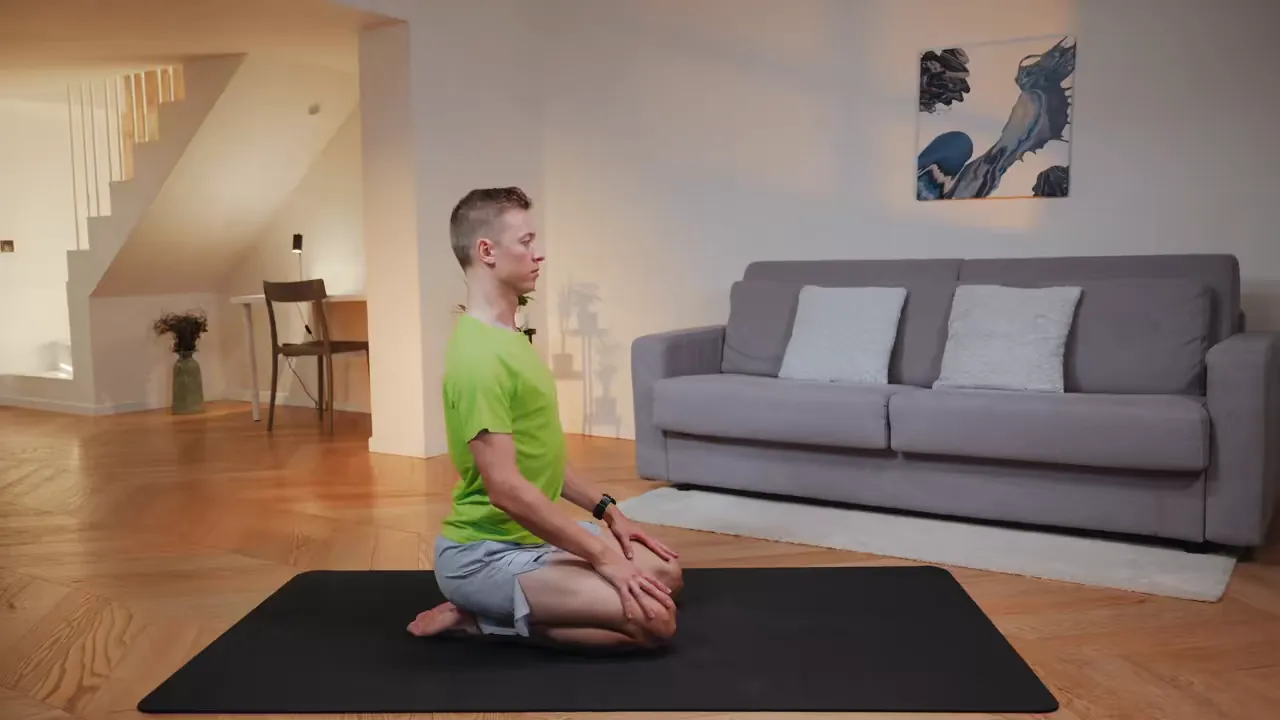
Step 1: Kneel, sit back on your heels and fold forward to the mat.
Keep: Kneel, sit back on your heels and fold forward to the mat.
Avoid: Hovering instead of sitting backIf you cannot sit back comfortably, your knees or hips are telling you something; do not force it.
-
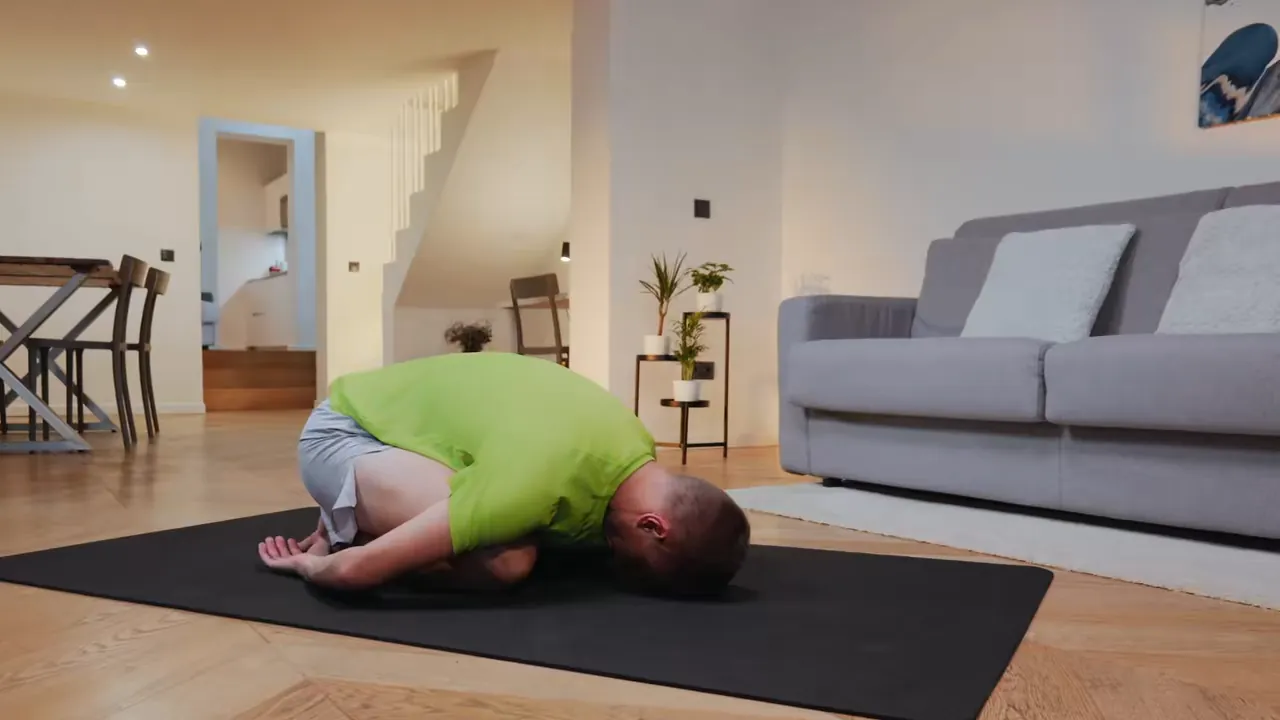
Step 2: Rest your forehead on the mat with your arms loose by your sides.
Keep: Your arms stay loose by your sides.
Avoid: Tensing the arms and shouldersReaching the arms forward is a different exercise, Side Child's Pose.
-
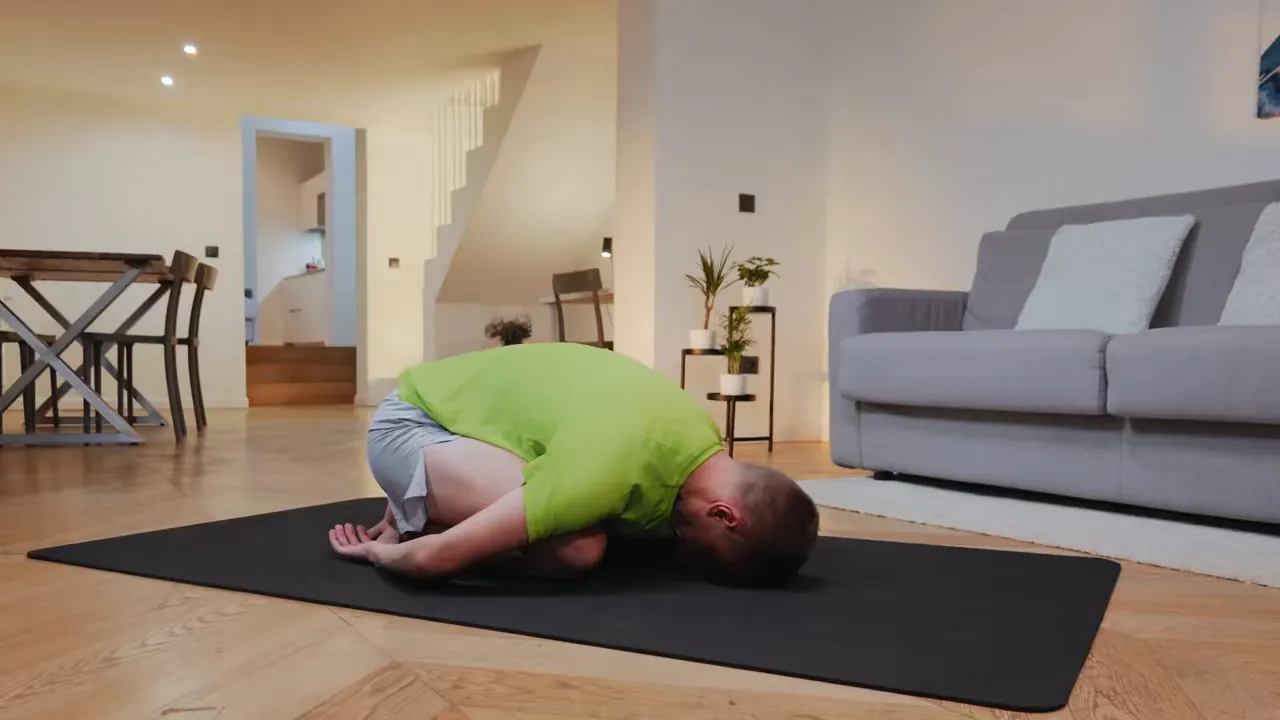
Step 3: Breathe into your back and let go a little more with each breath out.
Keep: Breathe into your back and let go a little more with each breath out.
Avoid: Holding or rushing the breath
-
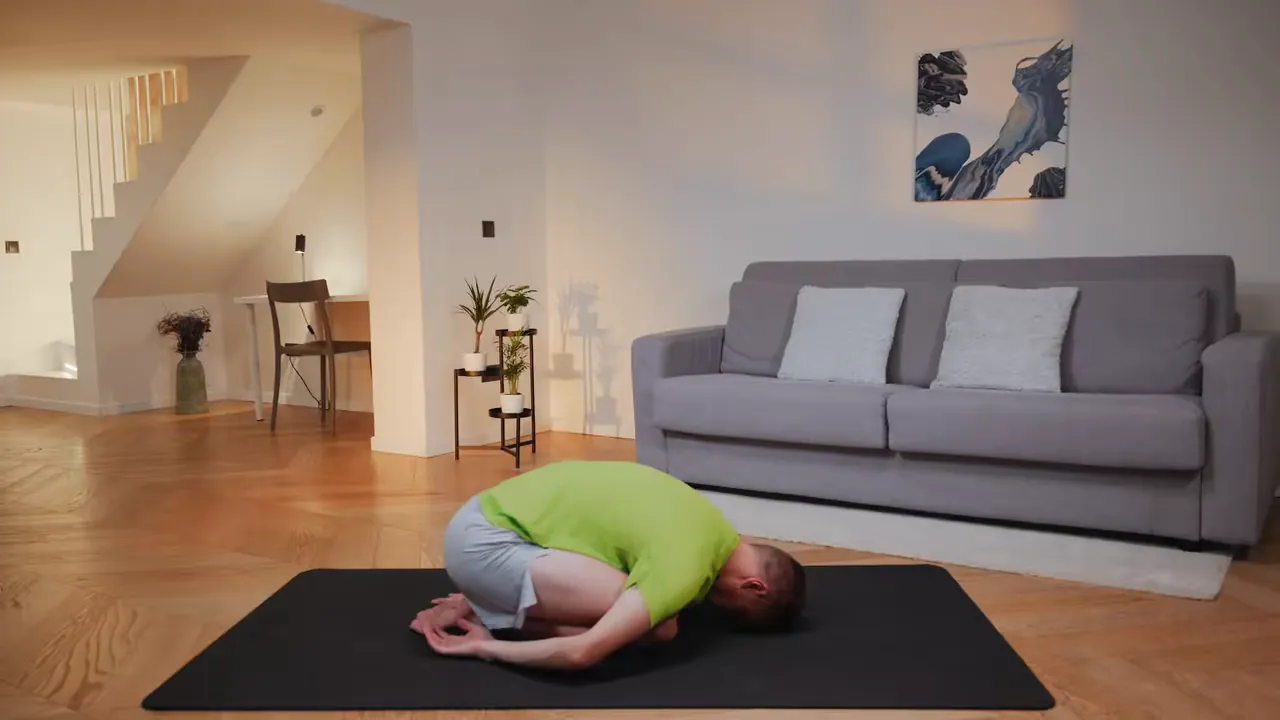
Step 4: Stay until your breath has fully calmed.
Keep: Stay until your breath has fully calmed.
Avoid: Coming up too soon
Stills from the exercise video in the Bavelu app, with physiotherapist Mgr. Lukáš Kučera.
How it should feel
Restful. A mild stretch along the back is fine, but the pose should not feel like effort. If you are straining to get your forehead to the mat or your hips to your heels, the position is not right for your body today.
Gentle pullRight
Restful: a mild stretch along the back is fine, but the pose should not feel like effort.
Sharp pain, tingling or numbnessStop
If you are straining to get your forehead to the mat or your hips to your heels, the position is not right for your body today.
Child's Pose Relaxation is one of 4 exercises in Before Bed
The other three are in the app, guided on video by a physiotherapist. The whole session takes about 10 minutes.
- Child's Pose Relaxation On this page
- Side Child's Pose 1:53 · in the app
- Reclined Pigeon 2:34 · in the app
- Calm Down 3:19 · in the app

Child’s pose is a kneeling, folded-forward resting position borrowed from yoga. In Bavelu it is called Child’s Pose Relaxation and opens the Before Bed session, and the app describes it as “a calm resting pose to finish, letting the back and the breath settle”. That is a fair summary of what it is: less a deep stretch than a position to rest in. This page explains what child’s pose does, what the research can and can’t say about it, how it should feel, and who should skip it.
What child’s pose does
Three things happen at once.
- The back rounds gently. With your forehead on the mat and your arms loose, the spine curves forward, the opposite of the work the erector spinae do when they straighten you up. The app lists the back and the lower back as the areas it targets. It should feel like a mild stretch along the back, not a strong pull in one spot.
- The knees, ankles and hips bend deeply. Sitting back on your heels asks a lot of these joints, which matters for who should skip the pose (see below).
- The breath slows. Two of the four steps above are about breathing: breathing into your back and letting go a little more with each breath out, then staying until it has calmed.
The breathing part has some research behind it, though not for this pose. A systematic review of 15 studies found that slow breathing techniques went with higher heart rate variability, which the authors linked with the body’s rest-and-digest (parasympathetic) activity, along with changes in brain activity and reports of more comfort and relaxation and less anxiety and arousal (Zaccaro et al., 2018). The studies were few, used different techniques and mostly involved healthy people, so this supports slowing the breath as a way to wind down, not any promise about pain.
Is child’s pose good for lower back pain?
No trial has tested child’s pose on its own. The nearest evidence is for yoga programmes as a whole.
A Cochrane review of 21 trials with 2,223 people with long-term low back pain found that, compared with no exercise, yoga led to small improvements in pain and back-related function at three months, too small to count as clinically important. Compared with other back-focused exercise, there was probably little or no difference in function. Yoga had more side effects than no exercise, mainly increased back pain, but about the same as other exercise (Wieland et al., 2022).
So child’s pose is a reasonable way to rest a back that has been sitting all day, not a treatment. If folding forward makes your back pain or any leg symptoms worse, it is not the right position for you; the NHS advice is to stop exercises that make back pain worse and see a GP (NHS). For what does have evidence, see lower back pain from sitting and Will back pain go away on its own?
How child’s pose should feel
Restful. A mild stretch along the back is fine, but the pose should not feel like effort. If you are straining to get your forehead to the mat or your hips to your heels, the position is not right for your body today.
The usual mistakes break one of the steps above:
- Tensing the arms and shoulders. The second step leaves your arms loose by your sides. Reaching them forward is a different exercise: Side Child’s Pose, on the stretches before bed page.
- Holding or rushing the breath. The third step is to breathe into your back and let go a little more with each breath out.
- Coming up too soon. The last step is to stay until your breath has fully calmed. In the app, the exercise takes just under two minutes.
- Hovering instead of sitting back. The first step is to sit back on your heels. If you cannot do that comfortably, your knees or hips are telling you something; see the next section rather than forcing it.
Where child’s pose fits
It suits the end of a session or the end of the day. In the app it starts the Before Bed session, and the rest of that session is listed above. If you would rather move your spine than rest it, the cat-cow stretch moves it through rounding and arching, the cobra stretch arches it, and lower back stretches has a gentle one done lying on your back.
Who should be careful
Stop if it hurts. Child’s pose should feel like rest, so pain anywhere means it is not the right position for you. Check with a doctor or physiotherapist first if:
- your knees are painful, swollen or recently operated on. The pose bends the knees fully under your body weight. The NHS lists knee pain and swelling that get worse with kneeling or bending, with warmth and redness, as a possible sign of bursitis. It advises getting help from 111 if your knee locks, gives way or is badly swollen, and seeing a GP if knee pain has not improved within a few weeks (NHS).
- you have had a hip replacement. While the hip recovers, the NHS advises not bending it more than 90 degrees (NHS). Folding forward over your knees bends the hips well past that.
- you have osteoporosis or have had a spinal fracture. A UK consensus statement recommends avoiding postures with a high degree of spinal flexion, and says movements involving sustained or end-range forward bending should be modified or avoided (Brooke-Wavell et al., 2022). Ask a physiotherapist whether child’s pose suits you. Rounded upper back explains why a curving spine in later life is worth getting checked.
- you are pregnant. Folding forward presses the trunk onto the thighs. The NHS advises listening to your body as your bump grows, telling any instructor you are pregnant, stopping if you feel uncomfortable, and speaking to your midwife if you have a health condition (NHS).
- your back pain comes with pain, tingling or numbness in a leg. Get that checked by a GP or physiotherapist. Call 999 or go to A&E if back pain comes with pain, tingling, weakness or numbness in both legs, loss of feeling around the genitals or anus, or changes in bladder or bowel control (NHS).
Child’s Pose Relaxation was designed and filmed for Bavelu by physiotherapists, and in the app it leads straight into the rest of the Before Bed session, guided on video.
Questions people ask
What is child's pose good for?
It is a resting position: the back rounds gently, the head is supported and the breath can slow down. The app uses it to finish a session or the day. It has not been tested on its own as a treatment for anything, so think of it as a way to rest, not a cure.
Is child's pose good for lower back pain?
No trial has tested child's pose on its own. Yoga as a whole gave small improvements in back pain and function compared with no exercise in a Cochrane review of 21 trials, and did about as well as other back exercise. If folding forward makes your back pain or any leg symptoms worse, stop.
How long should you stay in child's pose?
In the app, you stay until your breath has fully calmed, and the whole exercise takes just under two minutes. There is no evidence for a particular time. Come out sooner if your knees, hips or back complain.
Why does child's pose hurt my knees?
Kneeling and sitting back on your heels bends the knees fully, which some knees do not like. If it hurts, skip the pose. The NHS lists knee pain and swelling that get worse with kneeling or bending as a possible sign of bursitis, and advises seeing a GP if knee pain has not improved within a few weeks.
Can I do child's pose when pregnant?
Ask your midwife. Folding forward presses the trunk onto the thighs, which may not be comfortable as your bump grows. The NHS advises listening to your body, telling any instructor you are pregnant and stopping if you feel uncomfortable.
Terms on this page
Sources
- Zaccaro A et al. How breath-control can change your life: a systematic review on psycho-physiological correlates of slow breathing. Frontiers in Human Neuroscience, 2018.
- Wieland LS, Skoetz N, Pilkington K, Harbin S, Vempati R, Berman BM. Yoga for chronic non-specific low back pain. Cochrane Database of Systematic Reviews, 2022.
- NHS. Back pain. Last reviewed 5 March 2026.
- NHS. Knee pain. Last reviewed 21 December 2023.
- NHS. Recovering from a hip replacement. Last reviewed 6 March 2024.
- Brooke-Wavell K et al. Strong, steady and straight: UK consensus statement on physical activity and exercise for osteoporosis. British Journal of Sports Medicine, 2022.
- NHS. Exercise in pregnancy. Last reviewed 24 September 2026.
This page explains a topic in general terms. It is not a diagnosis and does not replace a doctor or physiotherapist. If something hurts badly, keeps getting worse or comes with numbness, weakness or fever, see a doctor.