Exercises · Whole spine
Stretches before bed after a day at a desk
Gentle stretching is the kind of movement that suits the last hour of the day. Below the steps: what the research says about stretching and sleep, and how to keep the routine calm.
Side Child's Pose
Child's pose with the hands walked to one side, lengthening the sides and the broad back muscle.
- 1:53
- On a mat
- Back
- Shoulders
Move slowly. Stop if it hurts, or if you feel tingling or numbness.
-
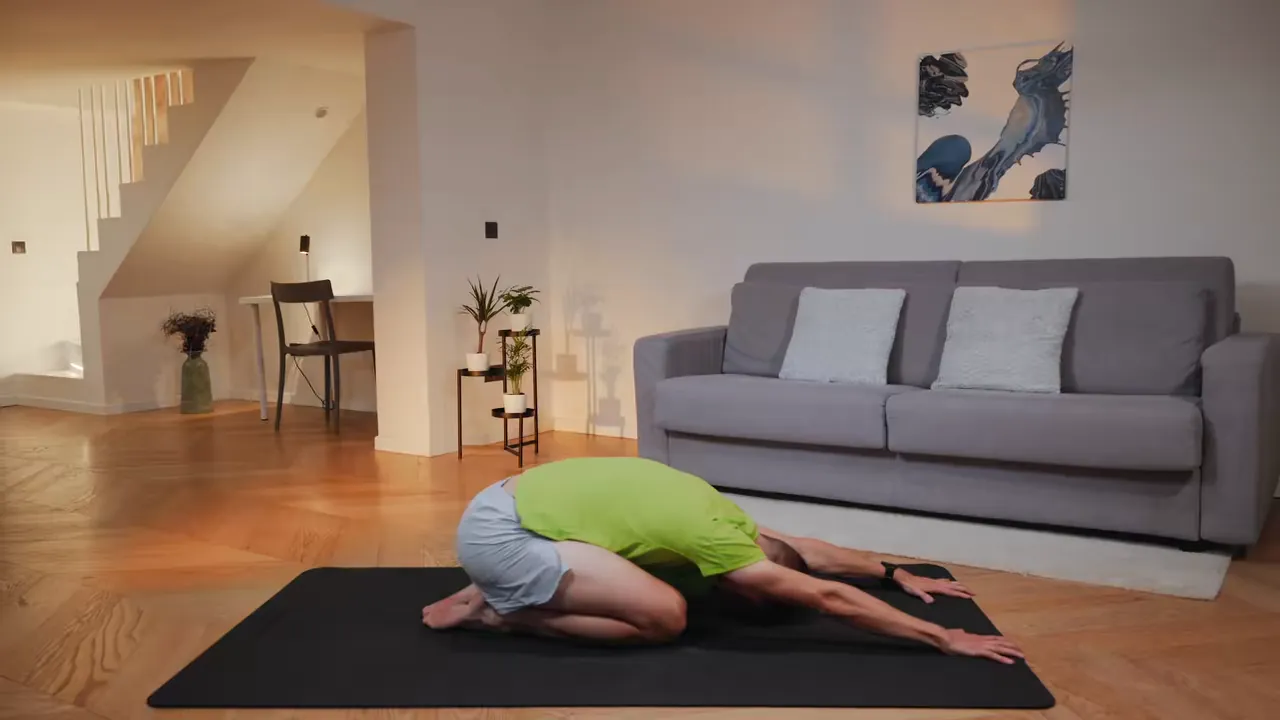
Step 1: Sit back on your heels and fold forward with your arms stretched ahead.
Keep: Sit back on your heels and fold forward with your arms stretched ahead.
Avoid: Coming off your heels
-
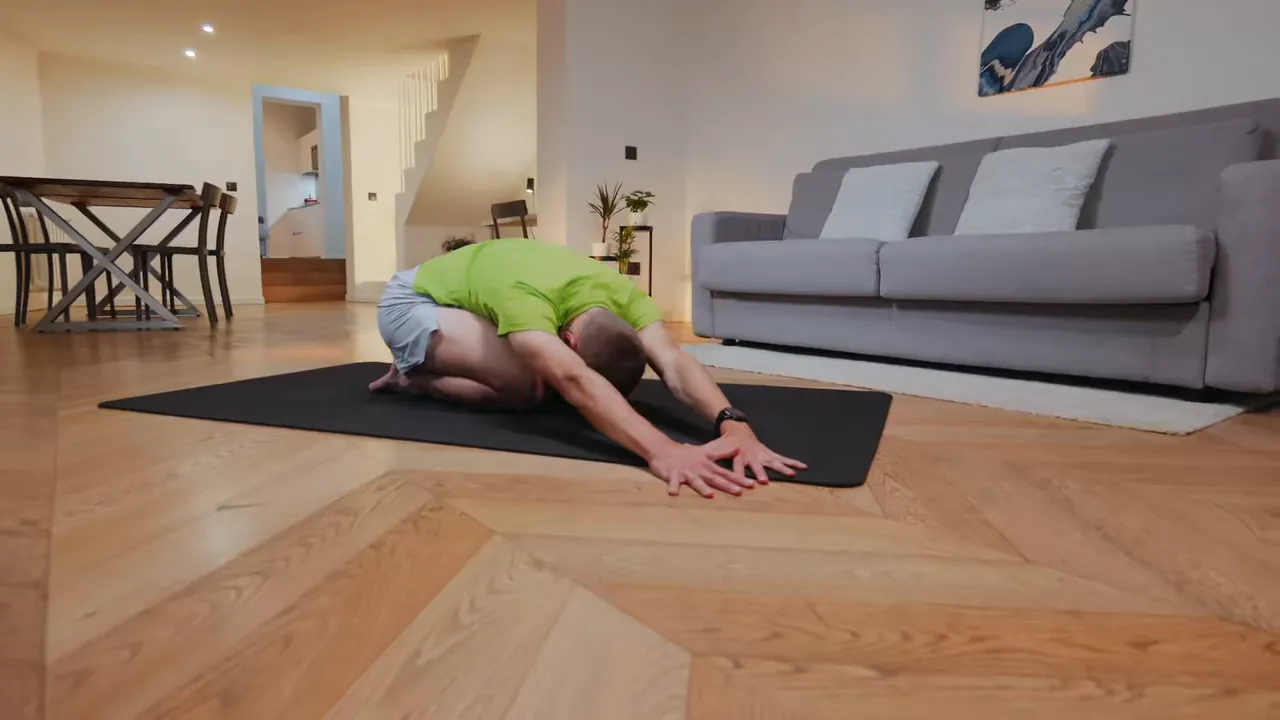
Step 2: Walk your hands to one side of the mat.
Keep: Walk your hands to one side of the mat, with your hips staying on your heels.
Avoid: Hips liftingIf your hips lift as you walk your hands across, you have left the position.
-
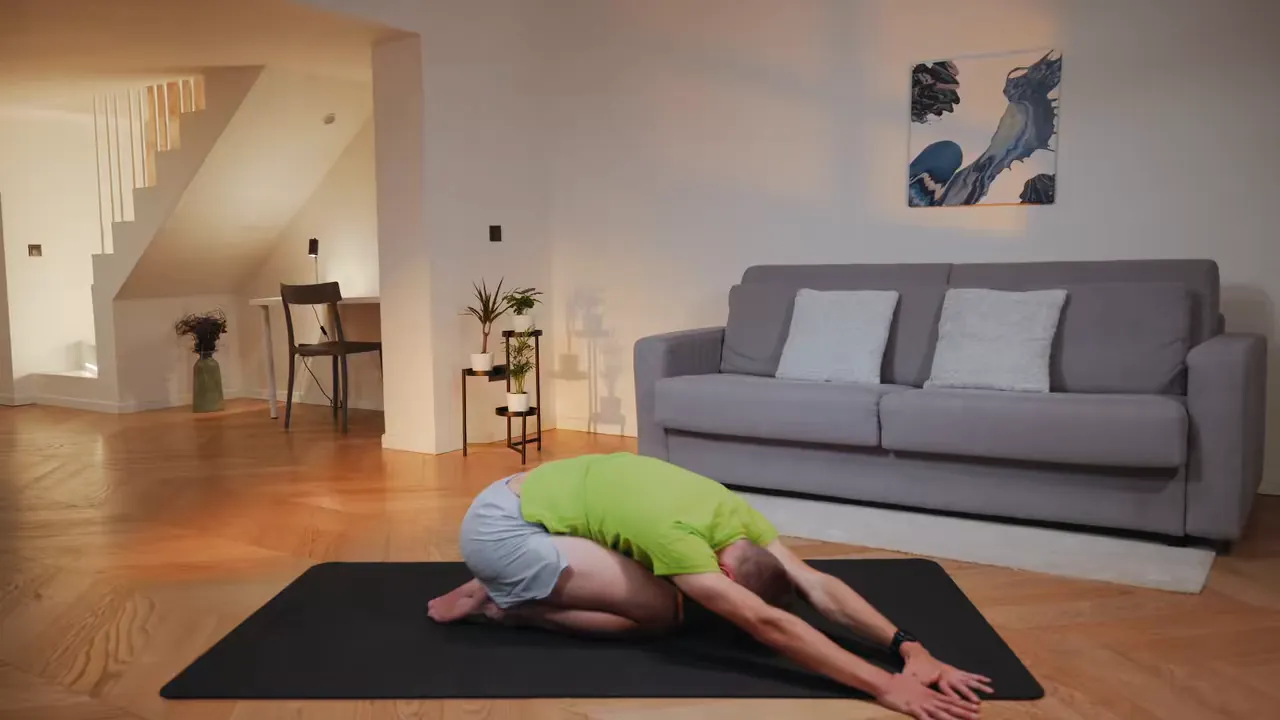
Step 3: Breathe into the stretched side and stay still.
Keep: Breathe into the stretched side and stay still. You settle into this stretch rather than work at it.
Avoid: Moving around in the stretchBouncing or wriggling to go further is not part of it.
-
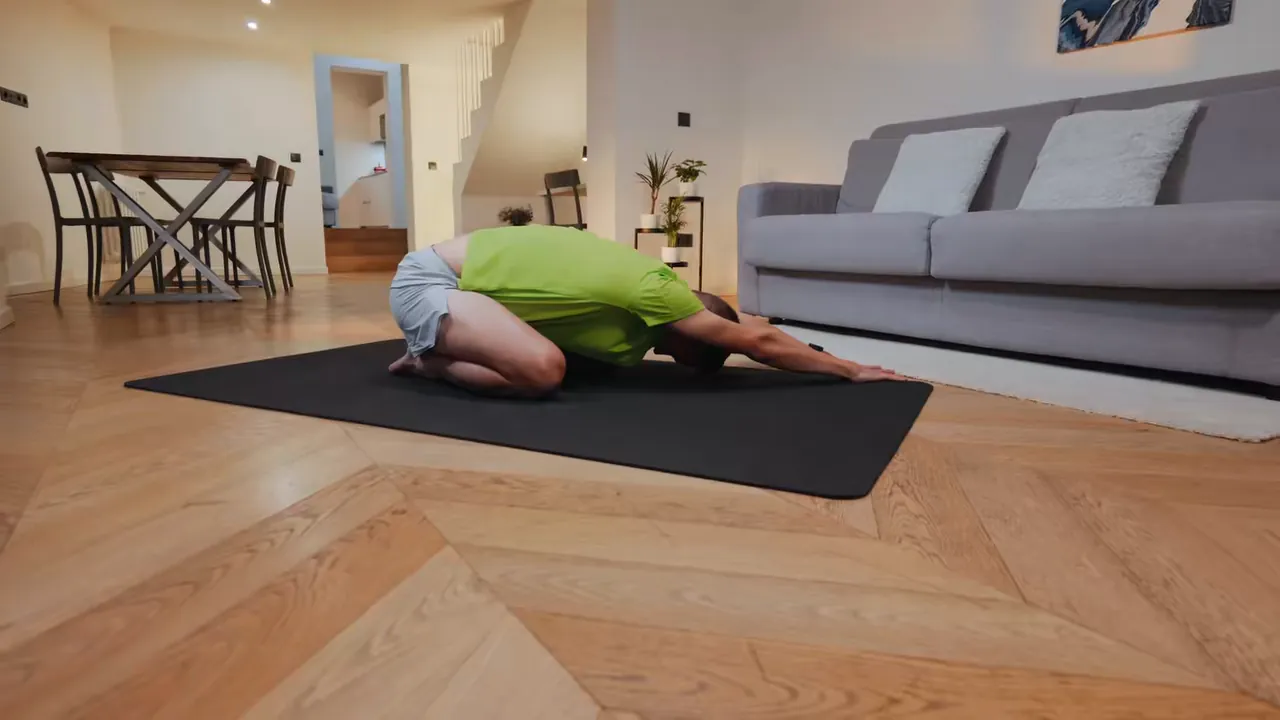
Step 4: Bring the hands back to the middle and walk them to the other side.
Keep: Bring the hands back to the middle and walk them to the other side.
Avoid: Doing one side only
Stills from the exercise video in the Bavelu app, with physiotherapist Mgr. Lukáš Kučera.
How it should feel
A gentle, even stretch along one side, while you breathe steadily. The third step says to breathe into the stretched side and stay still, so this is a stretch you settle into rather than one you work at.
Side Child's Pose is one of 4 exercises in Before Bed
The other three are in the app, guided on video by a physiotherapist. The whole session takes about 10 minutes.
- Child's Pose Relaxation 1:45 · in the app
- Side Child's Pose On this page
- Reclined Pigeon 2:34 · in the app
- Calm Down 3:19 · in the app

After a day in a chair, a few stretches before bed are a way to draw a line under it. The one above is Side Child’s Pose, the second exercise in Bavelu’s Before Bed session. The app describes it as “child’s pose with the hands walked to one side, lengthening the sides and the broad back muscle”. This page covers whether stretching before bed helps you sleep, what that stretch works, how it should feel, and who should be careful.
Do stretches before bed help you sleep?
It may help you wind down, but the evidence for stretching at bedtime specifically is thin. Three things are worth knowing.
- A small trial in insomnia. In one study, 28 people with long-term insomnia did four months of resistance exercise, four months of stretching, or nothing. The stretching group had one-hour, low-intensity classes three times a week, between 5 and 6pm. Compared with the control group, they improved more on an insomnia severity score. On wrist sensors, their time to fall asleep dropped by about five minutes and their time awake during the night by about seven, while the control group’s got slightly worse. Overnight lab recordings showed no change. The study was tiny, only 10 people did stretching, the control group was not randomly chosen, and the sessions were in the early evening, not at bedtime (D’Aurea et al., 2019).
- Evening exercise does not seem to ruin sleep. A review of 23 studies in healthy adults found that a single session of evening exercise did not harm sleep overall, and if anything slightly increased deep sleep. The exception was vigorous exercise ending an hour or less before bedtime, after which falling asleep, total sleep time and sleep efficiency might suffer (Stutz et al., 2019).
- The NHS advice is to keep the last hour calm. For insomnia, the NHS recommends relaxing for at least an hour before bed, exercising regularly during the day and not exercising in the four hours before bed (NHS).
Put together: slow, gentle stretching sits much closer to the relaxing end of the evening than to a workout, and nothing in this research suggests that kind of stretching harms sleep. But no one has shown that a bedtime stretch will make you sleep better. If you have insomnia, follow the NHS advice and keep anything energetic earlier in the day.
What side child’s pose stretches
The “broad back muscle” in the app’s description is the latissimus dorsi. It starts across a wide area of the lower and middle back, from the lower half of the thoracic spine, a sheet of connective tissue over the lower back, the top of the pelvis and the lowest three ribs, and attaches to the upper arm. It pulls the arm down and back and turns it inwards (TeachMeAnatomy).
With the arms stretched ahead and the hands walked to one side, the stretch is usually felt along the side of the body away from the hands. Because the muscle crosses the shoulder, you may feel it there too. The app lists the back and the shoulders as the areas it targets.
How it should feel
A gentle, even stretch along one side, while you breathe steadily. The third step says to breathe into the stretched side and stay still, so this is a stretch you settle into rather than one you work at.
The usual mistakes break one of the steps above:
- Moving around in the stretch. The third step is to stay still. Bouncing or wriggling to go further is not part of it.
- Coming off your heels. The first step sits you back on your heels. If your hips lift as you walk your hands across, you have left the position.
- Doing one side only. The last step brings the hands back to the middle and walks them to the other side.
Side Child’s Pose takes just under two minutes in the app. If you want the plain version with the arms resting by your sides, see child’s pose.
Keeping the evening routine calm
The Before Bed session runs for just under ten minutes and is listed above: Child’s Pose Relaxation, Side Child’s Pose, Reclined Pigeon, and Calm Down, a guided relaxation lying on your back. Reclined Pigeon is the gentler, lying-down relative of pigeon pose. Everything is done on a mat with no equipment.
A few things from the NHS insomnia advice help keep the hour calm: a dark, quiet bedroom, a comfortable mattress and pillow, and no television or phone right before bed, because the light keeps you more alert (NHS). If you wake up stiff, the cause may be how you sleep rather than how you stretch: sleeping position and pillow looks at the evidence, and stiff neck after sleeping covers when it needs checking. For stretches aimed at other parts of the back, see lower back stretches and upper back stretches.
Who should be careful
Stop if it hurts. A stretch before bed should leave you calmer, not sore. Check with a doctor or physiotherapist first if:
- your shoulder is painful or hard to move. The arms are stretched out ahead. The NHS advises not doing things that seem to make shoulder pain worse, and seeing a GP if it is getting worse, has not improved after two weeks, or it is very difficult to move your arm (NHS). Shoulder pain from computer work has more.
- your knees or hips object to kneeling, or you have had a hip or knee operation. The child’s pose page explains why.
- you have osteoporosis or have had a spinal fracture. The pose rounds the spine forward. A UK consensus statement recommends avoiding postures with a high degree of spinal flexion (Brooke-Wavell et al., 2022), so ask a physiotherapist whether it suits you.
- you are pregnant. Folding forward presses on the bump, and the session ends lying on your back. In later pregnancy the NHS advises avoiding any activity that involves lying flat on your back for more than a few minutes (NHS). Your midwife can advise you.
- pain keeps you awake. The NHS lists long-term pain among the things that get in the way of sleep, and advises seeing a GP if your sleep problems have lasted months or are hard to cope with (NHS). Back pain that is worse at night or does not improve with rest is also a reason to see a GP (NHS).
Bavelu’s Before Bed session was designed and filmed by physiotherapists. In the app it ends with Calm Down, a guided relaxation with your eyes closed, so the last few minutes are spent lying still rather than watching a screen.
Questions people ask
Is it good to stretch before bed?
Gentle stretching fits the wind-down hour well, as long as it stays calm. A review of 23 studies found that evening exercise generally did not harm sleep in healthy adults, although vigorous exercise ending within an hour of bedtime might. The NHS advice for insomnia is to exercise during the day and relax in the hour before bed.
Does stretching before bed help you sleep?
It may help some people, but the evidence is small. In a trial of 28 people with long-term insomnia, four months of early-evening stretching classes improved insomnia scores and time to fall asleep compared with a control group. The study was tiny, the control group was not randomly chosen, and the stretching was not done at bedtime.
What stretches are good before bed?
Slow, gentle ones that do not leave you out of breath or wound up, done where you can rest afterwards. Side child's pose, for the sides of the body and the broad back muscle, is one example. Skip anything that hurts or that you find energising rather than calming.
When should I see a GP about sleep?
The NHS advises seeing a GP if changing your sleeping habits has not helped, you have had trouble sleeping for months, or it affects your daily life so much that you find it hard to cope. Back pain that is worse at night or does not improve with rest is also worth a GP appointment.
Terms on this page
- Thoracic spineThe twelve vertebrae of the upper and middle back, T1 to T12, where the ribs attach.
- FasciaThe connective tissue that wraps, separates and links muscles, organs and other structures.
- Latissimus dorsiThe broad, flat muscle from the lower spine and pelvis to the upper arm that pulls the arm down and back.
Sources
- D'Aurea CVR et al. Effects of resistance exercise training and stretching on chronic insomnia. Revista Brasileira de Psiquiatria, 2019.
- Stutz J, Eiholzer R, Spengler CM. Effects of evening exercise on sleep in healthy participants: a systematic review and meta-analysis. Sports Medicine, 2019.
- NHS. Insomnia. Last reviewed 19 March 2024.
- TeachMeAnatomy. The superficial back muscles.
- NHS. Shoulder pain. Last reviewed 22 May 2023.
- Brooke-Wavell K et al. Strong, steady and straight: UK consensus statement on physical activity and exercise for osteoporosis. British Journal of Sports Medicine, 2022.
- NHS. Exercise in pregnancy. Last reviewed 24 September 2026.
- NHS. Back pain. Last reviewed 5 March 2026.
This page explains a topic in general terms. It is not a diagnosis and does not replace a doctor or physiotherapist. If something hurts badly, keeps getting worse or comes with numbness, weakness or fever, see a doctor.