Exercises · Upper back
Upper back stretches you can do at your desk
A seated twist holding the back of your chair turns the whole trunk without leaving your desk. Here is how it should feel, when to fit it in, and what the research says about moving during the working day.
Seated Twist Using the Chair Back
A seated twist holding the chair back to free the lower and mid back.
- 1:58
- On a chair
- Spine
- Lower Back
Move slowly. Stop if it hurts, or if you feel tingling or numbness.
-
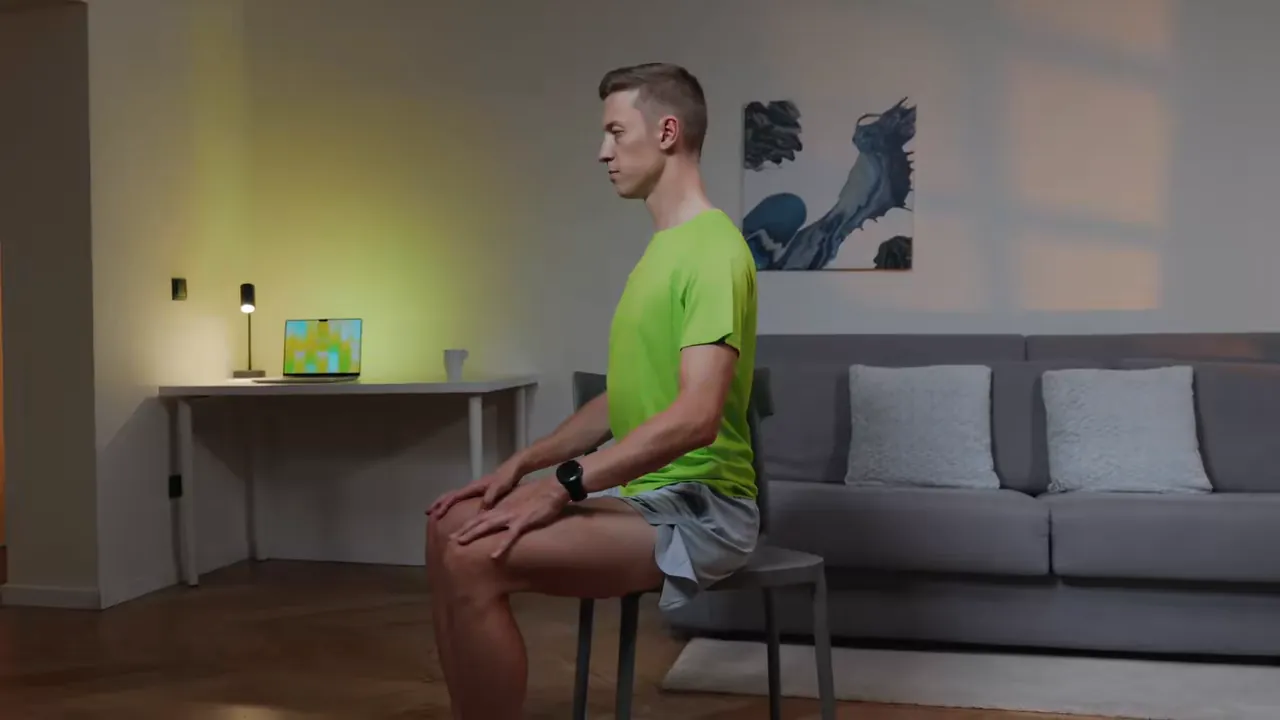
Step 1: Sit sideways on the chair.
Keep: Sit sideways on the chair, so the chair back is beside you.
Avoid: Sitting the usual way round
-
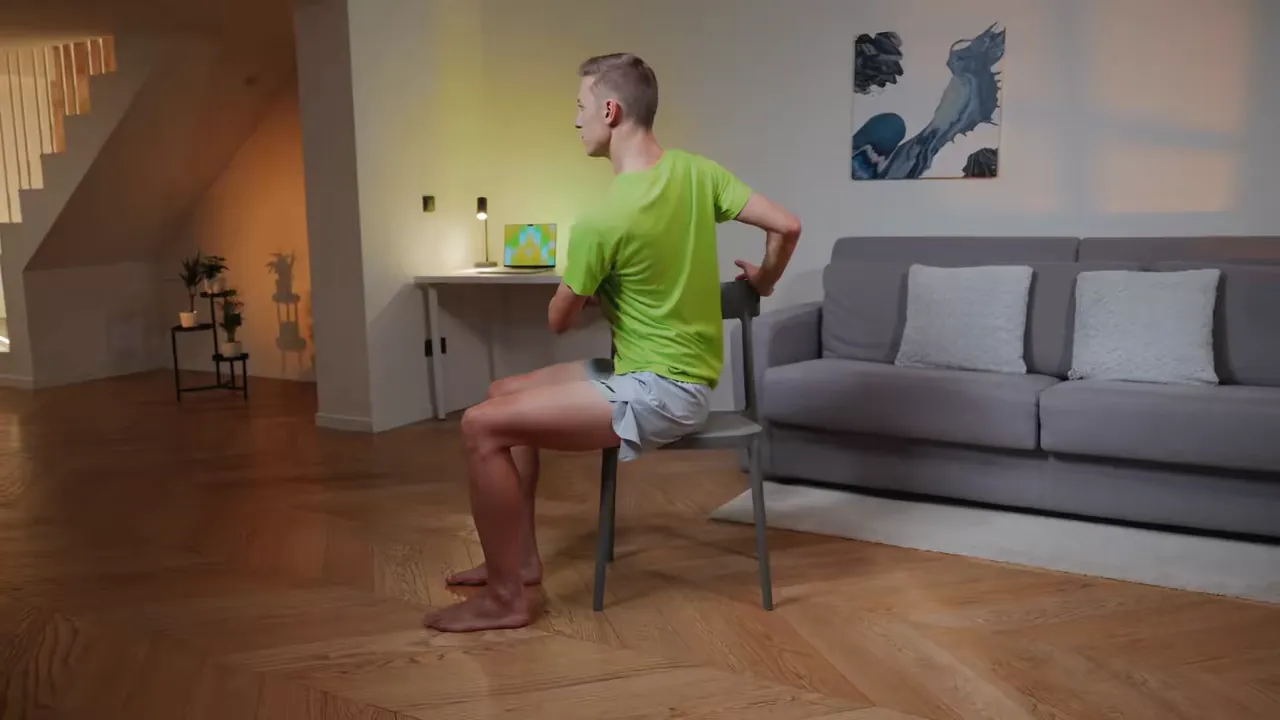
Step 2: Hold the chair back with both hands.
Keep: Hold the chair back with both hands.
Avoid: Holding on with one hand
-
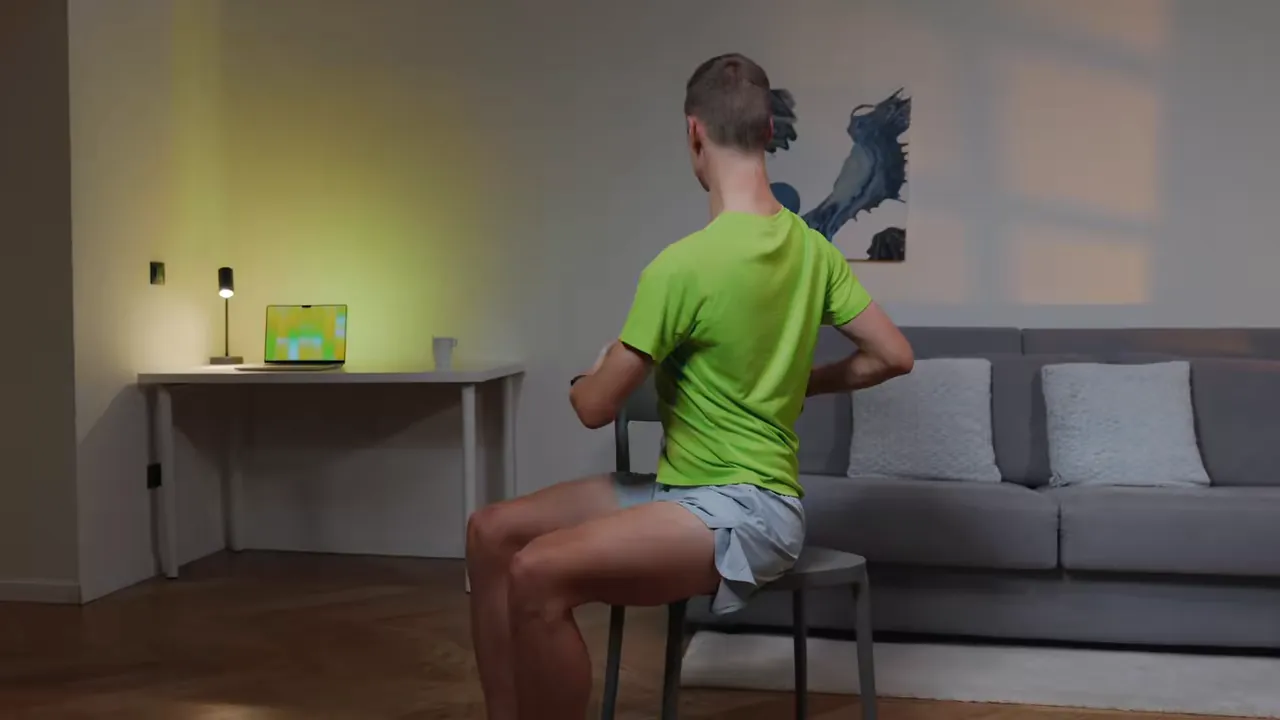
Step 3: Breathe out and turn your torso towards your hands.
Keep: Turn on the out-breath.
Avoid: Turning on the in-breath
Keep: Turn your torso towards your hands.
Avoid: Turning only your head
-
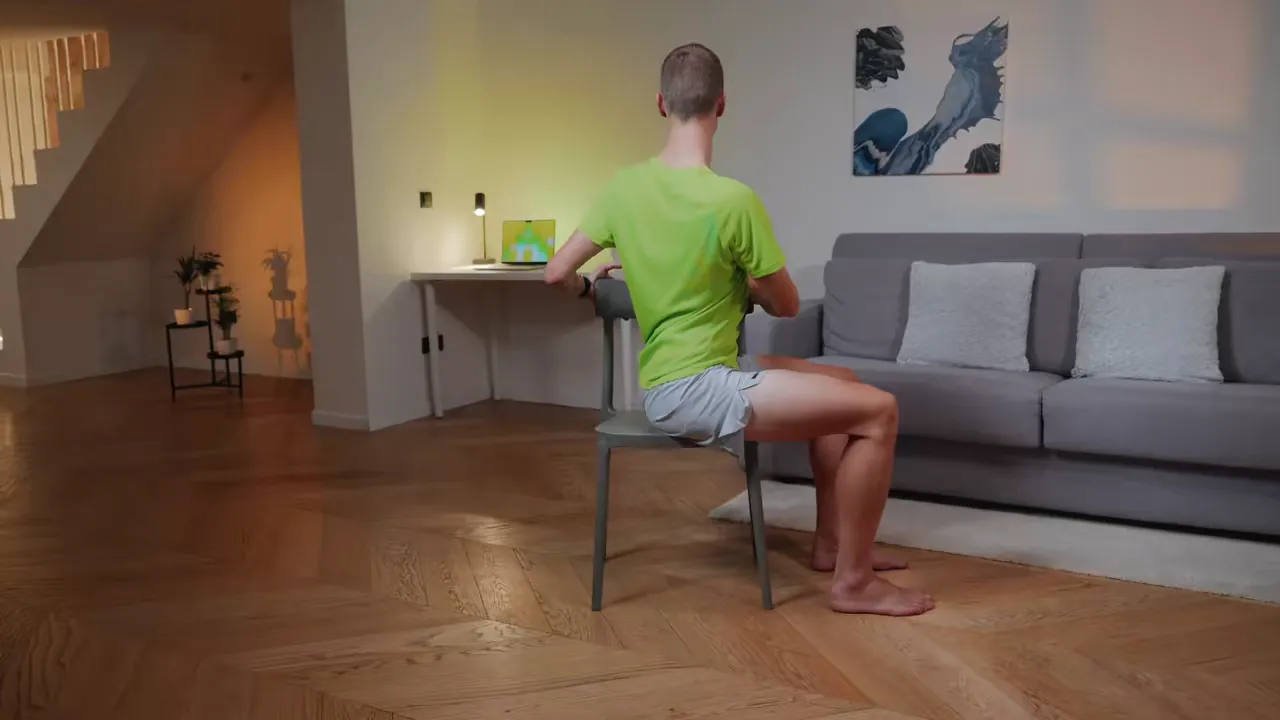
Step 4: Hold, then turn and twist the other way.
Keep: Hold, then turn and twist the other way.
Avoid: Doing one side only
Stills from the exercise video in the Bavelu app, with physiotherapist Mgr. Lukáš Kučera.
How it should feel
Expect a gentle, even turn through your trunk, with a stretch you can breathe into. It should not be sharp, and it should not send pain, tingling or numbness into an arm or a leg.
Gentle pullRight
A gentle, even turn through your trunk, with a stretch you can breathe into.
Sharp pain, tingling or numbnessStop
It should not be sharp, and it should not send pain, tingling or numbness into an arm or a leg.
Seated Twist Using the Chair Back is one of 4 exercises in Upper Back at the Desk
The other three are in the app, guided on video by a physiotherapist. The whole session takes about 6 minutes.
- Cat - Cow 1:10 · in the app
- Side Bends 1:43 · in the app
- Humble Warrior 1:28 · in the app
- Seated Twist Using the Chair Back On this page

Upper back stretches are among the easiest to fit into a working day, because most of them need nothing more than the chair you are already sitting on. The one on this page, the Seated Twist Using the Chair Back, comes from the app’s Upper Back at the Desk session. You sit sideways on the chair and hold its back to turn your trunk, and the app describes it as a twist to free the lower and mid back.
The steps above are exactly as they appear in the app. This page covers what the twist should feel like, the mistakes that undo it, when to fit it in, and what studies of exercise at work have and have not shown.
What counts as the upper back
The upper and mid back is the thoracic spine: twelve vertebrae, T1 to T12, between your neck and your lower back, each with joints for the ribs (Waxenbaum et al., 2026). Over it lie the muscles people tend to feel after a long day at a desk, such as the rhomboids between the shoulder blades and the long erector spinae that run up either side of the spine.
A twist turns the whole trunk rather than one muscle. The app lists the spine and the lower back as the areas this exercise targets, so expect to feel it along much of your back, not only between the shoulders. If the ache you want to reach sits right between the shoulder blades, the page about stretches for between the shoulder blades has an exercise aimed at that spot.
How the seated twist should feel
Expect a gentle, even turn through your trunk, with a stretch you can breathe into. It should not be sharp, and it should not send pain, tingling or numbness into an arm or a leg.
Each of these mistakes breaks one of the steps above:
- Sitting the usual way round. The first step is to sit sideways on the chair, so that the chair back is beside you and both hands can hold it.
- Turning on the in-breath, or holding your breath. The step pairs the turn with breathing out.
- Turning only your head. The step asks you to turn your torso towards your hands.
- Doing one side only. The last step takes you round the other way.
The length shown above is the time the app gives this exercise within its session.
Do upper back stretches help?
We found no trial of this particular twist, and very few trials look at the upper back on its own. The closest evidence comes from studies of exercise and movement breaks at work.
- An exercise programme for neck and upper back pain. In a 2024 trial, 138 hospital and remote office employees with neck and upper back pain were randomly assigned to a six-week exercise programme of 18 sessions or to assessments only. Among the office employees, the share reporting pain fell from 54% to 25% in the exercise group, with no change in the comparison group (Beneka et al., 2024). Nobody was blinded and the comparison group did nothing extra, so attention and expectation may explain part of the difference.
- Breaks that involve moving. In a trial in Bangkok, 193 office workers at high risk of neck and back pain were split, by workplace, into groups encouraged to take active breaks or to shift posture, each given equipment to help, and a control group given a placebo seat pad. Over six months, new neck pain affected 17% of each intervention group and 44% of the control group. New low back pain affected 9% and 7%, against 33% (Waongenngarm et al., 2021). It was a single trial, mostly of women, and it tested breaks rather than any particular stretch.
The fair summary is that moving during the working day did better than doing nothing in these trials. How much one twist adds on its own is not known. For neck pain that has lasted months, a Cochrane review found stronger support for strengthening of the neck, shoulders and upper back than for stretching alone (Gross et al., 2015). Is two minutes of exercise enough? looks at how small a strengthening routine can be and still show an effect.
When to fit it in
A seated twist is made for the middle of a working day: between meetings, after a long run of typing, while something loads. The Chartered Society of Physiotherapy suggests breaking up long periods of sitting with short bursts of activity every 30 minutes, such as light walking or going up and down the stairs (CSP). A twist on your chair is one way to use those breaks, and getting up to walk is another. The guide to microbreaks covers how often to move, and desk stretches has more for the gaps in the day.
A stretch also does not make up for a set-up that holds you in one position all day. How to set up your office chair and how to set up your monitor are the other half of the job.
Who should be careful
Skip this exercise, or check with a doctor or physiotherapist first, if any of these apply.
- A recent back injury or back surgery. Ask your surgeon or physiotherapist when it is safe to twist.
- Pain that spreads into an arm or a leg, or comes with numbness, tingling or weakness. The NHS advises seeing a GP for neck pain that comes with pins and needles or a cold arm (NHS). Call 999 or go to A&E if back pain comes with pain, tingling, weakness or numbness in both legs, loss of feeling around the genitals or anus, or changes in bladder or bowel control (NHS).
- Pain high in the back. The NHS lists back pain that comes from the top of your back, between the shoulders, as a reason to see a GP, and back pain with chest pain as a reason to call 999 (NHS). The page about pain between the shoulder blades has the full list of warning signs.
- Osteoporosis. A UK consensus statement on exercise for osteoporosis says twisting movements should be safe if they are done smoothly and comfortably (Brooke-Wavell et al., 2022). If you have had spinal fractures or many broken bones, the Royal Osteoporosis Society suggests talking to a doctor or physiotherapist before you start exercising (ROS).
Whatever the reason, stop if it hurts. NHS advice on exercises and stretches for back pain is to stop if the pain gets worse and see a GP (NHS).
The rest of the Upper Back at the Desk session
In the app, this twist is the last of four exercises in the Upper Back at the Desk session, all done on a chair, in a little over six minutes. The others are Cat - Cow, Side Bends and the Humble Warrior, which is on our page about shoulder stretches. For a mat-based session for the same part of the back, see thoracic spine mobility exercises.
Bavelu’s sessions are designed and filmed by physiotherapists, led by Mgr. Lukáš Kučera, and each one is guided on video in the app. For shorter gaps in the day, there are also desk routines of two to four minutes guided by your AirPods.
Questions people ask
Can I stretch my upper back without leaving my desk?
Yes. The seated twist on this page needs only a chair with a back you can hold. It is one way to use short breaks, and the Chartered Society of Physiotherapy also suggests getting up for short bursts of activity, such as a walk or the stairs, every 30 minutes.
Should an upper back stretch hurt?
No. A twist should feel like a gentle, even turn you can breathe through, never a sharp pain. Pain, tingling or numbness spreading into an arm or a leg is a reason to stop and get it checked.
Is twisting bad for your back?
For most people, no. Even for people with osteoporosis, a UK consensus statement says twisting movements should be safe if done smoothly and comfortably. If you have had back surgery, a recent back injury or spinal fractures, check with your doctor or physiotherapist first.
How often should I do upper back stretches?
There is no agreed dose. The trials that found benefits ran programmes or break routines over weeks or months, so regular short sessions are closer to what was tested than an occasional long one.
Terms on this page
- Thoracic spineThe twelve vertebrae of the upper and middle back, T1 to T12, where the ribs attach.
- RhomboidsTwo flat muscles between the spine and the shoulder blades that pull the blades back and hold them steady.
- Erector spinaeThree long columns of muscle either side of the spine that straighten the back and control bending.
Sources
- Waxenbaum JA, Reddy V, Margetis K. Anatomy, Back, Thoracic Vertebrae. StatPearls (NCBI Bookshelf), 2026.
- Beneka A, Sakellari P, Daskalaki K, Malliou P, Konstantinidis T. The effectiveness of a specific exercise program in alleviating work-related neck and upper back pain and improving mood state in various occupational populations: a randomized controlled trial. Medicina, 2024.
- Waongenngarm P, van der Beek AJ, Akkarakittichoke N, Janwantanakul P. Effects of an active break and postural shift intervention on preventing neck and low-back pain among high-risk office workers: a 3-arm cluster-randomized controlled trial. Scandinavian Journal of Work, Environment & Health, 2021.
- Gross A et al. Exercises for mechanical neck disorders. Cochrane Database of Systematic Reviews, 2015.
- Chartered Society of Physiotherapy. Working from home: easy exercises. Last reviewed 7 May 2019.
- NHS. Neck pain. Last reviewed 27 April 2023.
- NHS. Back pain. Last reviewed 5 March 2026.
- Brooke-Wavell K et al. Strong, steady and straight: UK consensus statement on physical activity and exercise for osteoporosis. British Journal of Sports Medicine, 2022.
- Royal Osteoporosis Society. How to exercise safely for bones. Last reviewed 1 June 2026.
This page explains a topic in general terms. It is not a diagnosis and does not replace a doctor or physiotherapist. If something hurts badly, keeps getting worse or comes with numbness, weakness or fever, see a doctor.