Exercises · Shoulders
Shoulder stretches you can do from your chair
The Humble Warrior is a seated forward fold that opens the front of the shoulders and the chest. Here is how it should feel, what stretching can and cannot do for sore shoulders, and when the joint needs checking instead.
Humble Warrior
A seated forward fold with hands clasped behind you that opens the shoulders.
- 1:28
- On a chair
- Shoulders
- Chest
Move slowly. Stop if it hurts, or if you feel tingling or numbness.
-
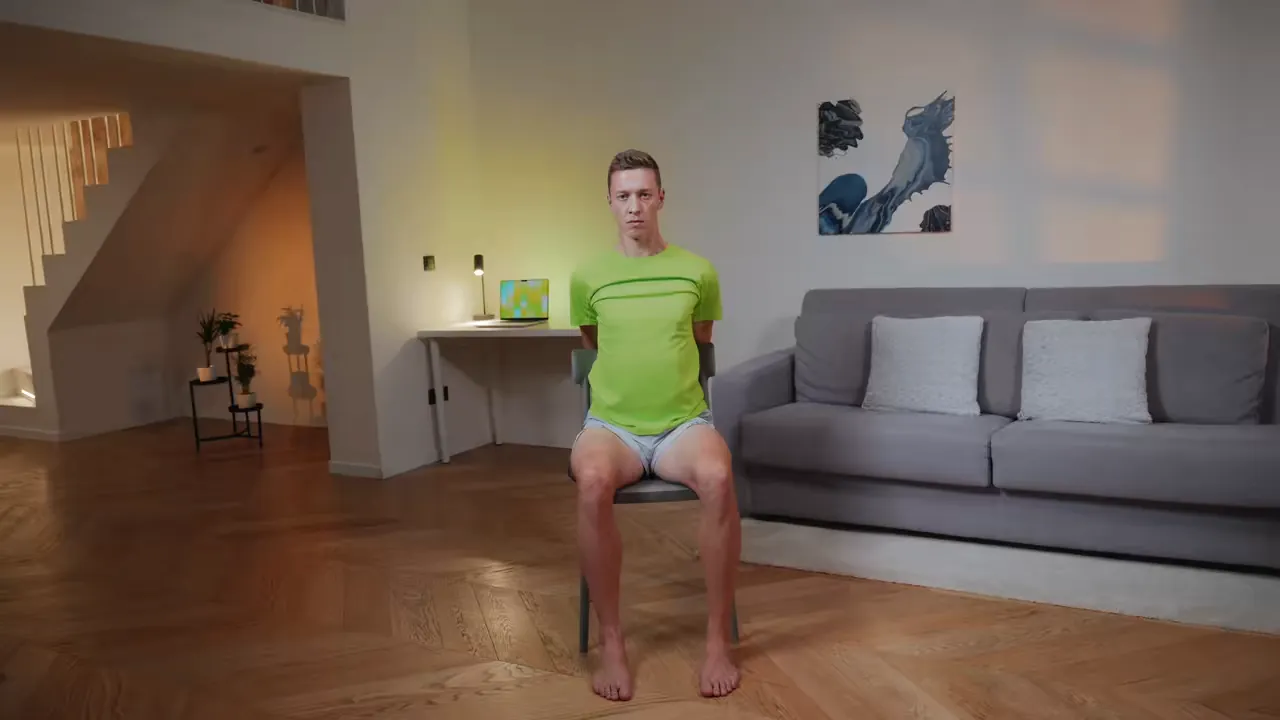
Step 1: Sit on the edge of the chair and clasp your hands behind your back.
Keep: Sit on the edge of the seat and clasp your hands behind your back.
Avoid: Sitting back in the chairThe edge of the seat is what leaves room to fold forward between your knees.
-
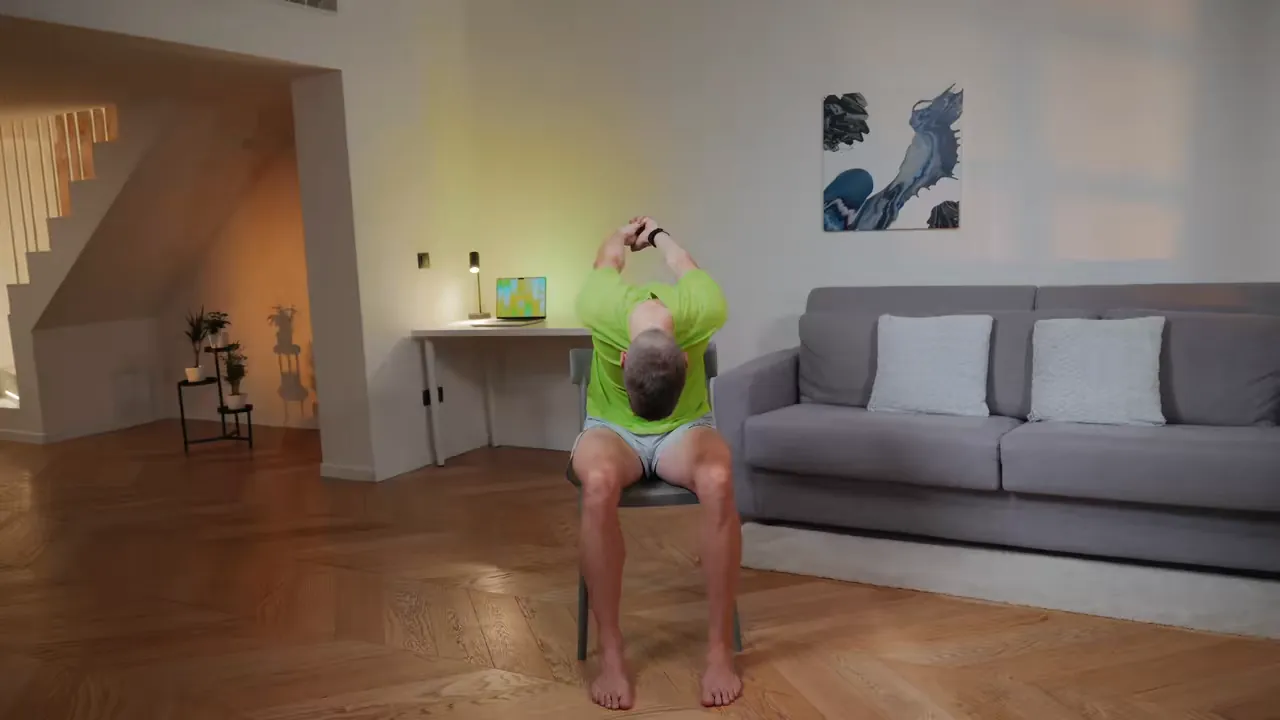
Step 2: Fold forward between your knees.
Keep: Fold forward between your knees.
Avoid: Staying upright
-
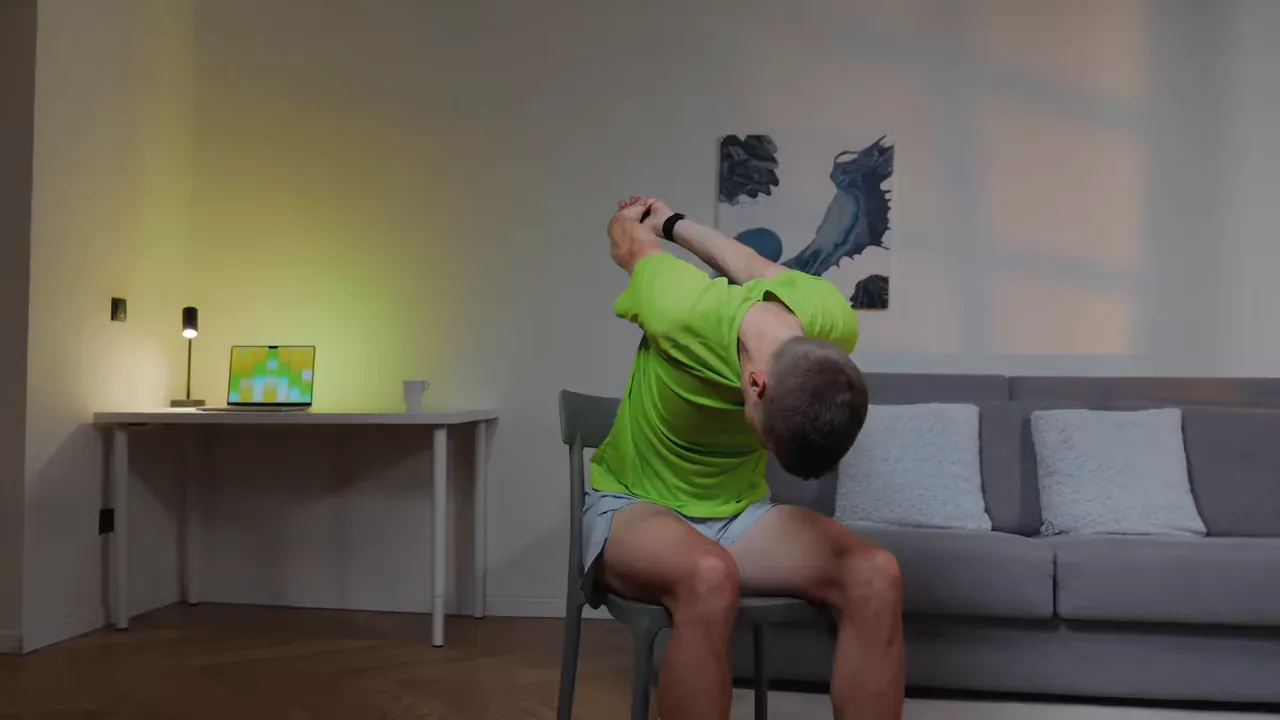
Step 3: Let your clasped hands rise towards the ceiling.
Keep: Let your clasped hands rise towards the ceiling. How far they go differs from person to person.
Avoid: Forcing the arms up
-
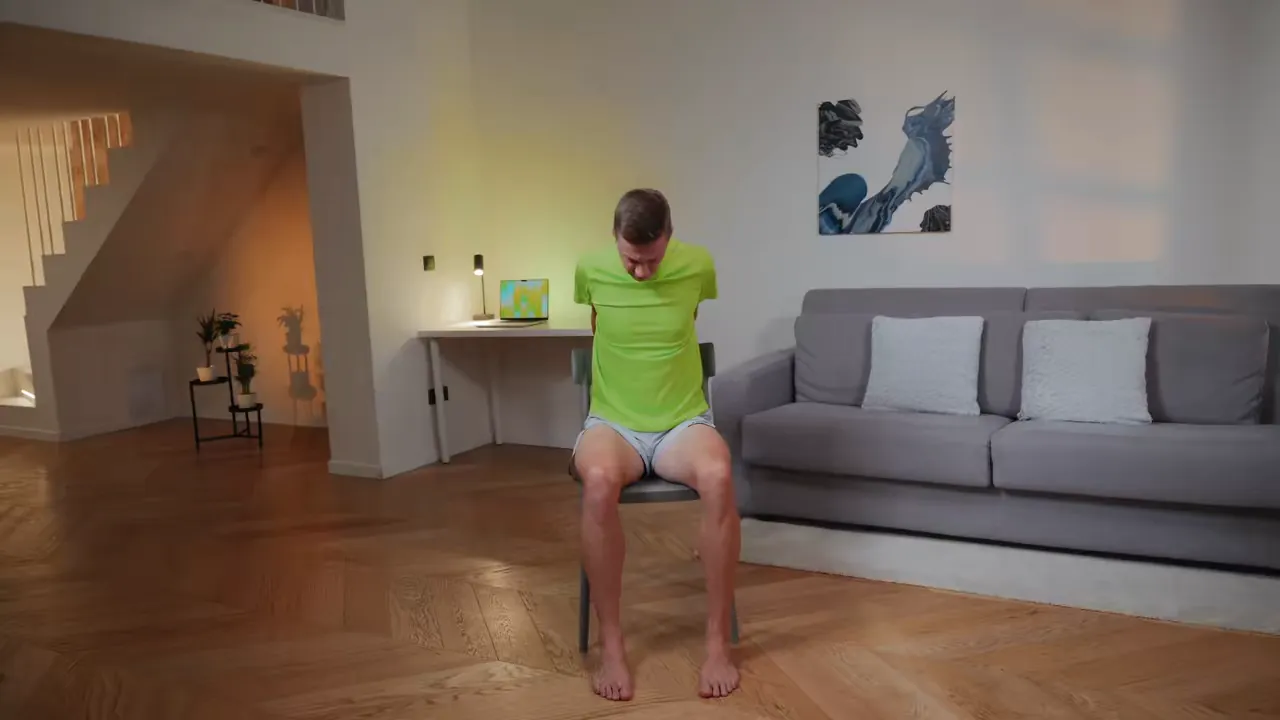
Step 4: Hold, then roll slowly back up.
Keep: Hold, then roll slowly back up.
Avoid: Coming up fastThis matters most if you tend to feel light-headed when you stand up or change position.
Stills from the exercise video in the Bavelu app, with physiotherapist Mgr. Lukáš Kučera.
How it should feel
Done as the steps describe, you should feel a gentle stretch across the front of the shoulders and the chest as your clasped hands rise behind you. It should never be sharp, and it should not bring on pins and needles or numbness in your arms or hands.
Gentle pullRight
A gentle stretch across the front of the shoulders and the chest as your clasped hands rise behind you.
Sharp pain, tingling or numbnessStop
It should never be sharp, and it should not bring on pins and needles or numbness in your arms or hands.
Humble Warrior is one of 4 exercises in Shoulders and Blades
The other three are in the app, guided on video by a physiotherapist. The whole session takes about 6 minutes.
- Shoulder Mobility - Thumbs Up and Down 1:38 · in the app
- Shoulders - Arc Over the Head 1:24 · in the app
- Humble Warrior On this page
- Chest Rotation on the Forearm 1:38 · in the app

Most shoulder stretches people look for are aimed at one feeling: the tight, pulled-forward sense across the front of the shoulders and chest after a day with your arms out at a keyboard. The exercise on this page, the Humble Warrior, comes from the app’s Shoulders and Blades session. It is a seated forward fold with your hands clasped behind your back, designed to open the shoulders and the chest, and all you need is an ordinary chair.
The steps above are the app’s own. Below is what the stretch should feel like, the mistakes that undo it, what the research says about stretching for desk-related shoulder aches, and when a sore shoulder needs a diagnosis rather than a stretch.
Which shoulder problem is this stretch for?
“Shoulder” covers several different things, and a stretch suits some of them better than others.
- The front of the shoulders and the chest. This is the area the Humble Warrior is designed for. The muscles here include the pectoralis minor, a small chest muscle that attaches to the front of the shoulder blade.
- The top of the shoulders. The heavy ache in the slope between your neck and your shoulder usually sits in the upper trapezius. A stretch aimed at that muscle is on the page about neck stretches.
- The shoulder joint itself. Pain that is often worse while you use your arm can come from the tendons or the small fluid-filled sacs around the joint: the NHS lists tendonitis, bursitis and impingement as possible causes. Pain and stiffness that lasts for months points more towards frozen shoulder or arthritis (NHS). These need an assessment before any stretching routine. Shoulder pain from computer work explains the difference in more detail.
How the Humble Warrior should feel
Done as the steps describe, you should feel a gentle stretch across the front of the shoulders and the chest as your clasped hands rise behind you. It should never be sharp, and it should not bring on pins and needles or numbness in your arms or hands.
The mistakes that matter are the ones that break a step:
- Sitting back in the chair. The first step puts you on the edge of the seat, which leaves room to fold forward between your knees.
- Forcing the arms up. The step says to let your clasped hands rise towards the ceiling, not to push them there. How far they go will differ from person to person.
- Coming up fast. The last step is to roll slowly back up. That matters most if you tend to feel light-headed when you stand up or change position. NHS advice for low blood pressure includes not bending down or changing posture suddenly (NHS).
Why your upper back matters for your shoulders
Your shoulder blades sit on the back of your ribcage, so the position of the upper back changes how the shoulder moves. In a laboratory study of 34 healthy adults, sitting slouched rather than upright reduced how far they could raise their arm by an average of 23.6 degrees. With the arm held out level, their muscle force was about 16% lower in the slouched position (Kebaetse et al., 1999).
A systematic review of ten studies found strong evidence for the same pattern: people can lift their arms further in upright postures than in slouched ones, whether or not they have shoulder pain. But it also found moderate evidence of no difference in the curve of the upper back between people with and without shoulder pain, and it noted that the range of movement studies each lasted a single session (Barrett et al., 2016).
Put simply, a slumped upper back limits the arm in the moment, but the evidence does not suggest that a rounded back is an important cause of shoulder pain. If the shape of your back is what worries you, see rounded upper back. For exercises that move the thoracic spine itself, see thoracic spine mobility exercises.
Do shoulder stretches help?
For aches around the shoulders from desk work, stretching has some trial support.
In a six-month trial, 142 office workers aged 20 to 50 with neck, shoulder and lower back pain were split into four groups: stretching exercises, changes to their workstation, both, or no treatment. Compared with the group that had no treatment, the stretching group reported lower pain scores for the neck, for each shoulder and for the lower back, and so did the group that combined stretching with workstation changes. Between the fourth and sixth months, only the stretching group kept improving (Shariat et al., 2018).
Pain was self-reported on a discomfort questionnaire, and the trial tested a programme of several stretches, not the Humble Warrior. We found no trial of this particular stretch.
The wider research points the same way as for the neck. A Cochrane review of 27 trials on neck pain found moderate-quality support for strengthening the neck, shoulder blade area and arms, a benefit for programmes that combine strengthening with stretching, and low-quality evidence that stretching alone may not change pain in the short term (Gross et al., 2015). We go through the trials in Do stretches help neck pain from desk work? A stretch like this is best thought of as one part of a routine.
For the joint itself, NHS advice is to stay active and move the shoulder gently, not to stop using it, and not to make up your own strenuous exercises or use heavy gym equipment (NHS).
Where it fits in the day
Because it only needs a chair, the Humble Warrior suits a break between calls or the end of a long run at the keyboard. It is also worth noticing what your shoulders do while you work. If they creep up towards your ears as you type, the armrests or the desk may be at the wrong height, and how to set up your office chair covers both.
Who should be careful
Skip this stretch, or check with a doctor or physiotherapist first, if any of these apply.
- A recent shoulder injury, dislocation or surgery. Ask when it is safe to take your arms behind your back.
- Warning signs in the shoulder or arm. The NHS advises an urgent GP appointment or NHS 111 for sudden or very bad shoulder pain, an arm you cannot move, a shoulder that has changed shape or is badly swollen, pins and needles that do not go away, or pain that started after a fall or injury (NHS).
- A frozen shoulder. NHS advice is to avoid movements that cause pain, move the shoulder only gently and follow any exercises from your GP or physiotherapist (NHS).
- Osteoporosis or a past spinal fracture. The Humble Warrior is a forward fold. A UK consensus statement on exercise for osteoporosis recommends modifying or avoiding movements that involve sustained, repeated or end-range bending forward of the spine (Brooke-Wavell et al., 2022). The Royal Osteoporosis Society suggests talking to a doctor or physiotherapist before starting exercise if you have had spinal fractures or many broken bones (ROS).
- Dizzy spells. If you get dizzy when you bend or stand up, take the last step slowly, and see a GP if you keep getting dizziness or fainting (NHS).
- Chest pain. Never put chest pain down to tight muscles. Call 999 if you have chest pain that feels tight or squeezing, or chest pain that spreads to your arms, neck or jaw (NHS).
Whatever the reason, stop if it hurts. A stretch should feel like a stretch, not like pain.
The rest of the Shoulders and Blades session
In the app, the Humble Warrior is one of four exercises in the Shoulders and Blades session, which takes about six minutes. The others are Shoulder Mobility - Thumbs Up and Down, Shoulders - Arc Over the Head and Chest Rotation on the Forearm, a rotation for the upper back covered on our page about stretches for between the shoulder blades. The Humble Warrior also appears in the Upper Back at the Desk session, alongside the seated twist on our page about upper back stretches.
Bavelu’s sessions are designed and filmed by physiotherapists, led by Mgr. Lukáš Kučera, and the whole session is guided on video in the app. It is exercise guidance, not a diagnosis or a treatment, so a shoulder joint that hurts when you lift your arm should be checked by a professional first.
Questions people ask
What is a good shoulder stretch for people who sit all day?
No single stretch has been shown to be the best. For tightness across the front of the shoulders and chest after desk work, a gentle opener such as the Humble Warrior is a reasonable choice. The trials that found a benefit tested regular stretching programmes over weeks or months, not a single stretch.
Should shoulder stretches hurt?
No. You should feel a gentle stretch, never a sharp pain, and nothing should spread into your arm or hand as pins and needles or numbness. If a stretch hurts, stop. The NHS advises an urgent GP appointment or NHS 111 for pins and needles that do not go away or an arm you cannot move.
Can I stretch a shoulder that hurts when I lift my arm?
Get it assessed first. The NHS lists tendonitis, bursitis and impingement as possible causes of shoulder pain that is worse when you use the arm, and advises against making up your own strenuous exercises. See a GP if shoulder pain is getting worse or has not improved after two weeks.
Is the Humble Warrior safe if I have osteoporosis?
Ask your doctor or physiotherapist first. It is a forward fold, and a UK consensus statement on exercise for osteoporosis recommends modifying or avoiding movements that involve sustained, repeated or end-range bending forward of the spine.
Terms on this page
- Pectoralis minorA small chest muscle beneath the pectoralis major that pulls the shoulder blade forwards and down.
- TrapeziusThe large muscle over the back of the neck and shoulders, and the most common seat of desk-work neck tension.
- Thoracic spineThe twelve vertebrae of the upper and middle back, T1 to T12, where the ribs attach.
Sources
- NHS. Shoulder pain.
- NHS. Low blood pressure (hypotension).
- Kebaetse M, McClure P, Pratt NA. Thoracic position effect on shoulder range of motion, strength, and three-dimensional scapular kinematics. Archives of Physical Medicine and Rehabilitation, 1999.
- Barrett E, O'Keeffe M, O'Sullivan K, Lewis J, McCreesh K. Is thoracic spine posture associated with shoulder pain, range of motion and function? A systematic review. Manual Therapy, 2016.
- Shariat A, Cleland JA, Danaee M, Kargarfard M, Sangelaji B, Tamrin SBM. Effects of stretching exercise training and ergonomic modifications on musculoskeletal discomforts of office workers: a randomized controlled trial. Brazilian Journal of Physical Therapy, 2018.
- Gross A et al. Exercises for mechanical neck disorders. Cochrane Database of Systematic Reviews, 2015.
- NHS. Frozen shoulder. Last reviewed 24 June 2024.
- Brooke-Wavell K et al. Strong, steady and straight: UK consensus statement on physical activity and exercise for osteoporosis. British Journal of Sports Medicine, 2022.
- Royal Osteoporosis Society. How to exercise safely for bones. Last reviewed 1 June 2026.
- NHS. Heart attack.
This page explains a topic in general terms. It is not a diagnosis and does not replace a doctor or physiotherapist. If something hurts badly, keeps getting worse or comes with numbness, weakness or fever, see a doctor.