Exercises · Upper back
Stretches for between the shoulder blades
This rotation on one forearm is designed to free the space between the shoulder blades. Before you try it, it helps to know which kinds of pain in that spot are not a job for a stretch.
Chest Rotation on the Forearm
A deeper rotation resting on one forearm that frees the space between the shoulder blades.
- 1:38
- On a mat
- Upper Back
- Shoulders
Move slowly. Stop if it hurts, or if you feel tingling or numbness.
-
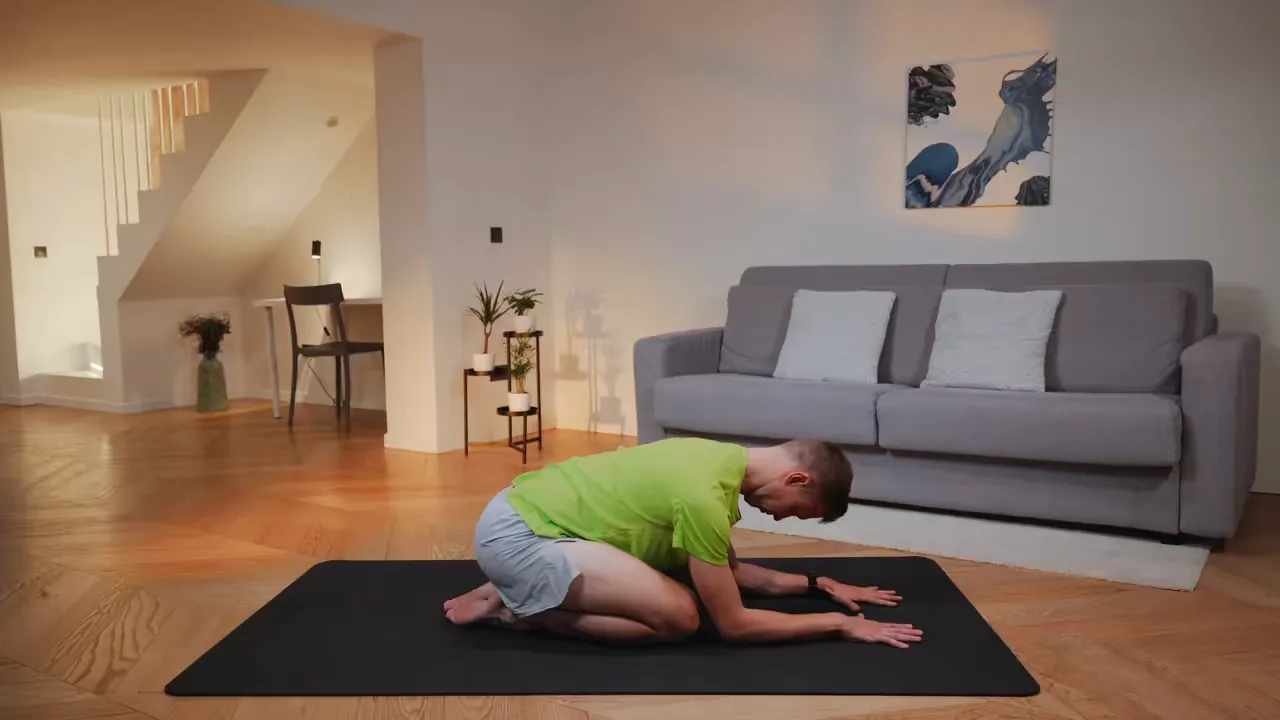
Step 1: From all fours, rest on one forearm.
Keep: From all fours, rest on one forearm.
Avoid: Staying on both hands
-
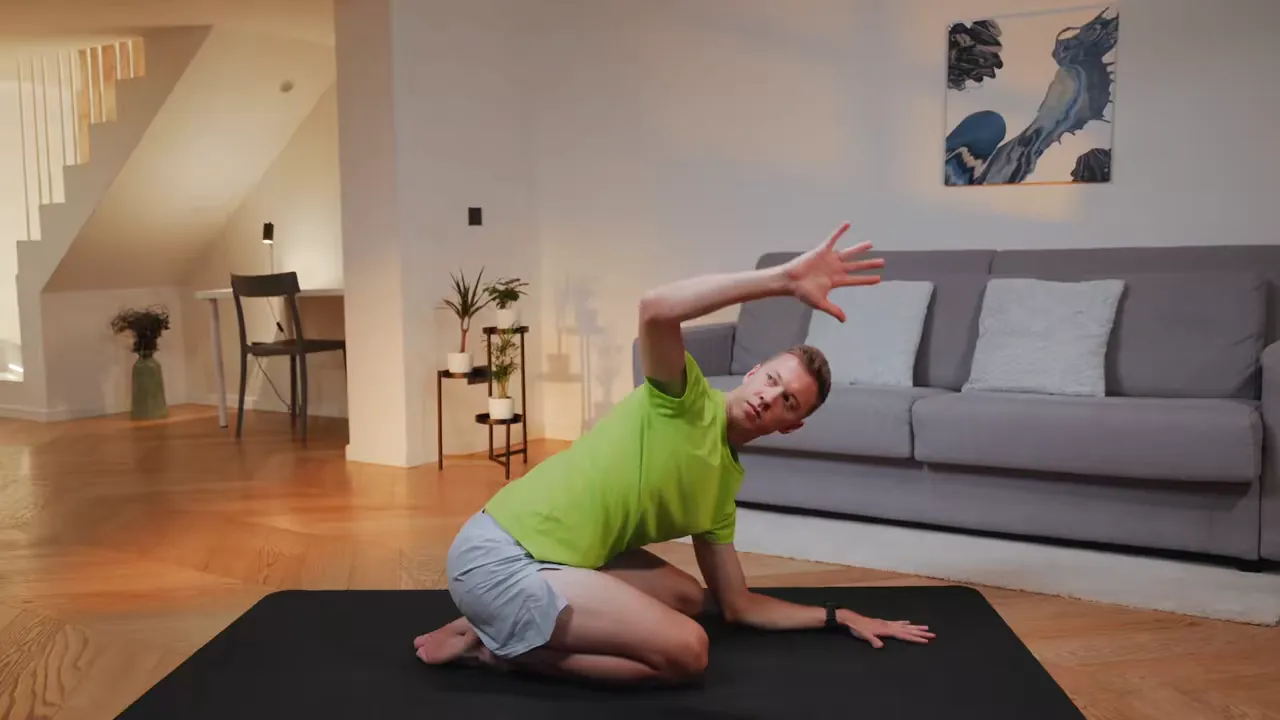
Step 2: Lift the other arm and turn your chest towards the ceiling.
Keep: Lift the other arm and turn your chest towards the ceiling.
Avoid: Lifting the arm without turning
-
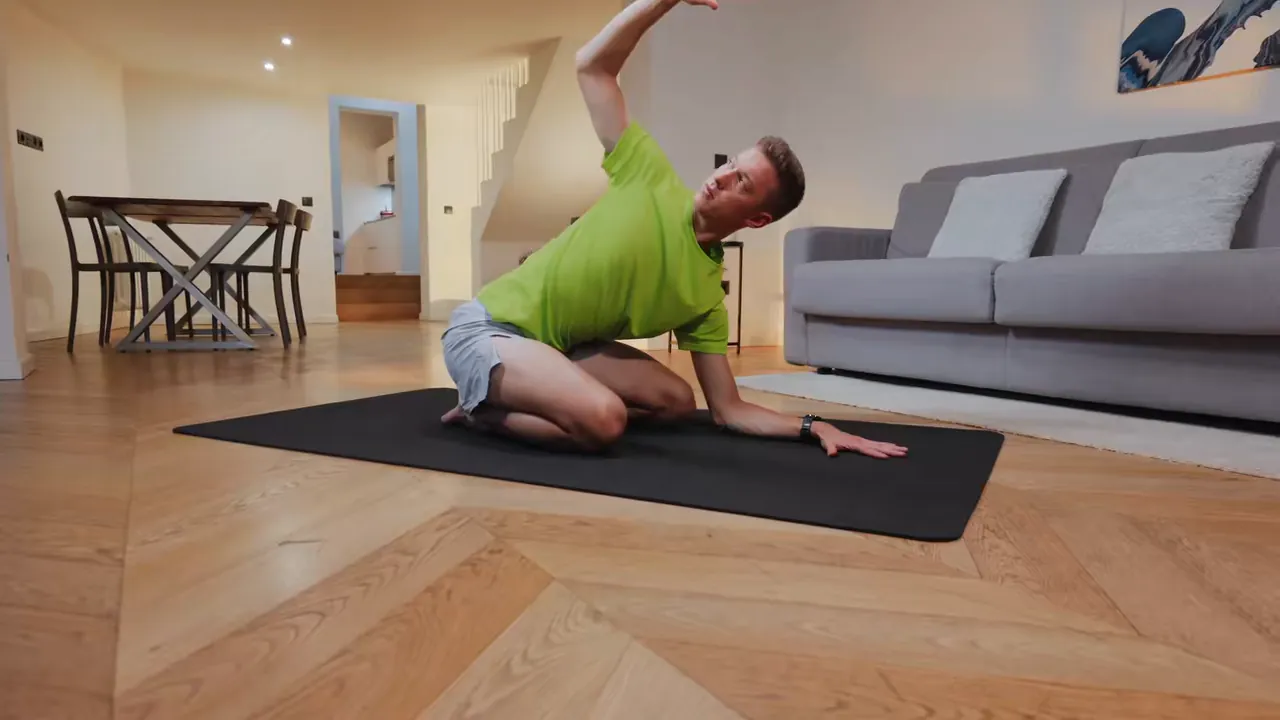
Step 3: Follow the hand with your eyes and keep your hips over your knees.
Keep: Keep your hips over your knees.
Avoid: Letting the hips driftIf they sway back or to the side, the turn is no longer coming from the upper back.
Keep: Follow the hand with your eyes, so your head turns with your chest.
Avoid: Leaving your eyes on the floor
-
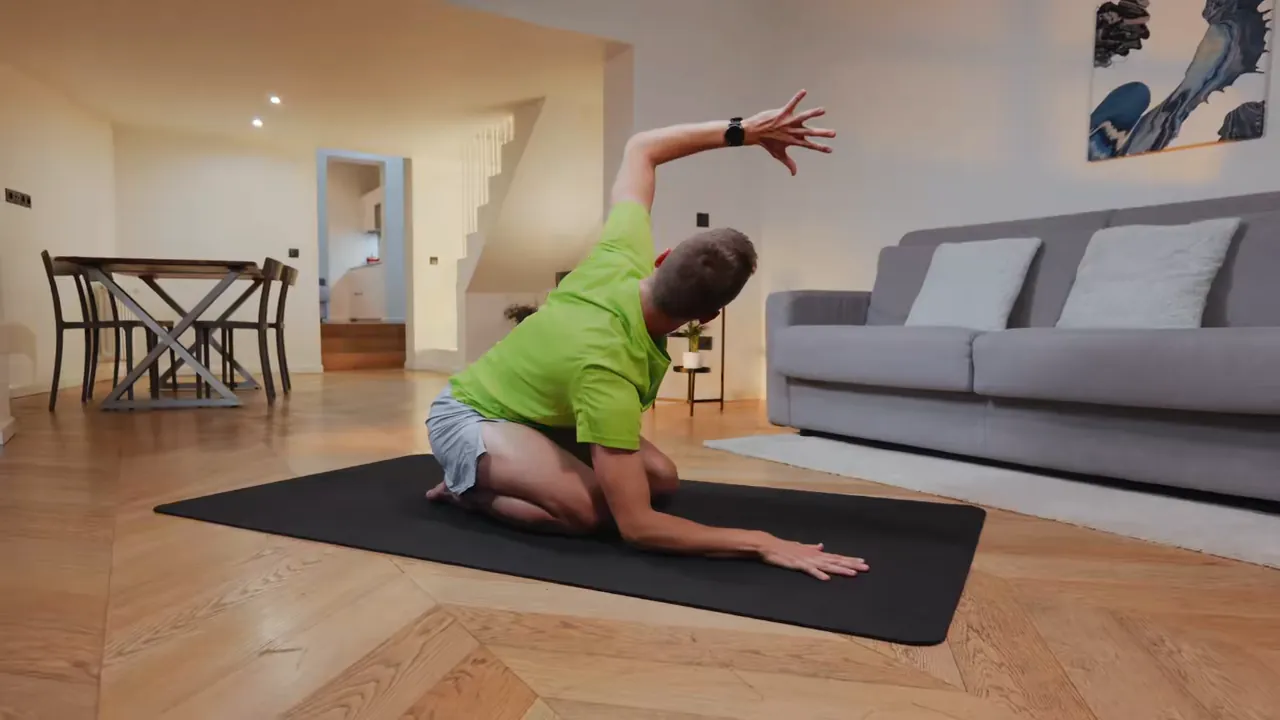
Step 4: Return slowly and switch sides after a few rounds.
Keep: Return slowly.
Avoid: Dropping back down
Keep: Switch sides after a few rounds.
Avoid: Staying on one side
Stills from the exercise video in the Bavelu app, with physiotherapist Mgr. Lukáš Kučera.
How it should feel
As your free arm lifts and your chest turns towards the ceiling, you should feel your upper back turning and the front of your chest opening, with a gentle stretch around the shoulder blades. It should never be sharp, and nothing should run down your arm as tingling or numbness.
Gentle pullRight
You should feel your upper back turning and the front of your chest opening, with a gentle stretch around the shoulder blades.
Sharp pain, tingling or numbnessStop
It should never be sharp, and nothing should run down your arm as tingling or numbness.
Chest Rotation on the Forearm is one of 4 exercises in Shoulders and Blades
The other three are in the app, guided on video by a physiotherapist. The whole session takes about 6 minutes.
- Shoulder Mobility - Thumbs Up and Down 1:38 · in the app
- Shoulders - Arc Over the Head 1:24 · in the app
- Humble Warrior 1:28 · in the app
- Chest Rotation on the Forearm On this page

People searching for stretches for between the shoulder blades usually have one spot in mind: a nagging ache beside the spine, along the inner edge of a shoulder blade, that builds over a day at a screen. The exercise on this page, Chest Rotation on the Forearm, comes from the app’s Shoulders and Blades session. It is a rotation done from all fours while resting on one forearm, and the app describes it as a deeper rotation that frees the space between the shoulder blades.
The steps above are the app’s own. Because a few kinds of pain in this spot have nothing to do with muscles, this page starts with when not to stretch.
Before you stretch: pain that needs a doctor instead
Most aching between the shoulder blades comes from the muscles and joints of the upper back and neck. A few causes are different, and a stretch will not help them.
- Call 999 if the pain comes with chest pain or pressure, breathlessness, sweating or feeling sick. The British Heart Foundation notes that heart attack pain can spread to the arms, neck, jaw, upper back or stomach, and that for some people it feels more uncomfortable than very painful (BHF).
- See a GP if the pain comes from the top of your back, between the shoulders. The NHS includes this on its list of reasons to see a GP about back pain, alongside pain that is worse at night or does not improve with rest (NHS).
The full list of warning signs is on the page about pain between the shoulder blades.
What sits between your shoulder blades
The space between your spine and the inner edges of your shoulder blades holds the rhomboids, covered by the middle part of the trapezius. Both pull the shoulder blades back towards the spine, and the rhomboids also rotate them (TeachMeAnatomy). Underneath lies the upper part of the thoracic spine.
Pain felt here does not always start here. In 50 people who had surgery for a single compressed nerve root in the neck, all of whom also had symptoms in the arm or fingers, 70% had pain in the neck or around the shoulder blades before those arm symptoms began. The pain had lasted more than seven months on average, and in 92% it eased soon after surgery. The authors concluded that pain between or around the shoulder blades can come directly from the compressed root (Tanaka et al., 2006).
So if your ache comes with neck pain, or with pain, tingling or weakness down an arm, a stretch for the upper back may be aimed at the wrong place. See neck pain from desk work and get your neck checked.
How the chest rotation on the forearm should feel
As your free arm lifts and your chest turns towards the ceiling, you should feel your upper back turning and the front of your chest opening, with a gentle stretch around the shoulder blades. It should never be sharp, and nothing should run down your arm as tingling or numbness.
Each of these mistakes breaks one of the steps above:
- Letting the hips drift. The step asks you to keep your hips over your knees. If they sway back or to the side, the turn is no longer coming from the upper back.
- Leaving your eyes on the floor. The step has your eyes follow your hand, so your head turns with your chest.
- Dropping back down. The last step says to return slowly.
- Staying on one side. The last step also has you switch sides after a few rounds.
Its close relative in the app’s Thoracic Mobility session, Thoracic Rotation on All Fours, is on our page about thoracic spine mobility exercises.
What stretches for between the shoulder blades can and cannot do
Research on the upper back is thin. The thoracic region has been largely neglected compared with the neck and lower back, and no clinical practice guideline exists for non-specific thoracic spine pain. In a survey of 424 physiotherapists in Italy, 79.7% said they would always treat it with a combined approach of education, therapeutic exercise and hands-on treatment, and 62.0% said they would always use therapeutic exercise (Risetti et al., 2023). The people who treat this pain, in other words, tend to combine exercise with explanation and hands-on care rather than rely on any one movement.
Because trials of the upper back alone are rare, the nearest evidence comes from office workers with neck pain. A review of eight trials found that most tested strengthening, and pooling them showed a clinically meaningful drop in pain compared with no exercise. Only two of the trials included stretching, and the authors concluded that its effect needs more research (Louw et al., 2017).
So a rotation like this is designed to move a stiff area, and it can be a useful part of a routine. On its own, it is not the kind of exercise with the strongest evidence. Is two minutes of exercise enough? looks at a short strengthening routine that was tested on office workers with neck and shoulder pain.
When to do it
This is a floor exercise on all fours, so it suits the morning, the evening or a break away from your desk rather than a minute between emails. For something you can do on your chair, see upper back stretches or desk stretches.
If the ache builds every afternoon, look at the set-up as well. A screen that sits low keeps you looking down for hours, and how to set up your monitor shows what to check.
Who should be careful
Skip this exercise, or check with a doctor or physiotherapist first, if any of these apply.
- Any of the warning signs above. Those come first.
- Pain, tingling, numbness or weakness in an arm. As the study above shows, this can point to the neck. The NHS advises seeing a GP for neck pain that comes with pins and needles or a cold arm (NHS).
- A recent injury or operation on your shoulder, ribs or spine.
- Pain in your wrists, elbows or knees when you put weight through them. The exercise rests on one forearm and both knees.
- Osteoporosis. A UK consensus statement on exercise for osteoporosis says twisting movements should be safe if they are done smoothly and comfortably (Brooke-Wavell et al., 2022). If you have had spinal fractures or many broken bones, the Royal Osteoporosis Society suggests checking with a doctor or physiotherapist before you start exercising (ROS).
Whatever the reason, stop if it hurts. NHS advice on exercises and stretches for back pain is to stop if the pain gets worse and see a GP (NHS).
The rest of the Shoulders and Blades session
Chest Rotation on the Forearm is the last of four exercises in the Shoulders and Blades session, which takes about six minutes, and it also appears in the Thoracic Mobility session. The others in Shoulders and Blades are Shoulder Mobility - Thumbs Up and Down, Shoulders - Arc Over the Head and the Humble Warrior, which is on our page about shoulder stretches.
Bavelu’s sessions are designed and filmed by physiotherapists, led by Mgr. Lukáš Kučera, and the whole session is guided on video in the app. It is exercise guidance, not a diagnosis, so pain between the shoulder blades that does not fit the usual pattern of a long day at a desk should be checked by a doctor first.
Questions people ask
What is the best stretch for between the shoulder blades?
No single stretch has been shown to be the best. A rotation like the one on this page is designed to move a stiff upper back and the space between the shoulder blades. Trials in office workers with neck pain found the clearest benefit from strengthening, so a stretch is best seen as one part of a routine.
Why do I get pain between my shoulder blades?
Most often it comes from the muscles and joints of the upper back and neck. It can also come from a compressed nerve root in the neck, sometimes before any arm symptoms appear. Rarely it is a sign of a heart problem, so pain with chest pain, breathlessness or sweating needs a 999 call.
When should I not stretch pain between my shoulder blades?
Do not stretch it if it comes with chest pain or pressure, breathlessness, sweating or feeling sick: call 999. Get it checked first if it comes with pain, tingling or weakness down an arm. The NHS also advises seeing a GP about back pain that comes from the top of the back, between the shoulders.
Can I do this stretch at my desk?
No. It starts on all fours, so it needs some floor space and a mat. For a stretch you can do on your chair, try the seated twist on our upper back stretches page.
Terms on this page
- RhomboidsTwo flat muscles between the spine and the shoulder blades that pull the blades back and hold them steady.
- TrapeziusThe large muscle over the back of the neck and shoulders, and the most common seat of desk-work neck tension.
- Thoracic spineThe twelve vertebrae of the upper and middle back, T1 to T12, where the ribs attach.
Sources
- British Heart Foundation. Heart attack.
- NHS. Back pain. Last reviewed 5 March 2026.
- TeachMeAnatomy. The superficial back muscles.
- Tanaka Y, Kokubun S, Sato T, Ozawa H. Cervical roots as origin of pain in the neck or scapular regions. Spine, 2006.
- Risetti M, Gambugini R, Testa M, Battista S. Management of non-specific thoracic spine pain: a cross-sectional study among physiotherapists. BMC Musculoskeletal Disorders, 2023.
- Louw S, Makwela S, Manas L, Meyer L, Terblanche D, Brink Y. Effectiveness of exercise in office workers with neck pain: a systematic review and meta-analysis. South African Journal of Physiotherapy, 2017.
- NHS. Neck pain. Last reviewed 27 April 2023.
- Brooke-Wavell K et al. Strong, steady and straight: UK consensus statement on physical activity and exercise for osteoporosis. British Journal of Sports Medicine, 2022.
- Royal Osteoporosis Society. How to exercise safely for bones. Last reviewed 1 June 2026.
This page explains a topic in general terms. It is not a diagnosis and does not replace a doctor or physiotherapist. If something hurts badly, keeps getting worse or comes with numbness, weakness or fever, see a doctor.